
If you’ve seen someone describe a video game’s backstory as “the lore,” or joke that an embarrassing moment is now “part of my lore,” you’ve probably wondered what lore actually means. The short version: lore is a body of knowledge, stories, or history connected to a subject — and depending on the context, that subject could be an entire culture, a fictional universe, or even your own life.
In this guide, you’ll learn the traditional dictionary meaning of lore, how it’s used in gaming and fandom communities, and the newer slang meaning that’s taken over social media. We’ll also cover how lore differs from canon and backstory, how to use it correctly in a sentence, common mistakes, and answers to the questions people ask most often about this word.
Quick Answer
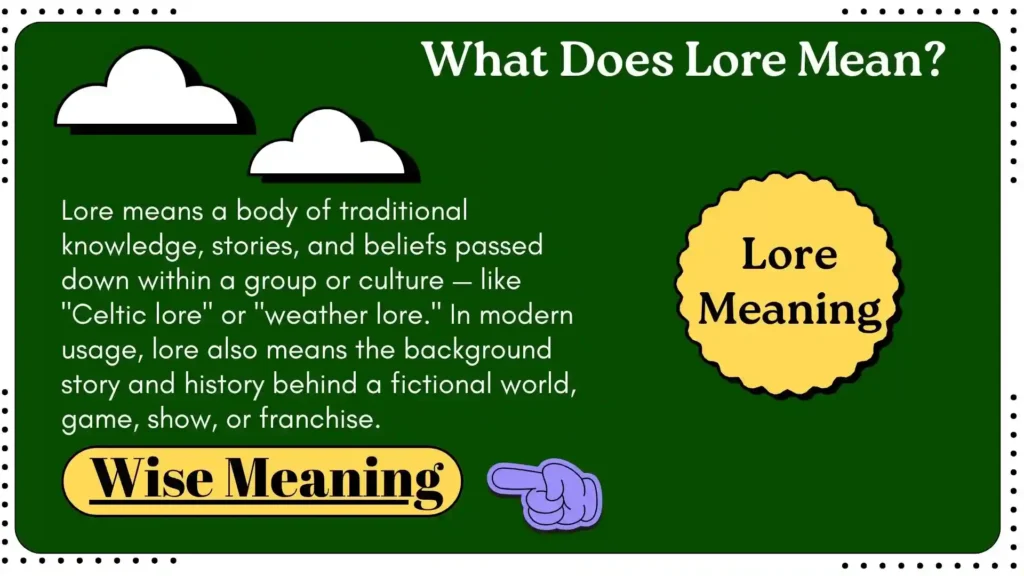
Lore means a body of traditional knowledge, stories, and beliefs passed down within a group or culture — like “Celtic lore” or “weather lore.” In modern usage, lore also means the background story and history behind a fictional world, game, show, or franchise (as in “Star Wars lore”), and even the string of personal facts and stories that make up a person’s own history (“that’s part of my lore”). The right meaning depends entirely on context.
TL;DR
- Traditional meaning: knowledge, customs, and stories passed down through generations, often orally.
- Modern pop-culture meaning: the backstory and internal history of a fictional universe (video games, movies, books, anime).
- Slang meaning: a person’s personal history, quirks, or life story shared as if it were an epic backstory.
- Part of speech: uncountable noun (no plural “lores” in standard use, though “lores” appears informally online).
- Tone: neutral to playful; works in both academic and casual writing.
- Common mistake: confusing “lore” with “canon” — they’re related but not identical.
- Related term: folklore, which is a specific type of lore tied to a culture’s traditions.
You Might Also Like That: Grammar Meaning
⭐ Key Takeaways:
What Does Lore Mean?
At its core, lore is a noun that refers to a body of knowledge, beliefs, or stories associated with a particular subject, place, or group of people — especially knowledge that isn’t formally written down but is instead shared through tradition, word of mouth, or repeated retelling.
The word comes from the Old English lār, meaning “instruction” or “learning,” and it’s related to the verb “learn.” For centuries, lore referred mainly to traditional or folk knowledge: weather lore, herbal lore, local lore about a town’s history, or the lore of a particular trade or craft.
In the last couple of decades, though, lore has picked up a second life. It’s now one of the most common words in gaming, fandom, and internet culture, where it describes the deep backstory of a fictional universe — and, increasingly, the “backstory” of a person’s own life.
Simple Definition
If you just need the short version: lore is the collected background information, history, and stories connected to something — whether that “something” is a real culture, a fictional world, or even a single person.
Different Meanings of Lore
Lore isn’t a one-definition word anymore. Here’s how it breaks down across contexts.
| Meaning | Context | Example |
|---|---|---|
| Traditional/cultural knowledge | Folklore, history, academic writing | “The village elders were known for their weather lore.” |
| Fictional backstory | Video games, movies, books, anime, fandom | “The Elden Ring lore is scattered across item descriptions.” |
| Personal history (slang) | Social media, casual conversation, TikTok/X | “Getting locked out of my own apartment is officially part of my lore.” |
| Zoological term | Ornithology/science (less common) | “The lore is the area between a bird’s eye and beak.” |
Lore in Everyday Language (Traditional Meaning)
In its oldest and most formal sense, lore describes knowledge gained through tradition, anecdote, or experience rather than formal study. This is the meaning you’ll find in most dictionaries and academic texts.
- “Local lore has it that the well was cursed by a witch.”
- “She grew up learning the herbal lore of her grandmother’s village.”
- “Sailors have long passed down their own lore about storms and tides.”
This traditional meaning overlaps closely with folklore — the customs, tales, and beliefs of a specific community — but “lore” is broader and can apply to any subject, not just cultural tradition. You can have “computer lore,” “baseball lore,” or “legal lore,” meaning the informal, experience-based knowledge that builds up around any field. The Oxford Learner’s Dictionary defines lore this way: uncountable knowledge and information related to a subject, especially when not written down.
Lore in Gaming, Movies, and Fandom (Modern Meaning)
This is where most people encounter the word today. In gaming and pop culture, lore refers to the internal history, mythology, and background details of a fictional universe — the “why” behind the world, characters, and events, often pieced together from item descriptions, dialogue, side quests, or supplementary material rather than the main plot.
According to Merriam-Webster’s slang dictionary, this usage exploded because fans wanted a word for backstory that felt bigger and more immersive than “backstory” itself — and “lore” fit perfectly, since games like The Elder Scrolls and Dark Souls built entire fictional histories that fans had to dig up and piece together themselves.
- “I’ve never heard anyone say ‘Elden Ring backstory,’ but everyone says ‘Elden Ring lore.'”
- “That YouTuber makes videos explaining the lore of the Marvel Cinematic Universe.”
- “The game’s lore is hidden in item descriptions instead of cutscenes.”
You’ll also see the adjective phrase “lore accurate”, used when fan art, cosplay, or theories match the official backstory of a franchise, and “lore drop,” meaning new backstory information revealed in an update, episode, or interview. Merriam-Webster’s slang dictionary confirms this shift, noting that lore now commonly describes the backstory of a person, character, or imagined world.
Lore as Personal History (Internet Slang)
The newest twist on lore takes the “epic backstory” idea and applies it to real, everyday people. In this sense, your “lore” is your personal history — the quirky facts, running jokes, dating history, and defining moments that make up who you are, told with the same dramatic flair as a fictional character’s backstory.
- “Getting stuck in an elevator on my first day of work is definitely part of my lore.”
- “Wait, I didn’t know competitive dance was in your lore!”
- “If I get comfortable enough, I might share some embarrassing personal lore.”
This usage is playful and self-aware — it treats an ordinary life event like a legendary backstory, which is exactly the joke. It’s common on TikTok, X (formerly Twitter), and in casual group chats, and it works well in informal writing but isn’t appropriate for formal or professional communication.
“Personal lore” fits right in with other internet slang built around inside jokes and shared context, like IFYKYK, or dramatic self-description terms like delulu. If you’re curious about other relationship-related slang that’s popped up alongside it, terms like situationship follow a similar pattern of turning everyday experiences into named, shareable concepts.
How to Use Lore in a Sentence
Lore is an uncountable noun, which means it doesn’t normally take a plural form or the article “a.” You wouldn’t usually say “a lore” or “two lores” — instead, you’d say “some lore,” “a piece of lore,” or “the lore.”
| Correct | Incorrect |
|---|---|
| There’s a lot of lore about this castle. | There’s a lore about this castle. |
| He shared an interesting piece of lore. | He shared an interesting lore. |
| The game has years of accumulated lore. | The game has years of accumulated lores. |
Note: in informal online writing, especially in gaming communities, “lores” and “a lore” do occasionally appear as playful or nonstandard usage. Stick to the uncountable form for formal or professional writing.
Lore vs Canon vs Backstory vs Worldbuilding
These four terms get mixed up constantly, but they aren’t interchangeable.
| Term | What It Means | Key Difference |
|---|---|---|
| Lore | The full body of background knowledge about a world, including widely accepted fan theories | Broadest term — can include unofficial material |
| Canon | Only the material officially confirmed by the creators | More restrictive than lore |
| Backstory | The history of one specific character | Narrower — focused on a single character, not the whole world |
| Worldbuilding | The creative process of designing a fictional setting | Describes the act of creating; lore is the resulting information |
In short: worldbuilding creates lore, lore can include both canon and fan theory, and backstory is just one small piece of a larger lore.
Synonyms for Lore
- Folklore
- Mythology
- Tradition
- Legend
- Backstory (in fictional contexts)
- Chronicles
- Wisdom (in the “traditional knowledge” sense)
Antonyms for Lore
- Fact (when contrasted with folklore or myth)
- Documented history (contrasted with oral tradition)
- Science (contrasted with folk belief)
Common Mistakes to Avoid
- Treating lore and canon as the same thing. Lore can include fan theories and interpretations; canon is only what’s officially confirmed.
- Pluralizing lore in formal writing. “Lores” is nonstandard outside of casual internet use — use “pieces of lore” or “bodies of lore” instead.
- Using “personal lore” in professional contexts. This is internet slang and doesn’t fit resumes, emails, or formal reports.
- Assuming lore always means fiction. The original and still-valid meaning refers to real cultural traditions, not just games or movies.
Frequently Asked Questions
What does lore mean in simple terms?
Lore means the body of stories, knowledge, and background information connected to a subject, culture, fictional world, or even a person. It can be traditional knowledge passed down through generations, or the backstory of a game, show, or franchise.
What does lore mean in slang?
In slang, “lore” — especially “my lore” or “personal lore” — refers to someone’s personal history and the stories, quirks, and past events that define them, told with playful, dramatic flair.
Is lore the same as canon?
No. Lore is broader and can include fan-created theories and interpretations, while canon refers only to the details officially confirmed by the creators of a story or franchise.
Why do people say “lore” instead of “backstory”?
“Lore” implies a larger, richer, more immersive body of history than a single character’s backstory. It suggests an entire world’s worth of interconnected knowledge, which is why gaming and fandom communities gravitated toward it.
Is lore a countable or uncountable noun?
Lore is uncountable. You wouldn’t say “a lore” or “two lores” in standard English — instead, use phrases like “a piece of lore” or “some lore.”
Can lore be used in formal writing?
Yes, in its traditional sense (cultural knowledge, folklore, or history), lore is perfectly appropriate for formal and academic writing. The slang “personal lore” usage should be kept casual.
What’s an example of lore in a sentence?
“According to local lore, the lighthouse keeper never left the island, even after it was decommissioned.”
Final Thoughts
The meaning of lore has genuinely expanded over the centuries — from Old English “instruction” to the traditional knowledge of a culture, and now to the sprawling backstories of games, movies, and even our own lives. Whatever context you’re in, the core idea stays the same: lore is the accumulated story behind something, whether that something is a village, a video game, or you.
Next time you hear someone talk about “the lore” of their favorite show — or drop a piece of their own “personal lore” in conversation — you’ll know exactly which meaning they’re reaching for, and how to use the word naturally yourself.