
If you’ve seen comments like “he mogged everyone in that photo” and had no clue what was going on, you’ve run into one of Gen Z’s most-used comparison words. Mog is internet slang for completely outshining someone else, most often in looks, but increasingly in style, confidence, or overall presence.
This guide explains exactly what mog means, where the word came from, how “mogging” and “getting mogged” work as opposites, and why the term’s origins are worth knowing before you use it casually.
Quick Answer
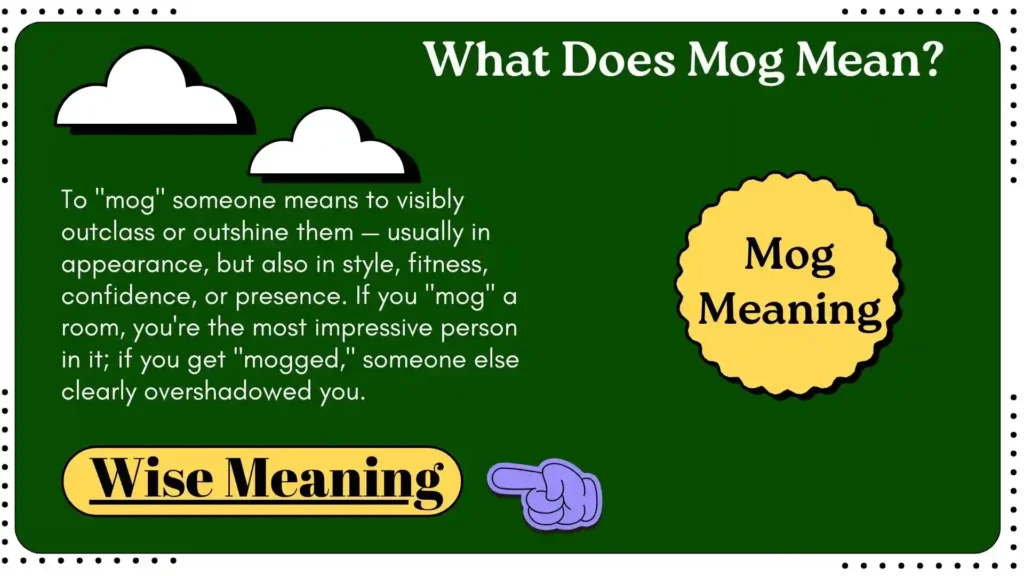
To “mog” someone means to visibly outclass or outshine them — usually in appearance, but also in style, fitness, confidence, or presence. If you “mog” a room, you’re the most impressive person in it; if you get “mogged,” someone else clearly overshadowed you.
TL;DR
- Main meaning: To dominate or outshine someone, especially in looks or presence.
- Part of speech: Verb (“to mog”), also used as noun/adjective (“a mog moment”).
- Origin: From “AMOG” (Alpha Male of Group), a term from pickup-artist and manosphere online culture.
- Tone: Can be playful or genuinely competitive, sometimes edgy.
- Opposite: Getting “mogged” — being outshined by someone else.
- Caution: Rooted in appearance-ranking culture, so it can come across as unkind depending on context.
- Related terms: looksmaxxing, rizz, sigma.
What Does Mog Mean?
In modern internet slang, mog is a verb meaning “to outclass” or “to dominate by comparison,” especially in physical appearance. Merriam-Webster defines the slang sense as describing one person appearing far more attractive, taller, or more impressive than another in a direct comparison.
Over time the meaning expanded beyond looks alone. Someone can now “mog” another person through fashion, fitness, confidence, or even a more impressive lifestyle — anything where one person’s presence clearly outshines someone else’s.
Where Does Mog Come From?
Mog comes from the acronym AMOG, short for “Alpha Male of Group,” a term that originated in pickup-artist and “manosphere” online communities focused on social status and dominance hierarchies. The word later spread into bodybuilding forums and “looksmaxxing” communities, where people compared facial features, body proportions, and overall attractiveness.
By the early 2020s, “mog” and “mogging” had broken out of niche fitness and appearance forums and into mainstream TikTok and gaming culture, eventually appearing in press conferences and even at the 2026 Winter Olympics, where a gold medalist used the term casually to describe her competition goals.
Mogging vs. Getting Mogged
| Term | Meaning | Example |
|---|---|---|
| To mog | To outshine or dominate someone | “He mogged everyone at the gym today.” |
| To get mogged | To be outshined or overshadowed | “I got mogged the second he walked in.” |
| Mogger | Someone known for mogging others | “That guy is a certified mogger.” |
| Mog moment | A specific instance of outshining someone | “That outfit was a total mog moment.” |
Where Mog Is Used
- Appearance comparisons: “That photo mogs his old profile pic.”
- Fitness and gym culture: “He’s been mogging everyone since he started lifting.”
- Fashion and style: “Her fit completely mogged the rest of the group.”
- Gaming and skill: “She mogged that whole lobby with her gameplay.”
- Playful self-deprecation: “My little brother mogs me and he’s twelve.”
Is Mog an Insult?
It depends entirely on tone and relationship. Among friends, calling someone a “mogger” is often a lighthearted compliment. But because the term originated in appearance-ranking, looks-focused online spaces, using it to put someone down — especially about their body or face — can come across as genuinely unkind rather than playful. It’s best avoided in serious conversations about body image or self-esteem.
Common Mistakes to Avoid
- Using it in professional or formal settings. Mog is internet slang and doesn’t belong in workplace or academic writing.
- Assuming it’s always about looks. Mog now covers fashion, confidence, skill, and lifestyle, not just physical appearance.
- Missing the origin. Not knowing that “mog” comes from status-ranking online communities can lead to using it more carelessly than intended.
- Confusing “mog” with “flex.” Flexing is showing off your own achievements; mogging is specifically about outshining someone else by comparison.
Frequently Asked Questions
What does mog mean in slang?
Mog means to dominate or outshine someone, most often in appearance, but also in style, fitness, or confidence.
What does AMOG stand for?
AMOG stands for “Alpha Male of Group,” the pickup-artist and manosphere term that “mog” is shortened from.
Is mogging always about looks?
Not anymore. While it started with appearance comparisons, mogging now also applies to fashion, fitness, skill, and general presence.
Is mog a compliment or an insult?
It can be either — among friends it’s often playful praise, but it can feel like an insult when used seriously to rank someone’s looks against another person.
Can girls “mog” too?
Yes. Although mog originated in male-dominated online spaces, all genders now use it to describe anyone outshining others in any context.
Is mog appropriate to use casually?
Generally yes, among friends in casual settings, but it’s worth avoiding in formal writing or serious discussions about appearance and self-esteem.
Final Thoughts
Mog meaning has traveled a long way — from niche pickup-artist forums to TikTok comment sections to Olympic press conferences. At its core, it’s still about one person clearly outshining another, whether that’s in looks, style, or overall presence.
Knowing where the term comes from helps you use it with a bit more awareness: fine for playful banter with friends, but worth skipping in situations where comparing people’s appearances could genuinely sting.