
If you’ve seen “ion” 📱 in a text message, chat, or social media post, you may wonder what it means. In texting, ion commonly means “I don’t.” People use it as an informal way to write how the phrase sounds in casual speech. For example, “ion know” means “I don’t know.” You may also see ion in phrases such as “ion care” or “ion think so.” The ion meaning in text depends on the words around it, so context can help you understand what someone means.
However, “ion” can have other meanings too. In online conversations, ION can mean “In Other News,” while in chemistry and physics, an ion means an electrically charged atom or group of atoms. So, when you search “what does ion mean” or “ion meaning,” the right answer depends on where you found the word. This guide explains the ion slang meaning, how people use it in texting, and how to tell its different meanings apart.
Quick Answer ⚡
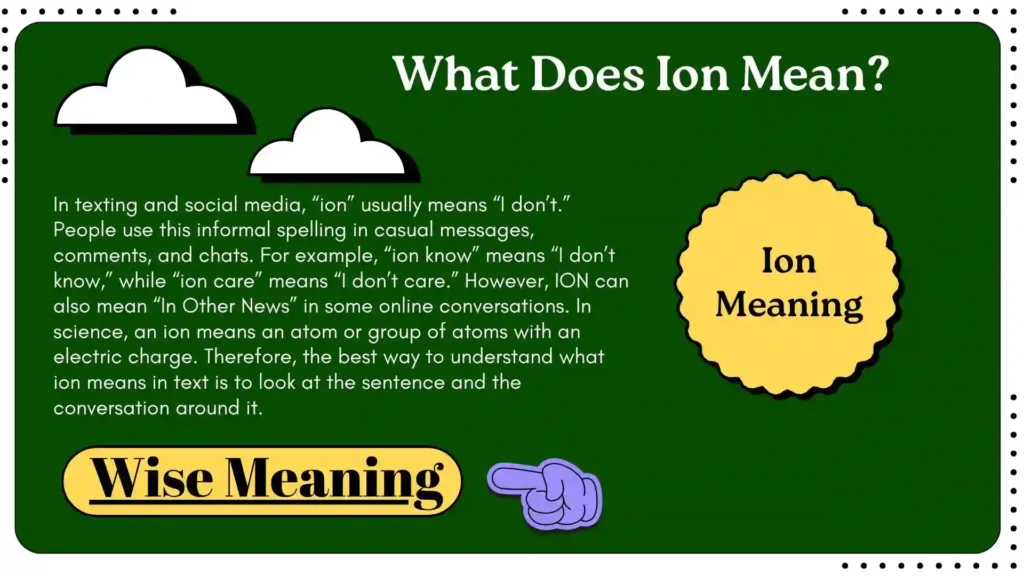
In texting and social media, “ion” usually means “I don’t.” People use this informal spelling in casual messages, comments, and chats. For example, “ion know” means “I don’t know,” while “ion care” means “I don’t care.”
However, ION can also mean “In Other News” in some online conversations. In science, an ion means an atom or group of atoms with an electric charge. Therefore, the best way to understand what ion means in text is to look at the sentence and the conversation around it.
TL;DR 📌
- 💬 Ion commonly means “I don’t” in texting.
- 🗣️ It works as an informal, casual spelling of “I don’t.”
- ✍️ “Ion know” means “I don’t know.”
- 📱 You may see it in texts, DMs, comments, TikTok, Snapchat, and other social platforms.
- 📰 ION can also mean “In Other News.”
- 🧪 In science, an ion is an electrically charged atom or group of atoms.
- 🔎 Context helps you understand which meaning someone intends.
- 🚫 Use “I don’t” instead of “ion” in formal writing.
You Might Also Like That: BRUH Meaning
What Does “Ion” Mean in Text? 💬
The most common ion meaning in texting is “I don’t.” People use this slang form in casual conversations because it matches the way the phrase can sound when spoken quickly. It does not change the basic meaning of the sentence. Instead, it gives the message a relaxed and informal tone.
For example, someone might text “ion know what you mean” instead of “I don’t know what you mean.” You may also see “ion care,” “ion want to,” or “ion think so.” This use appears in text messages, online chats, comments, and social media posts.
What Does “Ion” Mean in Slang? 🗣️
The ion slang meaning usually connects to “I don’t.” It works as an informal spelling rather than a standard English abbreviation. People often write words the way they sound in everyday speech, especially when they want their messages to feel natural and casual.
You can find this texting slang in DMs, social media comments, and conversations between friends. It does not normally carry a special emotion by itself. The speaker’s other words and the situation provide the tone. Because ion is informal language, readers should understand the context before deciding exactly what the person means.
How Is “Ion” Used in Texting? 📱
People use ion in texting before words that complete the phrase “I don’t.” This makes it easy to express a negative thought in a casual way. The meaning stays clear when the rest of the sentence provides enough context.
Common phrases with “ion”
- 💬 Ion know = I don’t know
- 🙅 Ion care = I don’t care
- 🤔 Ion think so = I don’t think so
- 🚫 Ion want to go = I don’t want to go
- ❤️🩹 Ion feel like it = I don’t feel like it
- ❓ Ion understand = I don’t understand
These phrases show how “ion” can replace “I don’t” in casual writing.
What Does “Ion Know” Mean? 🤔
“Ion know” means “I don’t know.” It is one of the most common phrases you may see when someone uses ion as texting slang. The writer simply uses “ion” as an informal version of “I don’t.”
For example, a friend might ask, “What time are we leaving?” You could receive the reply, “Ion know 😭.” In standard English, that means “I don’t know.” The phrase can sound casual, uncertain, dismissive, or playful depending on the conversation. So, when you see “what does ion know mean,” the simple answer is “I don’t know.”
What Does “Ion” Mean on TikTok, Snapchat, and Social Media? 📲
The ion meaning on TikTok, Snapchat, Instagram, and other social platforms usually stays the same: “I don’t.” Users may place it in captions, comments, direct messages, or casual conversations. The platform itself does not normally change the basic meaning.
You may also see different spellings or capitalization online. Some people write “ion,” “Ion,” or “ION.” However, capitalization does not always tell you the intended meaning. Always read the full sentence. If the phrase works as “I don’t,” the writer probably uses ion as slang. If it introduces a new topic, another meaning may apply.
How Can You Tell Which Meaning of “Ion” Someone Means? 🔎
Context is the best clue when you need to understand the meaning of ion. First, look at the words that follow it. If someone writes “ion know,” “ion care,” or “ion want,” they most likely mean “I don’t.” The rest of the sentence usually makes the meaning obvious.
You should also consider the conversation topic. A casual DM may use ion as slang, while a science discussion may use “ion” in its standard scientific sense. Capital letters can provide a clue, but they do not always settle the question. Read the whole sentence before deciding what “ion” means.
Does “ION” Mean “In Other News”? 📰
Yes. In some online conversations, ION stands for “In Other News.” People use it as a short transition when they want to introduce another subject. For example, someone might write, “ION, did you finish your homework?” Here, the writer changes the topic rather than saying “I don’t.”
This meaning differs from ion = “I don’t.” The surrounding sentence usually makes the difference clear. If “ion” comes before a verb and fits “I don’t,” it likely has the slang meaning. If ION introduces a new thought or topic, it may mean “In Other News.” 📰
Is “Ion” the Same as “I Don’t”? ✍️
In casual texting, “ion” can represent “I don’t,” but the two forms are not equal in every situation. “I don’t” remains the standard English phrase, while “ion” belongs to informal online language.
For example, “Ion want that” carries the same basic meaning as “I don’t want that.” The difference comes from style and setting. Someone may choose “ion” to make a message sound relaxed or conversational. However, you should use “I don’t” in school assignments, professional emails, formal reports, and other situations where standard English matters.
Is “Ion” Formal or Informal? ⚠️
“Ion” is informal slang when people use it to mean “I don’t.” You can normally use it in casual conversations with friends or in relaxed online communication. It can help a message sound more natural and conversational.
However, avoid this slang in formal writing. A teacher, employer, customer, or professional reader may expect standard English. Write “I don’t” instead of “ion” in essays, applications, business emails, reports, and official messages. Knowing the ion meaning in text does not mean you need to use it everywhere. The right choice depends on your audience and the situation.
What Does “Ion” Mean in Science? 🧪
In chemistry and physics, an ion has a completely different meaning. An ion is an atom or group of atoms with an electric charge. An atom normally has equal numbers of protons and electrons. When it gains or loses electrons, it can become electrically charged.
For example, an atom that loses electrons becomes positively charged, while an atom that gains electrons becomes negatively charged. This scientific meaning appears in textbooks, classrooms, laboratories, and science articles. So, if someone asks “what is an ion in chemistry?”, they are asking about a scientific term, not texting slang.
Ion vs. ION vs. I Don’t: Quick Comparison 📊
| Term | Meaning | Typical Context |
| 💬 ion | I don’t | Casual texting |
| 📰 ION | In Other News | Online conversation |
| 🧪 ion | Electrically charged atom or group | Science |
| ✍️ I don’t | Standard form | Everyday and formal English |
This comparison shows why context matters. The same letters can point to different meanings. A sentence such as “ion know” clearly suggests “I don’t know,” while a science sentence about electrons refers to the scientific term. When you see ION introducing a new subject, it may mean “In Other News.”
Common Questions About “Ion” ❓
What does ion mean in text?
In text messages, ion commonly means “I don’t.” It is an informal spelling used in casual communication.
What does ion mean in slang?
The ion slang meaning is usually “I don’t.” You may see it before verbs such as know, care, want, think, or feel.
What does ion know mean?
“Ion know” means “I don’t know.” People commonly use it in casual texts and social media conversations.
Is ion short for I don’t?
In informal texting, people use ion as a casual representation of “I don’t.” It is not the standard written form.
What does ION stand for?
In some online conversations, ION means “In Other News.” It introduces a new topic or thought.
What does ion mean on TikTok or Snapchat?
On social platforms, ion usually means “I don’t” when the sentence supports that interpretation.
Is ion formal?
No. When “ion” means “I don’t,” it is informal slang. Use “I don’t” in formal writing.
What does ion mean in science?
In science, an ion is an electrically charged atom or group of atoms. This meaning differs from the texting slang.
Final Thought 💡
The meaning of “ion” depends on context. In texting, chat, TikTok, Snapchat, and other social media, ion commonly means “I don’t.” Phrases such as “ion know” simply mean “I don’t know.” You may also see ION meaning “In Other News” when someone changes the subject.
In chemistry and physics, however, an ion refers to a charged atom or group of atoms. 🧪 So, when you see “ion,” look at the sentence and conversation first. That small clue usually tells you which meaning the writer intends.