
Have you ever received an update, an email, or an important message and replied with “Thank you for letting me know”? This simple phrase is one of the most common and polite expressions in English. People use it to show gratitude after someone shares information, provides an update, or brings something to their attention. Whether you are speaking with a friend, responding to a client, or writing a business email, understanding the meaning of “thank you for letting me know” helps you communicate with confidence and professionalism.
If you’ve ever wondered what does “thank you for letting me know” mean, when you should use it, or whether it sounds formal or professional, you’re in the right place. In this guide, you’ll learn the phrase’s meaning, correct usage, grammar, real-life examples, and professional alternatives. You’ll also discover common mistakes to avoid and better ways to acknowledge information naturally in both personal and workplace communication.
Quick Answer
“Thank you for letting me know” is a polite and professional phrase used to express gratitude when someone shares helpful information, an update, or important news. It is suitable for business emails, workplace communication, and everyday conversations because it acknowledges the information while showing appreciation.
Whether you’re replying to a colleague, client, friend, or family member, this expression helps maintain respectful and clear communication. If you want variety, you can also use alternatives like “I appreciate the update,” “Thank you for informing me,” or “Thanks for keeping me informed,” depending on the situation and level of formality.
TL;DR
“Thank You for Letting Me Know” is a polite and professional expression used to show appreciation when someone shares helpful information, gives you an update, or informs you about something important. It is grammatically correct, suitable for both formal and informal communication, and commonly used in emails, workplace conversations, customer service, and everyday chats. If you want to sound more natural or avoid repetition, you can also say “I appreciate the update,” “Thank you for informing me,” or “Thanks for keeping me posted.” Use this phrase whenever someone provides useful information that helps you, but choose more casual alternatives like “Thanks for letting me know” when talking with friends or family.
You Might Also Like That: Grammar Meaning
What Does “Thank You for Letting Me Know” Mean?
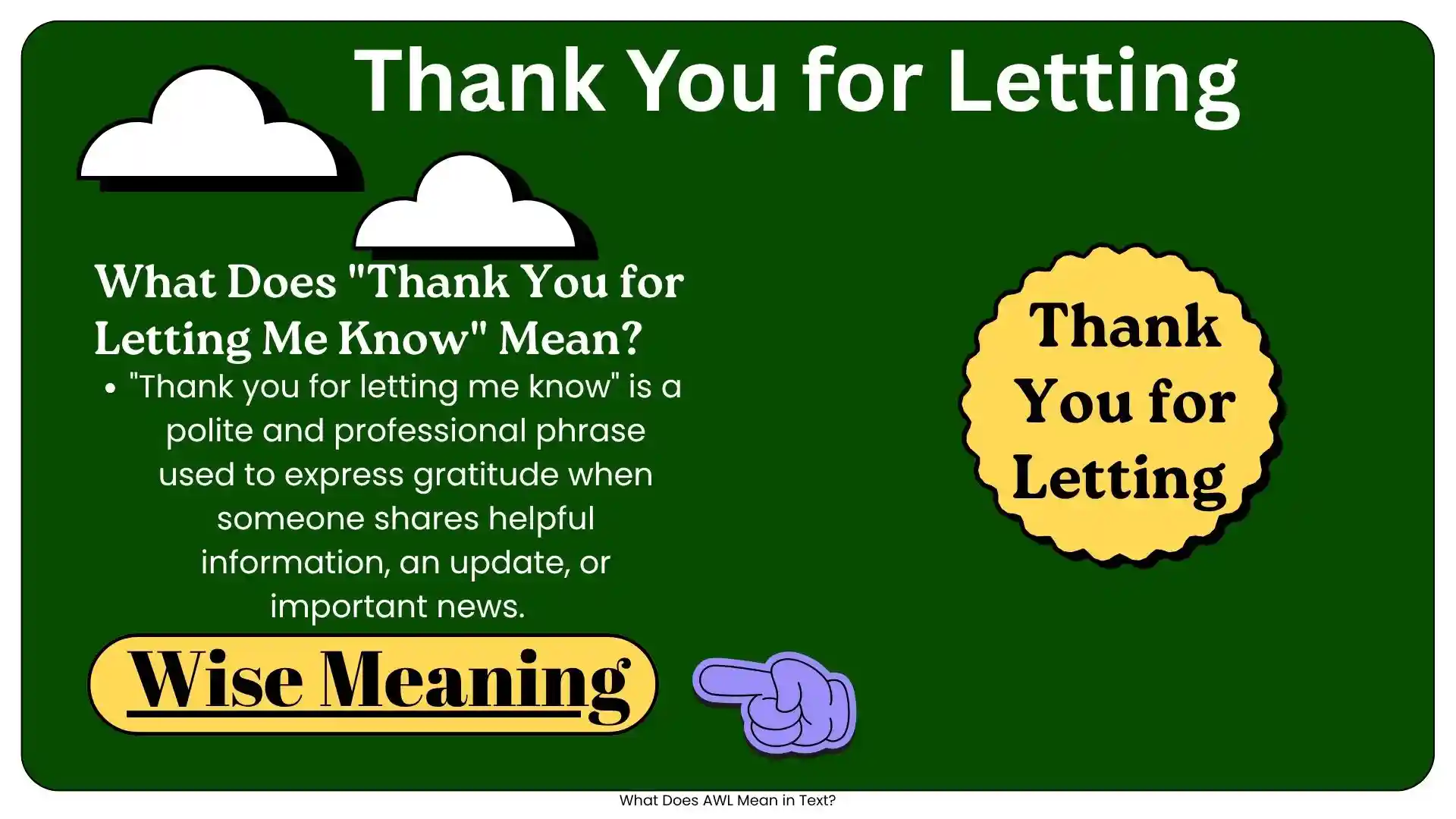
“Thank you for letting me know” means you are showing appreciation because someone shared useful information, gave you an update, or informed you about something important. It tells the other person that you value the time they took to keep you informed. The phrase is polite, respectful, and suitable for both personal and professional communication.
Unlike a simple “thanks,” this expression also acknowledges the information you received. It lets the speaker know that you noticed their message and appreciate their effort. Whether you receive a schedule change, project update, or personal news, this phrase is a natural way to respond.
When Should You Use “Thank You for Letting Me Know”?
You can use this phrase whenever someone shares information that helps you or affects you. It works well in emails, meetings, text messages, customer support conversations, and everyday discussions. It is especially useful when someone informs you about a change, delay, correction, or important announcement.
💡 Common situations include:
| Situation | Example |
| “Thank you for letting me know about the meeting.” | |
| 💼 Workplace | “Thank you for letting me know the deadline has changed.” |
| 👥 Personal | “Thank you for letting me know you’ll be late.” |
| 🛍 Customer Service | “Thank you for letting me know the order has shipped.” |
Using this phrase shows good communication skills and helps build positive relationships.
Is “Thank You for Letting Me Know” Grammatically Correct?
✅ Yes, it is completely grammatically correct.
The phrase uses “letting” because it follows the preposition “for.” In English grammar, a verb that comes after a preposition usually ends in -ing. That is why “Thank you for letting me know” is correct, while “Thank you for let me know” is not.
⚠️ Common grammar mistakes:
| ❌ Incorrect | ✅ Correct |
| Thank you for let me know | Thank you for letting me know |
| Thanks for let me know | Thanks for letting me know |
| Thank you letting me know | Thank you for letting me know |
Using the correct form makes your writing sound natural and professional.
Is It Formal or Informal?
One reason this phrase is so popular is that it works in many situations. It is neutral, meaning it is neither too formal nor too casual. Because of this, it fits well in business emails, workplace communication, and everyday conversations.
📌 Where it works best:
| Style | Suitable? |
| 💼 Business Email | ✅ Yes |
| 👨💼 Client Communication | ✅ Yes |
| 👩💻 Workplace Chat | ✅ Yes |
| 👨👩👧 Friends | ✅ Yes |
| 📱 Text Messages | ✅ Yes |
If you want to sound more formal, you can choose a professional alternative. If you are chatting with friends, a simple “Thanks for letting me know” also sounds natural.
Examples of “Thank You for Letting Me Know”
Professional Examples
In the workplace, this phrase shows respect and appreciation for updates. It helps create clear communication and a positive professional tone.
Examples:
- Thank you for letting me know about the schedule change.
- Thank you for letting me know the report has been completed.
- Thank you for letting me know about the client’s feedback.
Email Examples
This phrase is common in professional emails because it politely acknowledges information without making the response too long.
Examples:
- Thank you for letting me know. I’ll review the document today.
- Thank you for letting me know about the meeting time.
- Thank you for letting me know. I appreciate the update.
Everyday Conversation Examples
You can also use this phrase in daily life when someone tells you something helpful.
Examples:
- Thank you for letting me know you’ll arrive later.
- Thanks for letting me know about the event.
- Thank you for letting me know the store is closed today.
Professional Ways to Say “Thank You for Letting Me Know”
Sometimes you may want to avoid repeating the same phrase. These alternatives work well in professional communication.
✨ Professional alternatives:
| Alternative | Best Use |
| I appreciate the update. | Business emails |
| Thank you for informing me. | Formal writing |
| I appreciate you letting me know. | Workplace chats |
| Thanks for keeping me informed. | Ongoing projects |
| Thank you for bringing this to my attention. | Important issues |
| I appreciate your message. | Client communication |
| Many thanks for the update. | Formal emails |
Choose the option that matches the situation and the tone you want to create.
You Might Also Like That: Ish Meaning
Casual Alternatives
When speaking with friends, family, or close coworkers, shorter phrases sound more natural while still showing appreciation.
😊 Casual alternatives include:
- Thanks for letting me know.
- Thanks for the update.
- Good to know.
- I appreciate it.
- Thanks for telling me.
- Glad you told me.
- Thanks for the heads-up.
These expressions are friendly and work well in text messages or casual conversations.
Formal Alternatives
If you are writing to a manager, customer, professor, or business client, a more formal expression can leave a better impression.
📌 Formal options:
- Thank you for informing me.
- I sincerely appreciate the information.
- Thank you for bringing this matter to my attention.
- I appreciate your prompt update.
- Thank you for your notification.
- Many thanks for your email.
These phrases are suitable for professional writing while remaining polite and respectful.
Synonyms of “Thank You for Letting Me Know”
There is no exact synonym, but several phrases have a similar meaning. Each one fits a different situation depending on how formal or casual you want to sound.
| Phrase | Best For |
| Thank you for informing me | Formal emails |
| Thanks for the update | Everyday use |
| I appreciate the information | Professional settings |
| Thanks for keeping me posted | Team projects |
| Thank you for your message | Email replies |
| Appreciate you letting me know | Casual workplace chats |
Using different phrases makes your communication sound more natural and less repetitive.
How to Reply When Someone Says “Thank You for Letting Me Know”
If someone thanks you for sharing information, a simple and friendly reply is enough. Your response should acknowledge their appreciation and keep the conversation moving.
💬 Good replies:
- You’re welcome!
- Happy to help.
- Anytime.
- No problem at all.
- Glad I could help.
- Of course.
- My pleasure.
These replies work well in both personal and professional conversations.
Common Mistakes to Avoid
Many English learners make small mistakes when using this expression. Paying attention to grammar and tone can help you sound more natural.
⚠️ Avoid these mistakes:
- Using “Thank you for let me know.”
- Choosing a formal phrase when chatting with friends.
- Repeating the same expression in every email.
- Forgetting to respond after receiving important information.
- Using the phrase when no useful information was actually shared.
Using the right wording for the situation makes your communication more effective.
Thank You vs Thanks: Which Should You Use?
Both “Thank you” and “Thanks” express gratitude, but they create slightly different impressions. “Thank you” sounds more polite and professional, while “Thanks” feels relaxed and friendly.
📊 Quick comparison
| Phrase | Best Use |
| Thank you | Business, formal emails, clients |
| Thanks | Friends, coworkers, casual chats |
When you are unsure, choosing “Thank you” is usually the safer option because it works in almost every situation.
“Thank You for Letting Me Know” vs Similar Expressions
Several English phrases have similar meanings, but each one suits a different context.
| Phrase | When to Use |
| Thank you for letting me know | General updates |
| Thanks for the update | Ongoing work |
| Thank you for informing me | Formal communication |
| I appreciate the information | Professional settings |
| Thanks for keeping me informed | Long-term projects |
| Thank you for bringing this to my attention | Problems or important issues |
Choosing the right phrase helps you sound more confident and improves your communication.\
You Might Also Like That: AWL Mean in Text
Frequently Asked Questions
Is “Thank you for letting me know” polite?
✅ Yes. It is one of the most polite and commonly used English expressions for acknowledging information.
Can I use it in a business email?
Absolutely. It is professional, respectful, and suitable for managers, clients, coworkers, and customers.
Is “Thanks for letting me know” also correct?
Yes. It is grammatically correct but sounds slightly more casual than “Thank you for letting me know.”
What is the best professional alternative?
Many professionals use “Thank you for informing me,” “I appreciate the update,” or “Thank you for bringing this to my attention.”
Final Thoughts
“Thank you for letting me know” is a simple yet powerful phrase that shows gratitude, respect, and good communication. It works well in emails, meetings, workplace conversations, and everyday life. Learning when and how to use it correctly can make your responses sound more natural and professional.
Now that you understand its meaning, usage, grammar, examples, synonyms, and professional alternatives, you can choose the best expression for every situation. Whether you are replying to a colleague, client, teacher, or friend, using the right words helps you build stronger relationships and communicate with confidence.