
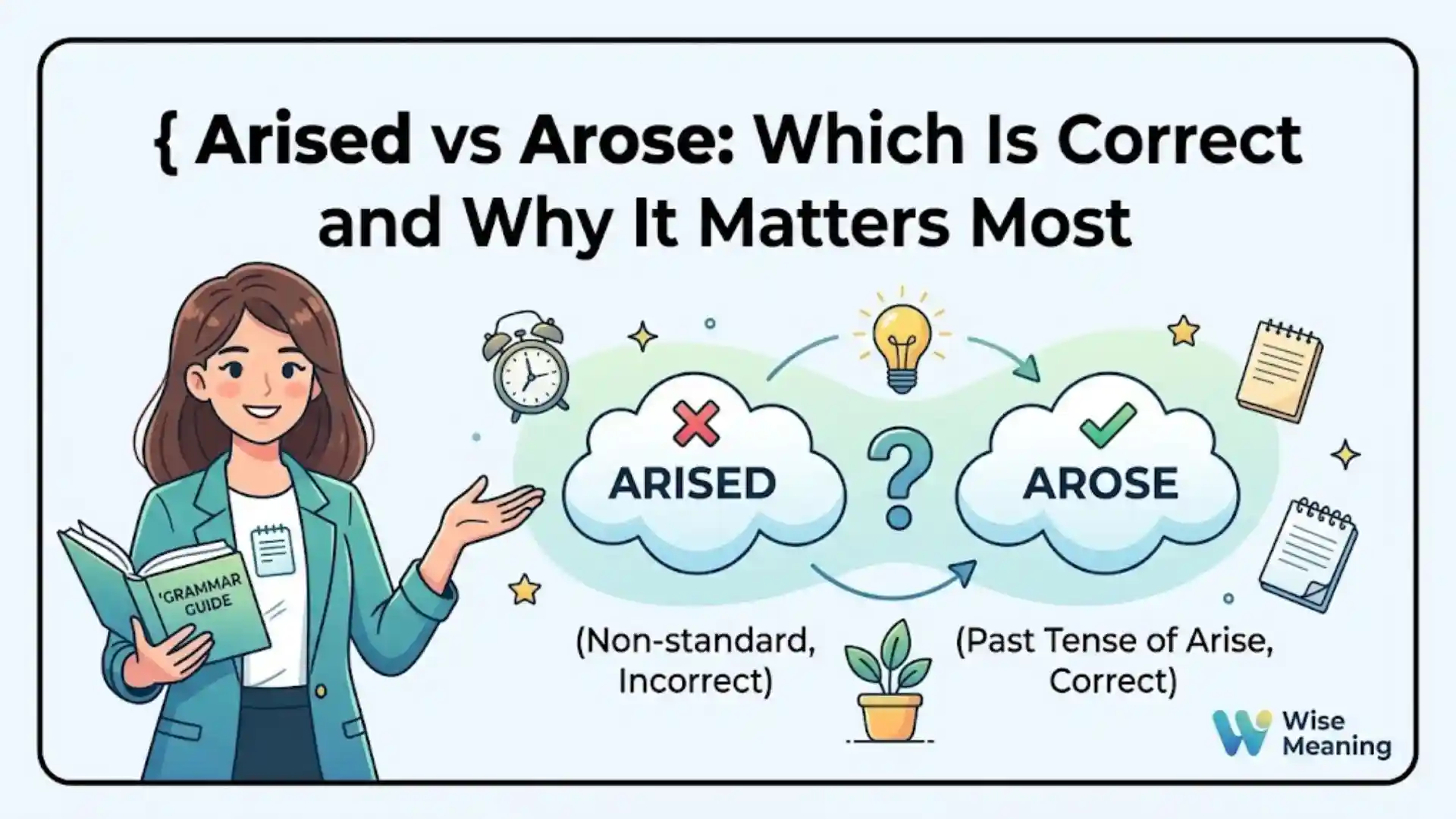
If you are confused about “arised” vs “arose,” you are not alone. Many English learners think arised should be the past form of arise because many English verbs add -ed in the past tense. However, arose is the correct simple past form of arise, while arised is not the standard English form.
The verb arise is an irregular verb, so its form changes instead of simply adding -ed. The main forms are arise → arose → arisen. Understanding these three forms will help you use this verb correctly in everyday writing, academic work, and professional communication.
Quick Answer ⚡
Arose is correct, and arised is incorrect. The verb arise is irregular, so its correct forms are arise, arose, and arisen. Use arose when talking about something that happened in the past: “A problem arose during the meeting.” Use arisen with helping verbs: “A new problem has arisen.” Remember: arise → arose → arisen.
TL;DR 📝
Arose is the correct past tense of arise, while arised is incorrect in standard English. The three main forms are arise → arose → arisen. Use arose for the simple past, as in “A problem arose yesterday.” Use arisen as the past participle after has, have, or had, as in “Several problems have arisen.” So, avoid arised, had arised, and has arised.
You Might Also Like That: IGH Mean in Text
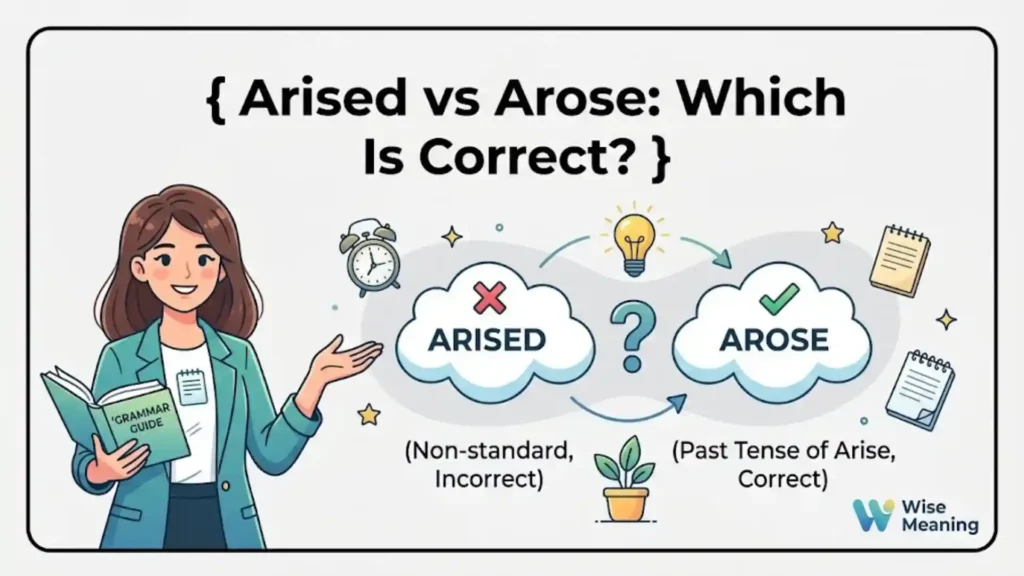
Arised vs Arose: Which Is Correct?
Arose is the correct word when you need the simple past form of arise. For example, you can say, “A problem arose during the meeting.” You should not write, “A problem arised during the meeting.” Merriam-Webster lists arose and arisen among the forms of arise.
The easiest way to remember the difference is to learn the forms together:
| Form | Correct? | Use |
| Arise ✅ | Yes | Present/base form |
| Arose ✅ | Yes | Simple past |
| Arisen ✅ | Yes | Past participle |
| Arised ❌ | No | Not the standard form |
Why Is “Arised” Incorrect?
The main reason “arised” is incorrect is that arise is an irregular verb. Regular verbs usually form their past tense by adding -ed, such as walk → walked or play → played. Irregular verbs follow different patterns. For arise, the past form changes to arose instead of becoming arised.
This can feel confusing at first because arised follows a pattern that works with many other English verbs. However, English has many irregular verbs that must be learned separately. Remembering arise → arose → arisen is the simplest way to avoid this mistake.
Why Does “Arised” Sound Natural?
“Arised” sounds natural because English speakers often expect verbs to take -ed in the past tense. For example, change becomes changed, and start becomes started. But arise does not follow that pattern. Its past form is arose, so replacing it with arised creates a grammar error.
Arise, Arose, and Arisen: Verb Forms
The three main forms of the verb are arise, arose, and arisen. Each form has a different grammatical purpose. Arise is the base or present form, arose is the simple past form, and arisen is the past participle. Cambridge also gives these three forms when explaining the difference between arise and rise.
| Verb Form | Word | Example |
| Base form | Arise | Problems arise quickly. |
| Simple past | Arose | A problem arose yesterday. |
| Past participle | Arisen | A problem has arisen. |
| Present participle | Arising | New issues are arising. |
Simple Rule to Remember
👉 Arise = now
👉 Arose = past
👉 Arisen = with has, have, or had
This simple pattern can help you choose the correct form without thinking too much about complicated grammar rules.
When to Use “Arose”
Use arose when you are talking about something that happened, appeared, or came up in the past. It is the simple past form of arise. The word often appears with nouns such as problem, issue, question, opportunity, or conflict. For example, “A serious problem arose during the project” means that the problem appeared or happened during that past event.
You can use arose when the past event is complete:
- A problem arose yesterday.
- Several questions arose during the meeting.
- A disagreement arose between the teams.
- A new opportunity arose last year.
When to Use “Arisen”
Use arisen when arise works as a past participle. It usually comes after helping verbs such as has, have, or had. For example, “A new problem has arisen” is correct, while “A new problem has arose” is incorrect. The form arisen is especially common when discussing problems, questions, concerns, or situations that have developed.
Here are some correct examples:
- A new problem has arisen.
- Several concerns have arisen.
- A serious issue had arisen.
- Questions have arisen about the decision.
- New challenges have arisen.
You Might Also Like That:
Arose vs Arisen: What Is the Difference?
The main difference between arose and arisen is their grammatical role. Arose is the simple past form, so it can work as the main verb by itself. Arisen is the past participle, so it normally needs a helping verb such as has, have, or had.
| Word | Grammar | Example |
| Arose | Simple past | A problem arose yesterday. |
| Arisen | Past participle | A problem has arisen. |
Compare These Two Sentences
A problem arose yesterday. ✅
A problem has arisen today. ✅
The first sentence describes a completed past event. The second connects the problem to the present, so has arisen is needed.
Is “Had Arised” Correct?
❌ Had arised is not correct in standard English. The correct phrase is had arisen because arisen is the past participle form used with had in the past perfect tense. For example, “Several problems had arisen before the meeting began” is correct.
Compare these examples:
- ❌ Several problems had arised.
- ✅ Several problems had arisen.
- ❌ A serious issue had arised.
- ✅ A serious issue had arisen.
👉 Remember: had + arisen, not had + arised.
Is “Had Been Arised” Correct?
In normal English, “had been arised” is not the correct construction when you mean that problems or issues appeared. The natural sentence is usually “Several security issues had arisen.” The verb arise is normally used without a direct object when it means that something happens, develops, or comes up.
For example:
- ❌ Security issues had been arised.
- ❌ Security issues had arised.
- ✅ Security issues had arisen.
This is an important difference because arise does not normally work like a verb that receives an object in this meaning.
Arise vs Rise: What Is the Difference?
Arise and rise look similar, but they have different meanings. Arise commonly means happen, occur, or develop, while rise commonly means move upward or go up. Cambridge explains this difference and gives their forms as arise → arose → arisen and rise → rose → risen. Cambridge Dictionary
| Verb | Main Meaning | Past | Past Participle |
| Arise | Happen/occur | Arose | Arisen |
| Rise | Go upward | Rose | Risen |
Examples of Arise and Rise
- A problem arose during the meeting. ✅
- The sun rose early this morning. ✅
- New questions have arisen. ✅
- Prices have risen recently. ✅
Arise vs Raise: Another Common Confusion
Arise and raise are also different verbs. Arise often means that something happens or appears, while raise can mean to lift something, increase something, or bring something up. This difference matters because using raise instead of arise can change the meaning of your sentence.
For example:
- A problem arose during the meeting. ✅
- The company raised its prices. ✅
- A problem raised during the meeting. ❌
👉 Use arise when something happens or develops, and raise when someone or something actively lifts or increases something.
What Does “Arise” Mean?
The verb arise has several meanings, but it often means to happen, occur, appear, or develop. It is commonly used with words such as problem, question, issue, opportunity, and conflict. For example, “Several problems may arise during the project” means that several problems may happen or develop.
According to Merriam-Webster, arise can also have other meanings, including to get up or to move upward, depending on the context. Merriam-Webster
Common Meanings of Arise
- Happen: A problem may arise.
- Develop: New concerns can arise.
- Appear: Questions may arise.
- Get up: He arose from his chair.
Examples of Arise, Arose, and Arisen
Using these forms in real sentences makes the grammar easier to understand. The correct form depends on the tense and the structure of the sentence.
| Form | Example |
| Arise | Problems can arise unexpectedly. |
| Arose | A serious problem arose yesterday. |
| Arisen | Several problems have arisen. |
| Arising | New concerns are arising. |
More Example Sentences
- Unexpected problems can arise at any time.
- A disagreement arose during the discussion.
- Several questions have arisen since the announcement.
- New challenges are arising every day.
Common Mistakes With “Arise”
Many mistakes happen because people try to use arised as if arise were a regular verb. The same mistake can appear with has, have, and had. Learning the correct forms can prevent all of these errors.
| Incorrect ❌ | Correct ✅ |
| The problem arised. | The problem arose. |
| The issue has arised. | The issue has arisen. |
| Problems had arised. | Problems had arisen. |
| Questions have arised. | Questions have arisen. |
👉 The key rule is arose for simple past and arisen after has, have, or had.
How to Remember the Correct Forms
The easiest way to remember this verb is to learn its three main forms as one group:
Arise → Arose → Arisen
Think of them as a simple timeline:
- Now: Problems arise.
- Past: A problem arose.
- Perfect: A problem has arisen.
If you remember this short sequence, you will not need to guess whether arised is correct. You can also connect it with rise → rose → risen, which follows a similar irregular pattern.

You Might Also Like That : Aura Meaning: What Is an Aura
Quick Answer: Arised vs Arose
Arose is correct; arised is incorrect in standard English. The verb arise is irregular, so its main forms are arise → arose → arisen. Use arose as the simple past form, as in “A problem arose yesterday.” Use arisen as the past participle, as in “A problem has arisen.” Therefore, avoid forms such as arised, had arised, and has arised in standard English. Merriam-Webster
Frequently Asked Questions
Is “Arised” a Word?
Arised is not the standard past-tense form of arise. Use arose for the simple past and arisen as the past participle.
Is “Arose” the Past Tense of “Arise”?
Yes. Arose is the simple past form of arise. For example: “A problem arose during the meeting.”
Should I Use “Had Arised” or “Had Arisen”?
Use had arisen. The word arisen is the past participle needed after had.
Is “Arose” or “Arisen” Correct?
Both are correct, but they are used differently. Arose is the simple past, while arisen is the past participle.
What Are the Three Forms of “Arise”?
The three main forms are arise → arose → arisen. Cambridge Dictionary
What Is the Difference Between “Arise” and “Rise”?
Arise often means “happen” or “occur,” while rise usually means “go up.” Their past forms are arose and rose, respectively. Cambridge Dictionary
Conclusion
The answer to “arised vs arose” is simple: use arose, not arised. Arise is an irregular verb, so its main forms are arise → arose → arisen. Use arose when describing a completed past event, such as “A problem arose yesterday.” Use arisen with helping verbs, such as “Several problems have arisen.”
Once you remember arise → arose → arisen, you can avoid the most common mistakes, including arised, had arised, and has arised. This simple rule will make your English writing clearer and more accurate.