
When you need the past tense of panic, the correct form is panicked. Many people wonder whether they should write panicked or paniced, but only panicked is correct. The verb panic follows a regular pattern, although its spelling changes slightly when we add -ed. Understanding this small spelling rule can help you avoid common mistakes in everyday and formal writing.
In this guide, we’ll explain the panic past tense, past participle, and other panic verb forms in simple language. You’ll also learn why panic becomes panicked, how to use it in sentences, and how panicked differs from panicking. By the end, you’ll know exactly how to use these forms with confidence.
⚡ Quick Answer
- ✅ The past tense of panic is panicked.
- ✅ The past participle of panic is also panicked.
- ✅ The present participle of panic is panicking.
- ❌ Paniced is an incorrect spelling.
- ❌ Panic is not the past tense of the verb.
- 📚 Panic is a regular verb, even though its spelling changes when adding -ed.
- 🔤 The correct forms are panic → panicked → panicking.
- ✍️ Example: “She panicked when she heard the alarm.”
- 💡 Use panicked for a completed past reaction and panicking for an action that was happening at a particular time.
- 🎯 In short, if you’re asking “What is the past tense of panic?”, the answer is panicked.
📌 TL;DR
- Panic — Base Form (V1) → “I sometimes panic.”
- Panicked — Past Tense (V2) → “I panicked yesterday.”
- Panicked — Past Participle (V3) → “I have panicked before.”
- Panicking — Present Participle → “I am panicking now.”
- ❌ Paniced → Incorrect
- ❌ Panick → Incorrect
- ✅ Panicked → Correct
- ✅ Panicking → Correct
- 🧠 Spelling tip: panic takes k before -ed and -ing.
- 🔎 Most important keyword: past tense of panic
- 🔑 Related keywords: panic past tense, panicked, past participle of panic, past simple of panic, panic verb forms, panic or panicked, panicked or paniced, panic conjugation, panic spelling, panicking.
You Might Also Like That: What Does BTA Mean in Text?
Past Tense of Panic: What Is the Correct Form?
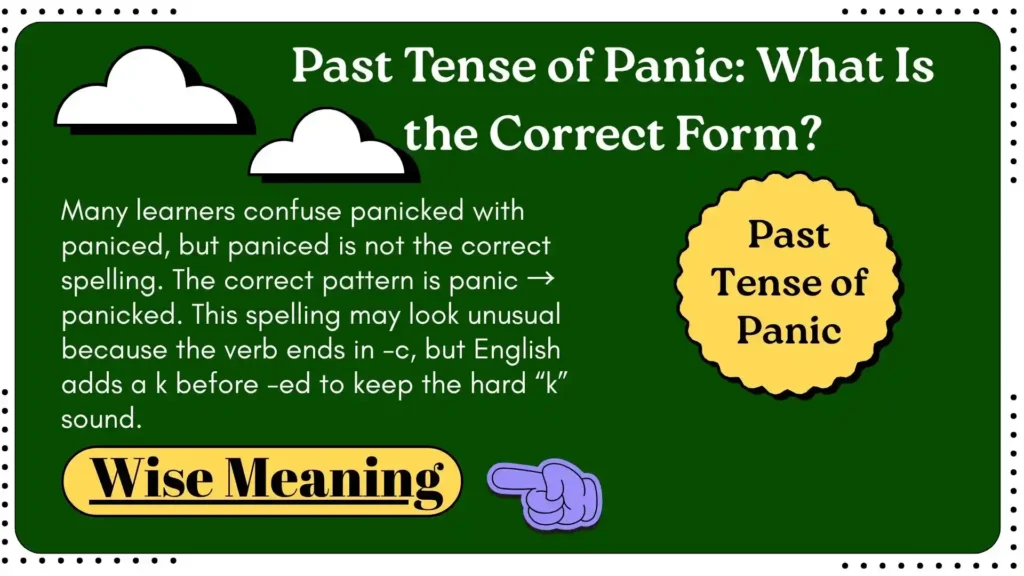
The past tense of panic is panicked. If you want to describe a situation where someone felt sudden fear or worry in the past, you should use panicked. For example, you can say, “She panicked when she lost her phone.” The word panicked works as both the simple past and past participle of the verb panic.
Many learners confuse panicked with paniced, but paniced is not the correct spelling. The correct pattern is panic → panicked. This spelling may look unusual because the verb ends in -c, but English adds a k before -ed to keep the hard “k” sound.
Is It Panicked or Paniced?
The correct spelling is panicked ✅, while paniced ❌ is incorrect. When you add -ed to panic, you cannot simply write paniced. Instead, English spelling changes the ending slightly and adds k before -ed. This gives us panicked, which keeps the original hard sound of the word.
Here are some quick examples:
- 😟 She panicked when the alarm rang.
- 🚗 He panicked after losing control of the car.
- 📚 I panicked before my final exam.
- ❌ She paniced when she saw the problem.
- ✅ She panicked when she saw the problem.
Why Does Panic Become Panicked?
The spelling of panicked follows a common English spelling rule. The base verb panic ends with the letter c, which normally represents a hard “k” sound. When we add -ed, English adds k before the ending: panic + ed = panicked. This keeps the pronunciation of the word clear and consistent.
You can see a similar pattern in other verbs. For example, mimic → mimicked and picnic → picnicked. The extra k does not make panic an irregular verb. It simply helps preserve the correct sound when we add a suffix. 🔤
All Verb Forms of Panic
The verb panic has several useful forms. Learning these forms together can help you avoid mistakes when writing sentences. The base form is panic, while panicked works as both the past tense and past participle. The present participle is panicking, which we use with forms of be to describe an action in progress.
| Verb Form | Correct Form | Example |
| Base form | panic | I sometimes panic. |
| Third-person singular | panics | She panics easily. |
| Past tense | panicked | He panicked yesterday. |
| Past participle | panicked | She has panicked before. |
| Present participle | panicking | They are panicking now. |
How to Use Panicked in a Sentence
Use panicked when you describe a completed reaction that happened in the past. It works naturally when someone suddenly becomes very worried, frightened, or unable to stay calm. You can use it with different subjects, including I, you, he, she, we, and they. The exact reason for the panic can appear after the verb.
For example:
- 😨 I panicked when I could not find my wallet.
- 🚨 The driver panicked after seeing the warning light.
- 📝 She panicked before the test started.
- 📱 They panicked when the phone disappeared.
These examples show how panicked describes a past reaction.
Panicked vs. Panicking: What’s the Difference?
Although panicked and panicking come from the same verb, they describe actions in different ways. Use panicked when the reaction happened and finished in the past. Use panicking when the action was happening at a particular time. The surrounding words usually make the difference clear.
Compare these examples:
- 😰 I panicked when I heard the news. → The reaction happened in the past.
- 😰 I was panicking when you called. → The reaction was still happening.
- 🚨 She panicked after seeing the accident.
- 🚨 She was panicking while waiting for help.
You Might Also Like That: IMS Mean in Text Discover the Real IMS
Is Panic a Regular or Irregular Verb?
Panic is a regular verb, even though its past form looks slightly different from verbs such as walk → walked. A regular verb normally forms its past tense by adding -ed or -d. With panic, English makes a small spelling change before adding the ending, producing panicked.
This change does not make the verb irregular. An irregular verb changes in a different way, such as go → went or eat → ate. With panic, the basic pattern remains regular: panic + -ed = panicked. So, you can safely describe panic as a regular verb. 📚
Can Panicked Be an Adjective?
Yes, panicked can sometimes work as an adjective. In this use, it describes a person, expression, voice, action, or reaction that shows strong fear or worry. The meaning depends on how the word functions in the sentence. This differs from using panicked as the simple past form of the verb.
Compare these examples:
- 😨 She panicked when the lights went out. → Verb
- 😨 She gave me a panicked look. → Adjective
- 🗣️ He spoke in a panicked voice. → Adjective
Looking at the words around panicked can help you identify whether it acts as a verb or adjective.
“I Panicked” vs. “I Was Panicking” vs. “I Was Panicked”
These three structures can look similar, but they do not always express the same idea. I panicked describes a completed reaction. I was panicking focuses on an action that continued for some time. I was panicked can work in certain contexts, but it often sounds less natural when you simply want to describe your own sudden reaction.
For everyday writing, these choices are usually clearer:
- ✅ I panicked when I saw the message.
- ✅ I was panicking while I waited for the answer.
- ✅ I felt panicked after hearing the news.
- ⚠️ I was panicked may need a specific context.
How Is Panicked Pronounced?
The pronunciation of panicked differs slightly from the base word panic because the final -ed creates a clear consonant sound. The word has two syllables, and you should stress the first syllable. The ending should sound connected to the final sound of panic, rather than like a separate “ed” syllable.
When you practice panicked, focus on saying the whole word smoothly. Do not treat the -ed ending as an extra full syllable. This can help your spoken English sound more natural and can also make the spelling easier to remember. 🗣️
Common Mistakes With Panic
Learners often make small spelling or tense mistakes with panic. The most common error is writing paniced instead of panicked. Some writers also use panic when they need the past tense or spell panicking as panicing. These mistakes happen because the spelling change is not obvious from the base form.
Keep these corrections in mind:
- ❌ paniced → ✅ panicked
- ❌ panicing → ✅ panicking
- ❌ panick → ✅ panic
- ❌ Yesterday, I panic. → ✅ Yesterday, I panicked.
- ❌ I was panicked when it happened. → ✅ I panicked when it happened.
Past Tense of Panic in Different Sentence Structures
You can use panicked in many sentence structures. In positive statements, it describes a completed past reaction. In negative sentences, use did not with the base form panic, not panicked. The same rule applies to questions using did. This distinction helps you build grammatically correct sentences.
Positive, Negative, and Question Forms
- ✅ Positive: I panicked when I saw the fire.
- ✅ Negative: I did not panic during the emergency.
- ✅ Question: Did you panic when you heard the news?
- ✅ With a time expression: She panicked yesterday.
- ✅ With a reason: He panicked because he missed the bus.
Notice that did takes the base form panic.
Panic, Panicked, and Panicking in Real-Life Contexts
You can use panic, panicked, and panicking in many everyday situations. The best form depends on whether the action happens now, happened in the past, or continues over a period of time. Using realistic examples makes the difference easier to understand than simply memorizing grammar rules.
For example, a student may panic before an important exam. If the reaction already happened, you can say, “She panicked before the exam.” If the reaction continues, you can say, “She is panicking about the results.” You can use the same pattern for work, travel, emergencies, public speaking, or unexpected news. 🎓
Quick Trick to Remember “Panicked”
A simple way to remember the correct past tense of panic is to focus on the letter K. When you add -ed to panic, keep the hard “k” sound by adding k before the ending. The pattern becomes panic → panicked.
You can also remember the -ing form in the same way: panic → panicking. Think of the word as keeping its hard sound while English adjusts the spelling. 🔤 Once you remember this small pattern, you are less likely to write paniced or panicing.
You Might Also Like That: GIF Meaning
Frequently Asked Questions
What is the past tense of panic?
The past tense of panic is panicked. For example, “I panicked when I could not find my keys.” The word panicked describes a completed reaction in the past.
Is it panicked or paniced?
The correct spelling is panicked. The spelling paniced is incorrect. English adds k before -ed to keep the hard sound of the original verb.
What is the past participle of panic?
The past participle of panic is panicked. You can use it with helping verbs, such as “She has panicked before.”
Is panic a regular verb?
Yes. Panic is a regular verb. Its spelling changes slightly when you add a suffix, but it follows the regular past-tense pattern.
Why does panic add a k?
English adds k before -ed in panicked to keep the hard “k” sound. This spelling pattern also appears in words such as mimicked and picnicked.
What is the present participle of panic?
The present participle is panicking. For example, “He is panicking because he cannot find his passport.”
Is panicked an adjective?
Yes, panicked can function as an adjective when it describes something showing fear or worry, such as “a panicked expression.”
Is “I was panicking” correct?
Yes. I was panicking is correct when you describe an action that was continuing at a particular time in the past.
How do you spell panicked?
The correct spelling is panicked, with a k before -ed. Remember the simple pattern: panic + ed = panicked.
Conclusion
The correct past tense of panic is panicked, not paniced. Although the spelling changes when you add -ed, panic remains a regular verb. The same spelling idea helps you form panicking, the present participle. Once you understand this small rule, the different forms become much easier to remember.
Keep this simple pattern in mind: panic → panicked → panicking. Use panicked for a completed past reaction, panicking for an ongoing action, and panic for the base or present form. With these forms and examples, you can use the verb confidently in both everyday and formal writing.