
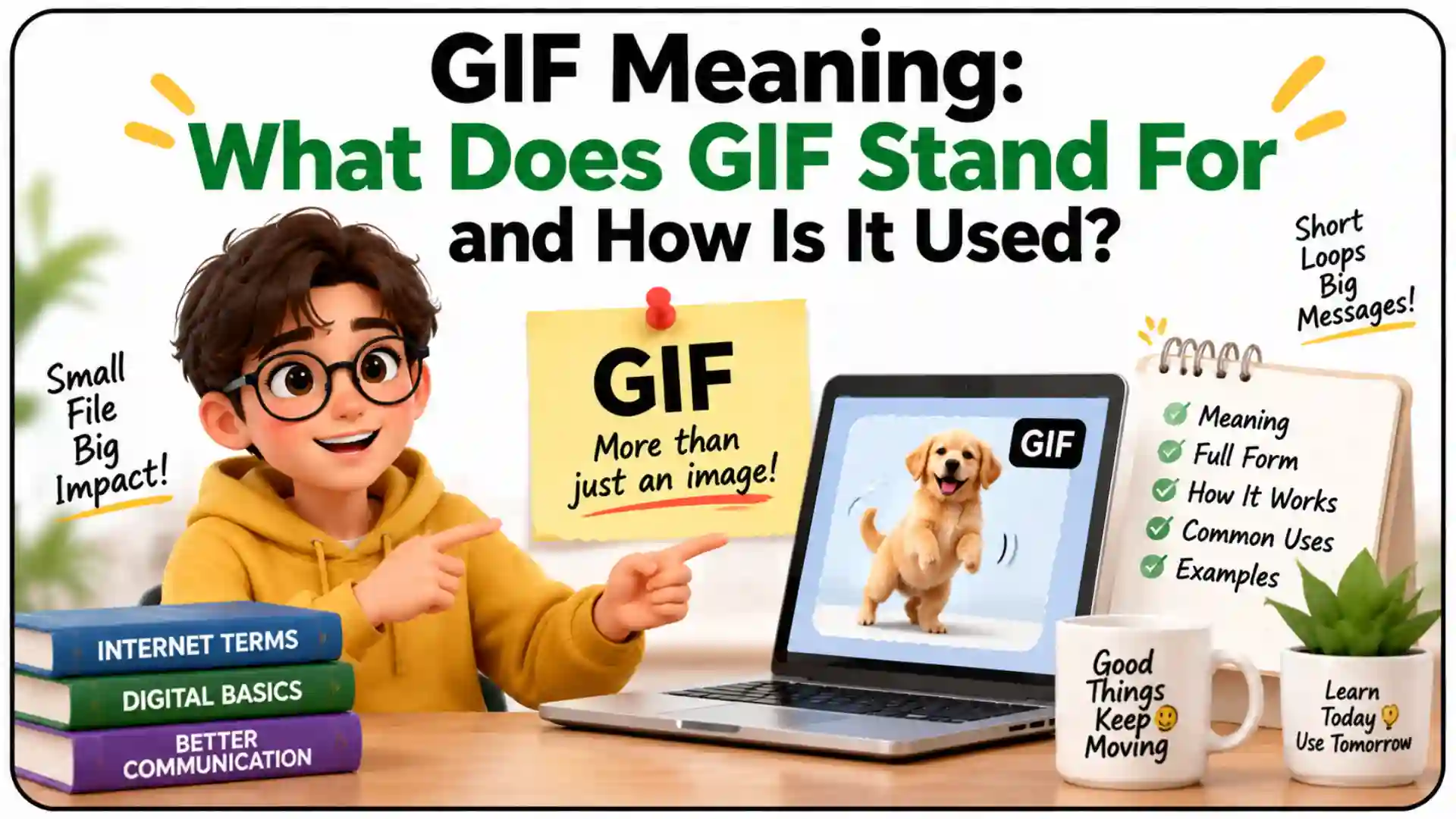
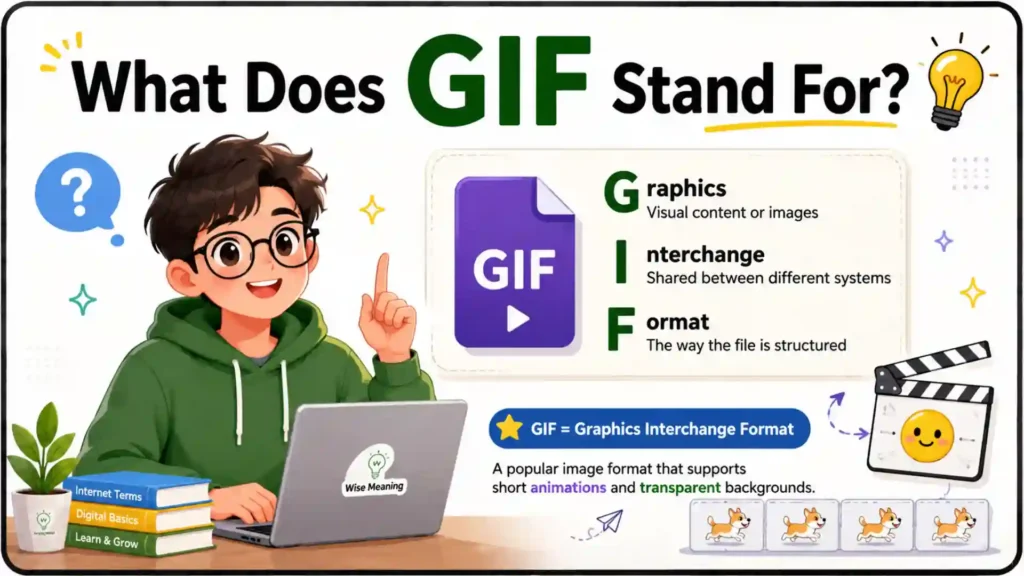
You have probably seen a GIF in a text message, social media comment, or online post. GIFs are often short moving images that show a reaction, joke, emotion, or memorable scene. But what does GIF actually mean? The abbreviation stands for Graphics Interchange Format, a digital image format created for sharing pictures online.
Today, the word GIF means more than a file type. People use GIFs to communicate feelings and reactions without writing a long reply. 😄 A GIF can show laughter, surprise, excitement, confusion, or even sarcasm in just a few seconds, making online conversations more visual and fun.
Quick Answer: What Does GIF Stand For?
GIF stands for Graphics Interchange Format. It is an image file format that can store a single picture or a series of images that play one after another as an animation. GIF became popular on the internet because it could share simple images and short animations in a compact format.
In everyday communication, however, a GIF usually means a short looping animation used as a reaction or visual message. For example, instead of typing “That is hilarious,” someone may send a funny GIF that shows a person laughing. This is why GIFs are now closely linked with online communication.
TL;DR 📌
- GIF stands for Graphics Interchange Format.
- A GIF is a digital image format that can contain a still image or multiple frames.
- Today, people mostly use GIFs as short, looping animations online.
- In texting, a GIF can show laughter, surprise, excitement, sarcasm, or other reactions.
- GIFs are popular on social media, messaging apps, websites, and blogs.
- A GIF usually has no sound, unlike a video.
- “GIF” and “JIF” are both common pronunciations.
- GIF was introduced by CompuServe in 1987.
- GIFs are best for short reactions, simple animations, memes, and visual expressions.
You Might Also Like That: SFW Meaning Explained
What Is a GIF?
A GIF is a digital image file that uses the .gif extension. Unlike a normal photo, a GIF can contain several frames, allowing those images to play in sequence and create movement. This is why many GIFs look like tiny silent video clips.
GIFs can also be static, meaning they contain only one image. Still, animated GIFs are much more common in modern internet culture. 🎬 They are widely used in messaging, social media, blogs, websites, memes, and online communities because they quickly communicate an idea or reaction.
What Does GIF Mean in Texting?
In texting, a GIF often acts like a visual reaction. Instead of explaining an emotion with words, a person can send a short animated image that instantly shows how they feel. A laughing GIF may mean “That is really funny,” while a shocked GIF may mean “I cannot believe this!”
The meaning depends on the context and the relationship between the people chatting. A GIF can be playful, friendly, sarcastic, supportive, or dramatic. 💬 For example, replying to good news with a celebration GIF can show excitement without needing a long written response.
What Does a GIF Mean on Social Media?
On social media, GIFs are commonly used in comments, replies, messages, and posts. They help users react to content in a fast and entertaining way. Someone may use a GIF to show laughter, agreement, disbelief, excitement, embarrassment, or frustration.
GIFs are also a major part of internet humor and meme culture. A familiar movie or TV reaction can communicate an idea that would take several sentences to explain. Brands and creators use GIFs too, especially when they want content to feel more friendly, active, and relatable. 🌐
Examples of GIFs in Everyday Conversations
The meaning of a GIF becomes easier to understand through examples. A person might send a laughing GIF after a funny joke, a clapping GIF after someone shares an achievement, or a confused GIF when a message is unclear.
Here are some common examples:
| GIF Type | Possible Meaning |
| 😂 Laughing GIF | “That is hilarious.” |
| 🎉 Celebration GIF | “I am excited for you!” |
| 😲 Shocked GIF | “Wow, I did not expect that.” |
| 👏 Clapping GIF | “Great job!” |
| 🤔 Confused GIF | “I do not understand.” |
| 😅 Awkward GIF | “That was uncomfortable.” |
Why Do People Use GIFs?
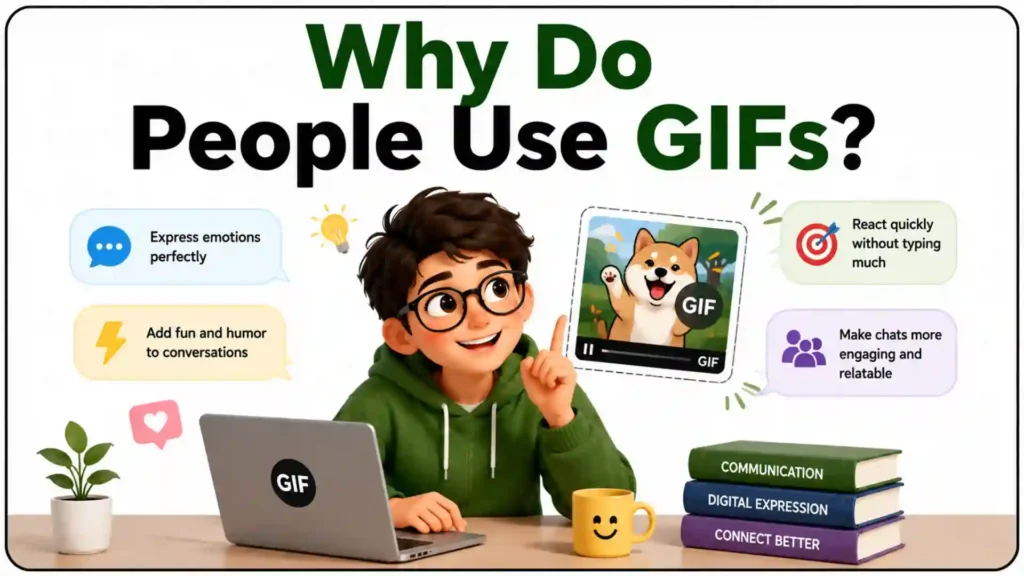
People use GIFs because images can express emotions faster than words. A short animation can communicate a reaction instantly, which makes conversations feel more natural and entertaining. GIFs are especially useful when a person wants to avoid sounding too serious or when a written reply feels boring.
They are also popular because they add personality and humor to digital communication. 😎 A well-chosen GIF can make a message warmer, funnier, or more expressive. In many cases, one GIF can communicate a feeling more clearly than a full sentence.
You Might Also Like That: IGH Mean in Text Explained
How Are GIFs Different From Videos?
GIFs and videos can both contain moving content, but they are not the same thing. A GIF is an image format, while a video normally uses a video format designed to handle longer moving scenes and often sound.
GIFs are usually short, silent, and designed to loop automatically. Videos are better for longer content, detailed visuals, or situations that need audio. A GIF is useful for a quick reaction or simple animation, while a video is usually better for full scenes, tutorials, or storytelling. 🎥
How Do You Pronounce GIF?
The pronunciation of GIF has caused a long-running debate. Some people pronounce it with a hard “G”, like “gift” without the “t,” while others pronounce it with a soft “G,” sounding like “jif.”
Both pronunciations are widely heard in English. Major dictionaries record variation, and the debate has continued for years. The format’s creator, Steve Wilhite, preferred the “jif” pronunciation. However, many speakers naturally say “gif.” So, when speaking, either version may be understood depending on your audience and region.
When Should You Use a GIF?
GIFs work best when you want to communicate a short visual reaction or simple idea. They are useful in casual text messages, social media replies, online communities, blogs, and marketing content.
Consider using a GIF when:
- 😄 You want to show a reaction.
- 🎉 You want to celebrate something.
- 😂 You want to add humor.
- 👏 You want to praise someone.
- 💡 You want to demonstrate a simple action.
- 💬 You want to make a message more expressive.
For serious business messages, long explanations, or content that needs sound, another format may be more suitable.
Are All GIFs Animated?
No, not all GIFs are animated. The GIF format can store a single still image or several frames. When several frames are played in sequence, the result is an animated GIF.
However, most people today associate the word GIF with animation because animated GIFs became extremely popular on the web. This modern meaning can sometimes make the technical definition confusing. In simple terms, a GIF is a file format, while an animated GIF is one common way that format is used.
Can a GIF Have Sound?
No, a standard GIF does not contain audio. GIFs are designed to display images and animation, not sound. That is one of the key differences between a GIF and a typical video file.
This is why GIFs are useful for quick reactions, visual jokes, and simple demonstrations. If a piece of content needs music, speech, sound effects, or detailed audio, a video is usually a better choice. 🔊 GIFs remain useful because they can communicate movement and emotion without requiring sound.
A Brief History of GIF
The Graphics Interchange Format was introduced by CompuServe in 1987. It was created to provide a practical way to display and share images on early online services. The format became widely known because it supported simple graphics and could use multiple frames for animation.
Over time, GIFs moved beyond their original technical purpose. As internet culture grew, people began using them for reactions, jokes, memes, and short animations. Today, GIFs are a familiar part of online communication and remain one of the easiest ways to add movement and emotion to digital content.
GIF vs. PNG vs. Video
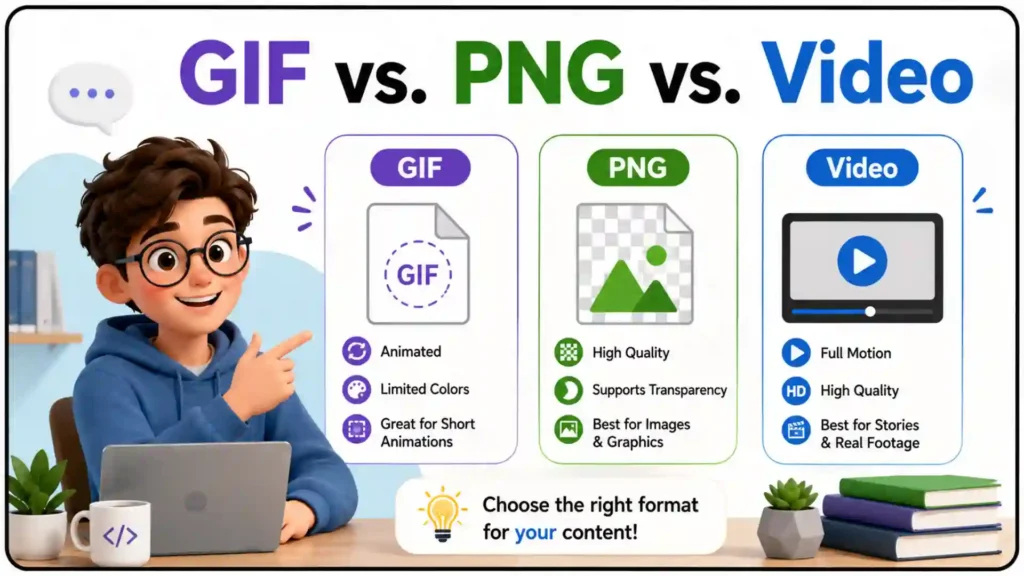
Choosing the right format depends on what you want to show. GIF is useful for short, simple animations. PNG is usually better for high-quality static graphics and images that need transparency. Video is the stronger choice for longer movement, detailed visuals, and audio.
You Might Also Like That: Igniter or Ignitor
| Format | Best For | Animation | Sound |
| GIF | Short reactions and simple animations | ✅ Yes | ❌ No |
| PNG | Static graphics and transparent images | ❌ Usually no | ❌ No |
| Video | Longer clips and rich media | ✅ Yes | ✅ Yes |
Frequently Asked Questions
What does GIF stand for?
GIF stands for Graphics Interchange Format. It is a digital image format that can store still images or multiple frames for animation.
What does GIF mean in texting?
In texting, a GIF usually works as a visual reaction. It can express laughter, surprise, excitement, agreement, sarcasm, or another emotion without using many words.
What is the full form of GIF?
The full form of GIF is Graphics Interchange Format.
Is a GIF an image or a video?
Technically, a GIF is an image file format, not a video format. However, an animated GIF can look similar to a short video because it displays several frames in sequence.
Are all GIFs animated?
No. A GIF can contain one still image or multiple frames. Animated GIFs are simply the most common type seen online today.
How do you pronounce GIF?
Both “gif” and “jif” are widely used pronunciations. The format’s creator preferred “jif,” but the hard-G pronunciation is also common.
Can GIFs have sound?
No. Standard GIFs do not include audio. For sound, a video format is generally more appropriate.
Who invented GIF?
GIF was developed by CompuServe and first introduced in 1987. Steve Wilhite was one of the key people associated with its development.
Why are GIFs used online?
GIFs make online communication faster, more visual, and more expressive. They are especially useful for reactions, humor, memes, and short demonstrations.
Final Thought
The simple answer is clear: GIF means Graphics Interchange Format. Technically, it is an image format that can hold still images or multiple frames. In modern online communication, though, GIF usually means a short animated visual used to show a reaction, emotion, joke, or idea.
Whether you see one in a text, comment, or social media post, the meaning depends on the context. 🎯 GIFs have evolved from a simple image format into a powerful part of digital communication, helping people express more with fewer words.