
If you’ve ever gotten a text that just says “TTYL” and wondered what it meant, you’re not alone. TTYL meaning in text comes down to one simple phrase: talk to you later. It’s one of the most common sign-offs in texting and online chat, used when someone is stepping away from a conversation but plans to pick it back up soon. This guide breaks down exactly what TTYL means, where it came from, and how to use it naturally without sounding awkward or out of place.
Quick Answer
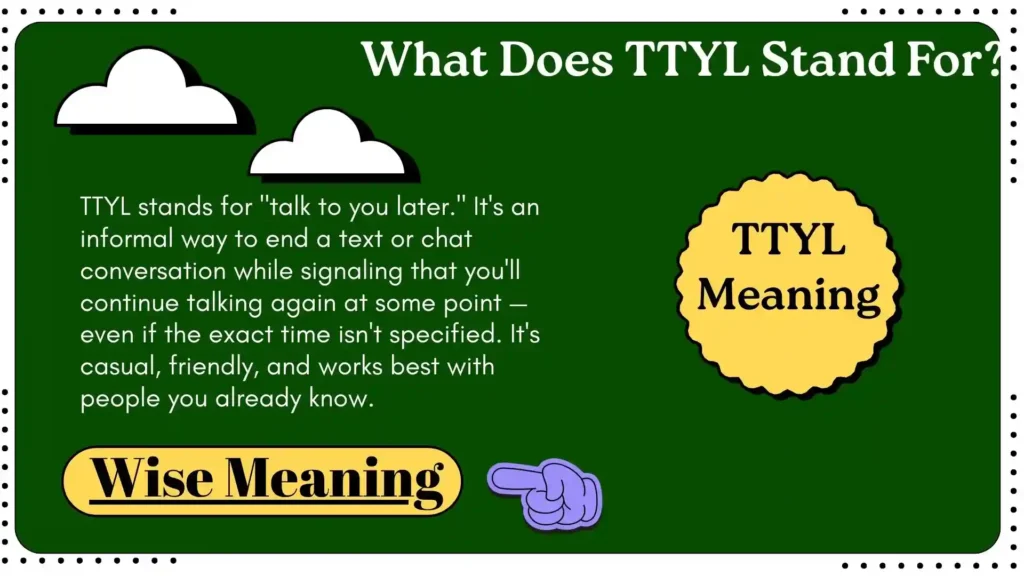
TTYL stands for “talk to you later.” It’s an informal way to end a text or chat conversation while signaling that you’ll continue talking again at some point — even if the exact time isn’t specified. It’s casual, friendly, and works best with people you already know.
TL;DR
- TTYL = Talk To You Later — a casual, temporary goodbye in texting and chat.
- It does not mean the conversation is over for good, unlike a plain “goodbye.”
- It’s an initialism (letters said individually), not a true acronym.
- Best used with friends, family, or casual coworkers — avoid it in formal emails or professional writing.
- Common close relatives: BRB (short pause), TTFN (playful goodbye), GTG (more urgent exit).
You Might Also Like That: MK Mean in Text
What Does TTYL Stand For?
TTYL stands for “talk to you later.” Merriam-Webster defines it simply as an informal way of saying “talk to you later.” It’s used to close out a text, DM, or chat message when the sender is leaving the conversation but expects to reconnect with the other person again — that day, later in the week, or at some unspecified future point.
The phrase works as a polite exit line. It softens the end of a conversation compared to a flat “bye,” because it implies continuity — you’re pausing, not walking away for good.
Example sentences:
- “Gotta run to class, ttyl!”
- “Busy at work right now — ttyl tonight?”
- “That was fun. TTYL 😊”
You’ll see it written in all caps (TTYL) or lowercase (ttyl); both mean exactly the same thing. Lowercase tends to read as slightly more casual, which is why it’s common in quick texts between friends.
Is TTYL an Acronym or an Initialism?
This is a small but genuinely useful distinction competitors often skip. An acronym is an abbreviation pronounced as a single word (like NASA or laser). An initialism is an abbreviation where each letter is said individually (like FBI or ATM). Because people say TTYL as “T-T-Y-L” rather than as one word, it’s technically an initialism, even though “acronym” gets used as the everyday umbrella term for both.
Most people simply say the full phrase “talk to you later” out loud rather than spelling out the letters — the initialism form is really a written shorthand for texting and typing.
Where Did TTYL Come From?
TTYL is a product of early internet chat culture. Its origins trace back to early internet chatrooms like IRC, where people used shorthand acronyms instead of full phrases, and the term gained further traction with instant messaging apps like AIM, MSN, and Yahoo Messenger, where it was commonly typed before someone logged off. TTYL grew alongside other early internet shorthand from the dawn of instant messaging platforms in the 1990s and early 2000s, when typing speed and character limits made abbreviations genuinely useful.
There isn’t a single, verified “invention date” for TTYL — dictionaries and language sites describe its rise through chatroom and instant-messaging culture rather than pointing to one exact origin. Some casual sources speculate about alternate backstories (such as a link to the British phrase “ta ta”), but this isn’t confirmed by any major dictionary, so it’s worth treating as folk etymology rather than fact.
As mobile messaging apps like WhatsApp, iMessage, and Telegram became the norm, TTYL shifted meaning slightly — since most people now carry their phones everywhere, TTYL today often signals “I need to do something else for a bit” rather than “I’m shutting down my computer.”
How to Use TTYL Correctly
TTYL fits naturally into casual digital communication. Here’s when it works well:
- Ending a text conversation with a friend or family member
- Pausing a chat because you’re busy, driving, or heading into something
- Signing off a DM on Instagram, Snapchat, or WhatsApp
- Closing a casual group chat message before going offline
Correct example: “Running to a meeting, ttyl!” — clear, casual, and appropriate for a friend or relaxed coworker.
Awkward example: “Please review the attached contract. TTYL.” — mixing a formal request with slang undercuts the professionalism of the message.
One nuance worth knowing: TTYL doesn’t promise an exact time. It could mean later that day, tomorrow, or “sometime soon.” If timing actually matters, it’s clearer to say something specific, like “I’ll message you after dinner” instead.
TTYL vs. Similar Sign-Offs
Several texting abbreviations serve a similar function but carry different tones or timeframes.
| Abbreviation | Meaning | Typical Duration | Tone |
|---|---|---|---|
| TTYL | Talk to you later | Unspecified — hours to days | Friendly, casual |
| BRB | Be right back | Very short (minutes) | Casual, immediate |
| TTFN | Ta-ta for now | Unspecified | Playful, lighthearted |
| GTG | Got to go | Immediate | Slightly more urgent |
| CU | See you | Unspecified | Brief, casual |
The main distinction to remember: BRB signals a short pause within the same session, while TTYL signals the conversation is ending for now and will resume another time.
When NOT to Use TTYL
TTYL is strictly informal, so it doesn’t belong everywhere. Avoid it in:
- Professional emails or client communication
- Academic writing, essays, or reports
- Formal business messaging, even in some workplace chat tools with clients present
- Serious or sensitive conversations, where a bare “TTYL” can come across as dismissive
For formal contexts, swap it for a full phrase like “I’ll follow up shortly” or “I’ll be in touch soon.”
How to Respond to TTYL
Replying to TTYL is simple — match the tone of the person who sent it:
- “Okay, talk later!”
- “Sounds good, ttyl!”
- “Bye, take care!”
There’s no strict rule here; just mirror the casualness and warmth of the original message.
Frequently Asked Questions
What does TTYL mean in a text message?
TTYL means “talk to you later.” It’s used to end a text or chat casually while implying the conversation will pick back up at some point in the future.
Is TTYL rude?
No. TTYL is generally seen as a polite, friendly way to pause or end a casual conversation. It can feel abrupt only if used alone during a serious discussion.
How do you pronounce TTYL?
Most people either say the letters individually — “T-T-Y-L” — or simply say the full phrase, “talk to you later,” rather than spelling it out loud.
What’s the difference between TTYL and BRB?
BRB (“be right back”) implies a short pause within the same conversation. TTYL implies the conversation is ending for now and will resume at an unspecified later time.
Can TTYL be used in professional settings?
It’s best avoided in formal emails, client messages, or academic writing. It’s fine in casual internal chats among coworkers who already communicate informally.
Is TTYL still used, or is it outdated?
TTYL remains widely used and understood across texting apps and social platforms. While newer slang has emerged, TTYL hasn’t fallen out of use.
Test Your Understanding
1. What does TTYL stand for?
A. Try to yell loudly
B. Talk to you later
C. Text to you later
D. Time to yield later
2. Is TTYL technically an acronym or an initialism?
A. Acronym, because it’s pronounced as one word
B. Initialism, because the letters are said individually
C. Neither — it’s a full word
D. Both, depending on the region
3. Which of the following is the closest match in meaning to BRB?
A. TTYL
B. GTG
C. A very short, immediate pause in conversation
D. A formal goodbye
4. Which situation is TTYL LEAST appropriate for?
A. Texting a friend before class
B. A casual group chat with coworkers
C. A formal client email
D. A quick Instagram DM
5. Where did TTYL most likely originate?
A. Television broadcasting scripts
B. Early internet chatrooms and instant messaging platforms
C. Legal documents
D. Academic writing style guides
Answer Key
- B — TTYL is a direct shorthand for “talk to you later.”
- B — The letters are spoken individually (T-T-Y-L), making it an initialism.
- C — BRB signals a short, immediate pause, unlike TTYL’s longer, unspecified gap.
- C — Formal client communication calls for full, professional language, not texting slang.
- B — TTYL rose alongside early chatroom and instant-messaging culture in the 1990s and 2000s.
Conclusion
TTYL is a simple, well-established piece of texting shorthand: it means “talk to you later,” and it works as a casual, friendly way to pause a conversation without shutting the door on it. Use it freely with friends, family, and relaxed group chats — just swap it for a fuller phrase when you’re writing something formal. Once you know the difference between TTYL and cousins like BRB or GTG, you’ll never second-guess a sign-off again.
Related Grammar and Language Guides
What Does SMH Mean In Chat: What It Stands For and How People Use It in Chat
NS Mean in Text: Discover the True NS Meaning With Easy Examples
BK Meaning in Text: Proven Guide With Real Life Chat Examples
AWL Mean in Text: Discover the Real AWL Meaning and Uses Today