
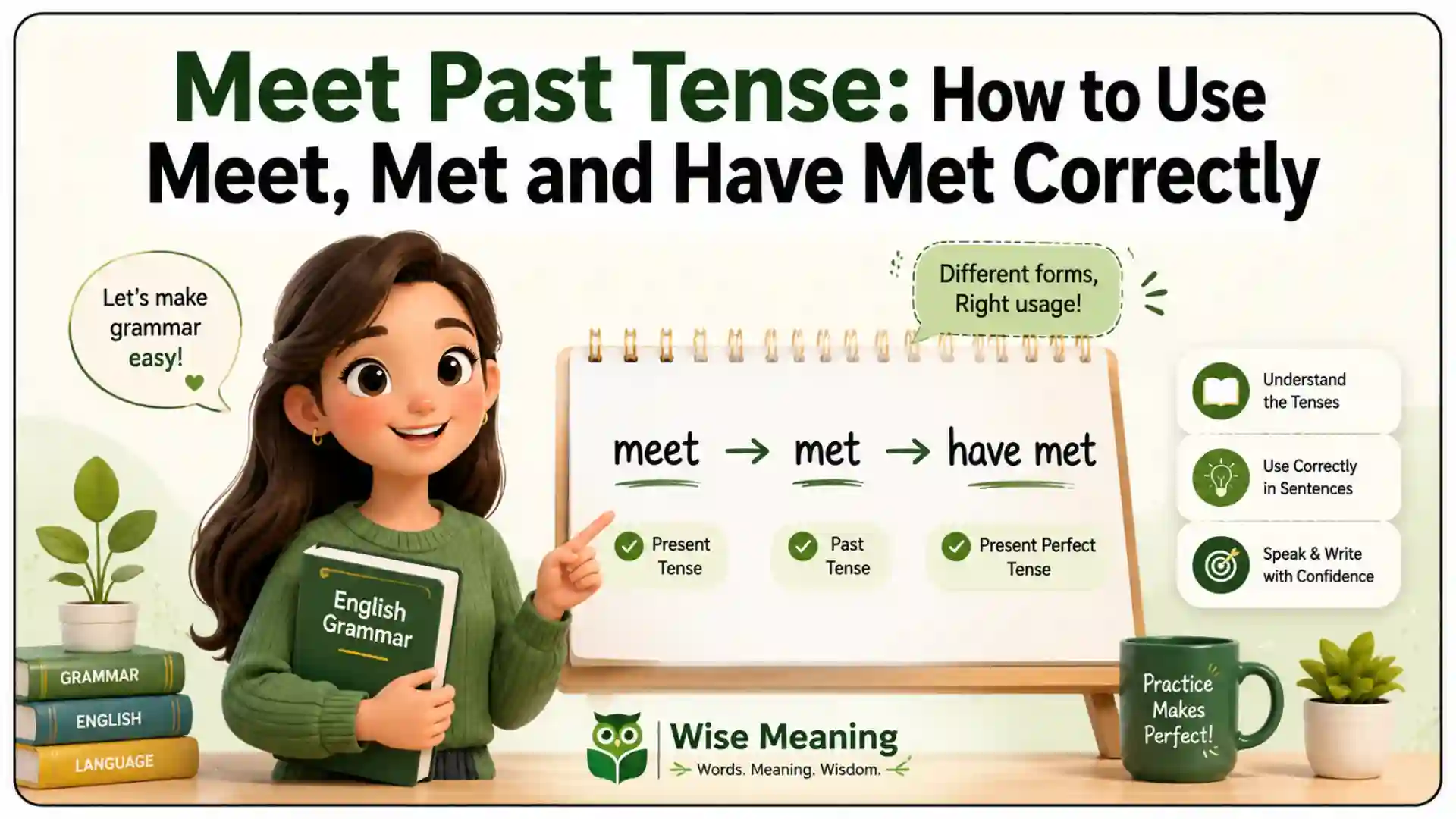
The past tense of meet is met. The past participle is also met, so the main verb forms are meet → met → met. Because meet is an irregular verb, the word does not become meeted in standard English.
If you are unsure when to use meet, met, have met, had met, or meeting, this guide explains each form with simple examples. You will also learn why we say “Did you meet?” instead of “Did you met?” and how to avoid other common mistakes.
Quick Answer
The past tense of meet is met. The past participle is also met, so the main verb forms are meet → met → met. Because meet is an irregular verb, meeted is incorrect in standard English.
Use met for a completed past action, as in “I met her yesterday.” After did or didn’t, use the base form meet: “Did you meet her?” and “I didn’t meet her.” After have, has, or had, use met: “I have met her before.”
TL: DR
- ✅ The past tense of meet is met.
- ✅ The past participle of meet is also met.
- 📌 Main forms: meet → met → met.
- ❌ Meeted is not the correct past tense.
- ✅ Say “I met him yesterday.”
- ✅ Say “Did you meet him?”, not “Did you met him?”
- ✅ Say “I didn’t meet her,” not “I didn’t met her.”
- ✅ Use have/has/had met for perfect tenses.
- 💡 Meet is an irregular verb, so its past form does not use -ed.
You Might Also Like That: Past Tense of See
What Is the Past Tense of Meet?
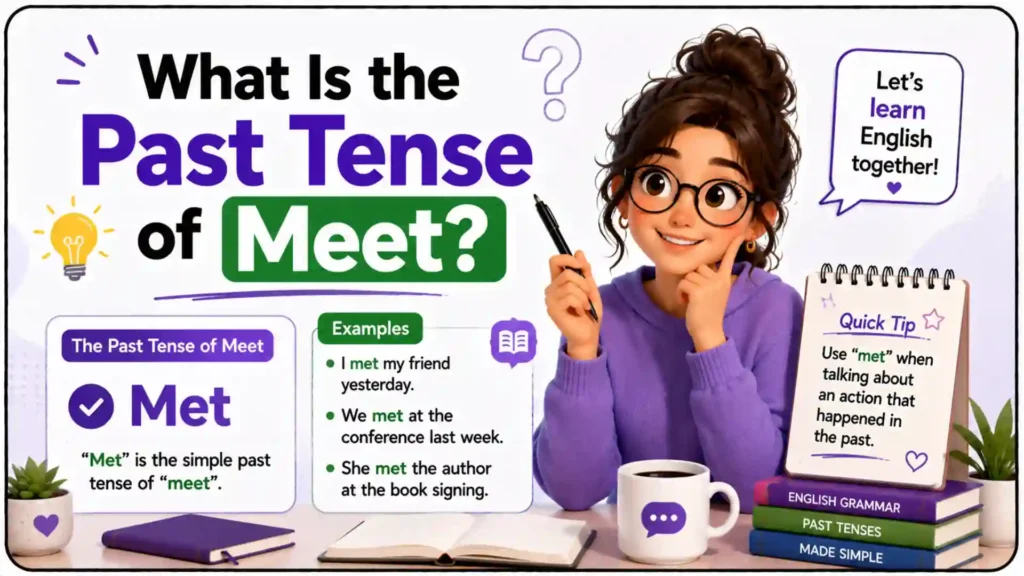
The simple past tense of meet is met. Use met when you talk about a meeting, encounter, or other action that happened and finished in the past.
For example:
- I meet my manager every Monday.
- I met my manager yesterday.
- Sarah met her new neighbors last week.
📌 Remember: Meet is the base form, while met describes a completed past action.
Here are the main forms of the verb:
| Verb Form | Word |
| Base form / V1 | meet |
| Simple past / V2 | met |
| Past participle / V3 | met |
| Present participle | meeting |
| Third-person singular | meets |
The important pattern is simple: meet → met → met.
Why Is the Past Tense “Met” and Not “Meeted”?
Meet is an irregular verb, which means its past tense does not follow the usual rule of adding -ed. The correct past form is met, not meeted.
Compare:
- ❌ I meeted him at school.
- ✅ I met him at school.
Many regular verbs form the past tense by adding -ed, such as walk → walked or talk → talked. Irregular verbs change differently, so their forms need to be learned individually.
⚠️ Do not confuse meet with mete. Mete is a different verb, often used in the phrase “mete out,” meaning to give or distribute something such as punishment. Its past tense is meted.
- The judge meted out the sentence.
- I met the judge yesterday.
Meet vs Met — What Is the Difference?
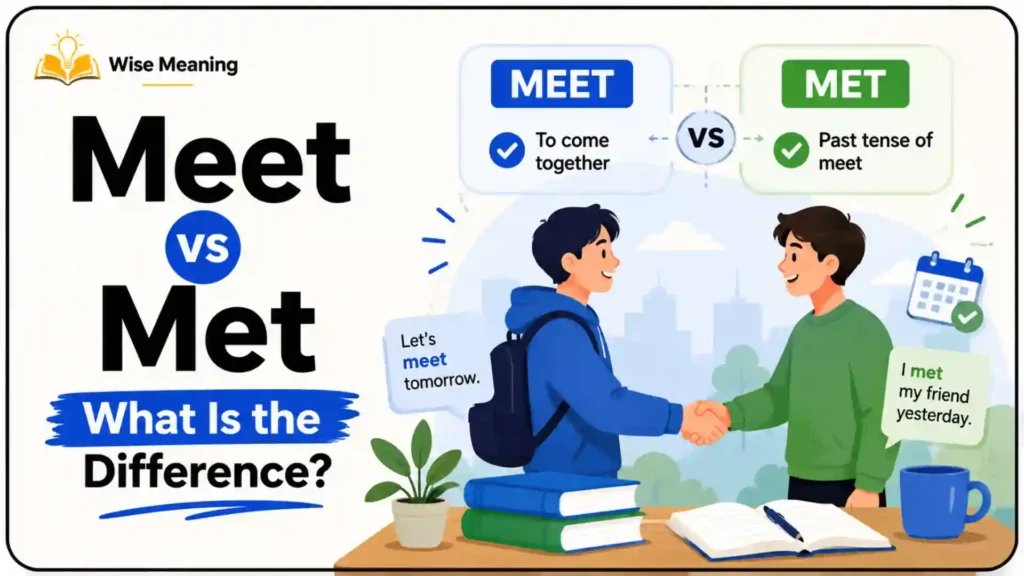
Use meet for the base or present form of the verb. Use met when the meeting or action happened in the past.
For example:
- We meet every Friday.
- We met last Friday.
- We will meet again next Friday.
The difference is mainly about time. Meet can describe something that happens regularly, follows another verb such as will, or appears after to. Met points to a completed past action.
You Might Also Like That: What Does Pookie Mean in Text
🔍 Example:
- I usually meet clients in the morning.
- I met three clients yesterday.
So, if you are describing something that already happened, met is usually the form you need.
What Is the Past Participle of Meet?
The past participle of meet is met. This means the simple past and past participle have the same spelling, even though they can perform different grammatical jobs.
Use the past participle met after helping verbs such as have, has, and had:
- I have met her before.
- He has met the new manager.
- We had met before the event started.
You should not say have meet or had meet. After have, has, or had, use the past participle met.
Met vs Have Met vs Had Met
These forms all refer to the past, but they show different relationships between events.
| Form | Main Use | Example |
| met | Completed past event | I met her yesterday. |
| have/has met | Past experience connected to now | I have met her before. |
| had met | Event that happened before another past event | I had met her before the conference. |
Met works well with a finished past time such as yesterday or last week. Have met often describes past experience without focusing on one finished time. Had met shows that one past event happened before another past event.
Did You Meet or Did You Met?
“Did you meet?” is correct. Do not say “Did you met?”
When did is used to form a simple past question, the main verb stays in its base form. The word did already shows that the sentence refers to the past, so meet does not change to met.
Examples:
- ✅ Did you meet Sarah yesterday?
- ❌ Did you met Sarah yesterday?
- ✅ Where did you meet him?
- ❌ Where did you met him?
- ✅ When did they meet?
💡 Simple rule:
did + meet, not did + met
This rule applies to other English verbs too. For example, we say Did you go?, not Did you went?
Didn’t Meet or Didn’t Met?
“Didn’t meet” is correct. The form “didn’t met” is incorrect for the same reason that “Did you met?” is incorrect.
The word didn’t is short for did not. Because did already carries the past tense, the verb that follows stays in its base form.
Examples:
- ✅ I didn’t meet him yesterday.
- ❌ I didn’t met him yesterday.
- ✅ We didn’t meet last week.
- ✅ She didn’t meet the deadline.
📌 Remember: In a normal positive past sentence, use met: I met him. After did or didn’t, switch back to meet: Did you meet him? I didn’t meet him.
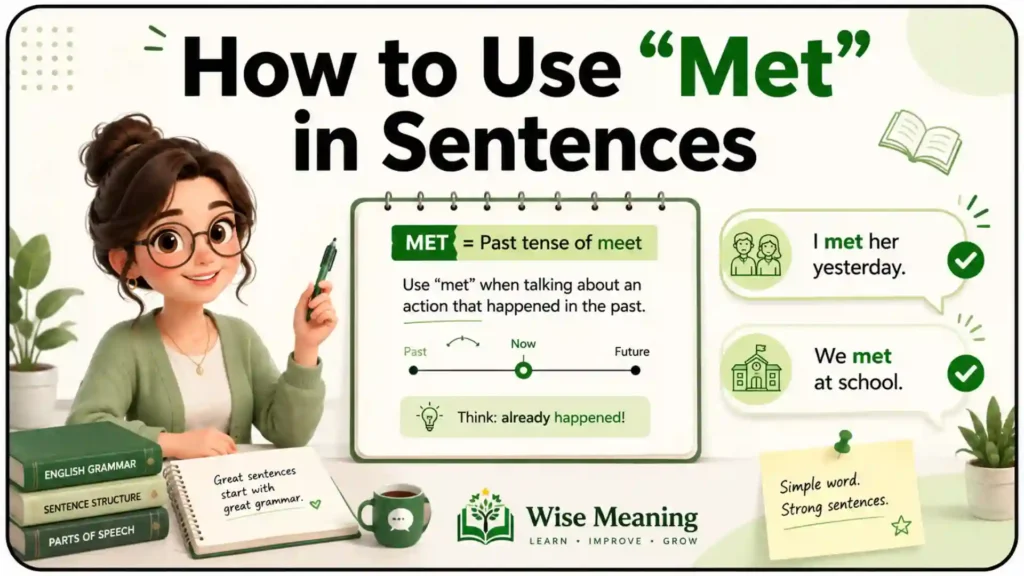
How to Use “Met” in Sentences
Met can describe more than meeting a person. The verb meet can also refer to holding a meeting, reaching a requirement, satisfying expectations, or completing a target or deadline.
Meeting a Person
Use met when two or more people came together in the past.
- I met Daniel at college.
- She met her new neighbor yesterday.
- We met for the first time in London.
You Might Also Like That: Good Communication
Meetings and Events
Met can also describe people gathering for a discussion or event.
- The committee met on Tuesday.
- The team met to discuss the project.
- We met after work to plan the trip.
Deadlines, Requirements, and Expectations
The verb also means to satisfy or fulfill something.
- The team met the deadline.
- She met all the requirements.
- The product met our expectations.
- The company met its annual target.
These examples show that met remains the correct past form regardless of which meaning of meet is being used.
Common Mistakes With Meet and Met
Most mistakes happen when someone adds -ed to meet or uses met after an auxiliary verb that requires the base form.
| Incorrect | Correct |
| I meeted him yesterday. | I met him yesterday. |
| Did you met her? | Did you meet her? |
| I didn’t met him. | I didn’t meet him. |
| I have meet her before. | I have met her before. |
| We had meet already. | We had met already. |
⚠️ The easiest way to avoid these errors is to look at the helping verb. After did/didn’t, use meet. After have/has/had, use met.
Which Form of Meet Should You Use?
The correct form depends on the grammar around the verb and when the action happens.
| Situation | Correct Form | Example |
| Present/base form | meet | I meet her every week. |
| Completed past | met | I met her yesterday. |
| Past question | meet | Did you meet her? |
| Past negative | meet | I didn’t meet her. |
| Present perfect | met | I have met her before. |
| Past perfect | met | I had met her earlier. |
| Continuous form | meeting | We were meeting every week. |
💡 A simple way to remember the pattern is:
Meet today → Met yesterday → Have met before
If did appears, use meet. If have, has, or had appears, use met.
FAQs About the Past Tense of Meet
Is “Met” Both the Past Tense and Past Participle of Meet?
Yes. Met is both the simple past and past participle of meet. For example, “I met her yesterday” uses the simple past, while “I have met her before” uses met as the past participle.
What is the past tense of meet?
The past tense of meet is “met.” For example: “I met my friend yesterday.” The verb forms are meet – met – met.
Do you say meet or met?
Use meet for the present or base form and met for the past. For example, “I meet my colleagues every Monday” is present, while “I met them yesterday” is past.
What are the 3 forms of meet?
The three main forms are meet (V1), met (V2), and met (V3). “Meet” is the base form, “met” is the past tense, and “met” is the past participle.
Have we meet or met?
The correct phrase is “Have we met?” After have, use the past participle met, not “meet.” Example: “Have we met before?”
Should I use “had met” or “have met”?
Use “have met” when connecting a past experience to the present, such as “I have met her before.” Use “had met” when one past meeting happened before another past event: “I had met her before the conference.”
What is the present tense of meet?
The present/base form is meet. Examples include “I meet my team every week” and “They meet at noon.”
What is the past tense of “meet up”?
The past tense of meet up is met up. Example: “We met up at the café yesterday.”
How is the past tense of meet pronounced?
Met is pronounced /met/, rhyming with “set” and “get.” It has a short e sound.
What is the V2 form of meet?
The V2 form of meet is “met.” The complete pattern is meet (V1) → met (V2) → met (V3).
What Are the V1, V2, and V3 Forms of Meet?
The three main forms are meet – met – met. V1 is the base form, V2 is the simple past, and V3 is the past participle.
Is “Meeted” Ever Correct?
Meeted is not the standard past tense of meet. Use met instead. However, meted is a real word from the separate verb mete, as in “meted out a punishment.”
Is It “Nice to Meet You” or “Nice to Met You”?
“Nice to meet you” is correct. After to in this expression, English uses the base form meet, not the past form met.
What Is the Past Tense of “Meet and Greet”?
The usual past form is met and greeted.
Example:
- We met and greeted the guests at the entrance.
Both verbs change according to their own past-tense forms: meet → met and greet → greeted.
Final Takeaway
The meet past tense is easy to remember once you know the main pattern:
Meet → Met → Met
Use met for a completed past action and after have, has, or had. Use meet after did or didn’t.
📌 Quick reminder:
- I met her yesterday.
- Did you meet her?
- I didn’t meet her.
- I have met her before.
If you remember those four patterns, you can handle most common uses of meet and met correctly.

![Sic Meaning_ What Does [sic] Mean in Text, Writing, and Quotes](https://wisemeaning.com/wp-content/uploads/2026/08/Sic-Meaning_-What-Does-sic-Mean-in-Text-Writing-and-Quotes-120x120.webp)