
Knowing the correct past tense of see can seem confusing because the verb does not follow the usual -ed pattern. Many learners also wonder whether the correct form is saw or seen. The simple answer is clear: the past tense of see is saw, while seen is the past participle of see. These forms have different jobs in English grammar.
In this guide, we will explain see, saw, and seen in simple language. You will learn when to use saw, when to use seen, how to form questions and negative sentences, and why phrases such as “I seen it” or “Did you saw it?” are incorrect in standard English.
Quick Answer
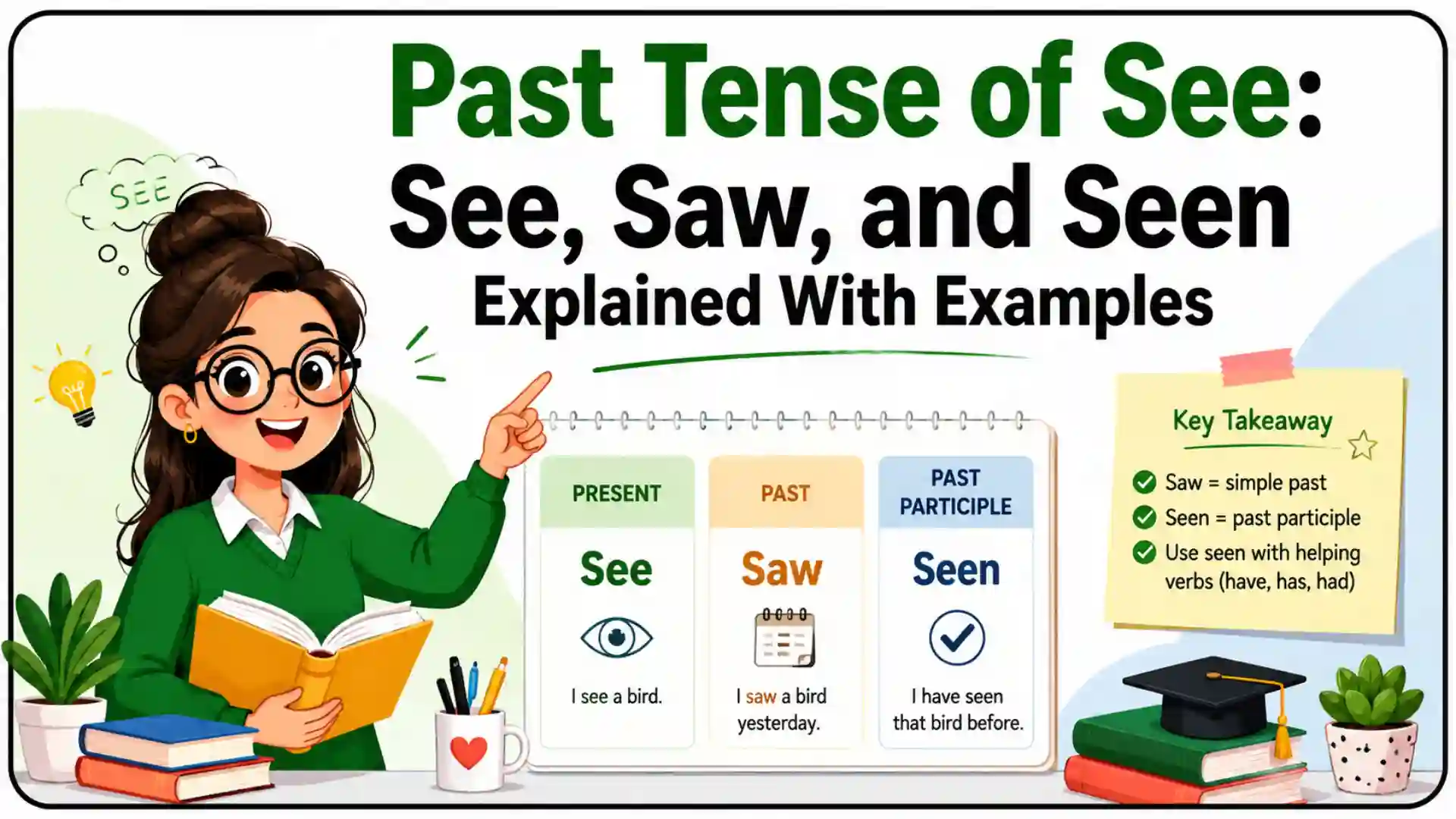
The past tense of “see” is “saw.” The verb follows an irregular pattern: see → saw → seen. Use saw for a completed action in the past, such as “I saw her yesterday.” Use seen as the past participle, usually with a helping verb such as have, has, or had, as in “I have seen her before.” Remember that “Did you see?” is correct, not “Did you saw?”, because did already shows the past tense.
TL;DR
- See → Saw → Seen is the basic verb pattern.
- Saw is the simple past tense of see.
- Seen is the past participle of see.
- Use saw for a completed past action: “I saw him yesterday.”
- Use seen with a helping verb: “I have seen him before.”
- Say “Did you see?”, not “Did you saw?”
- Say “I saw it”, not “I seen it” in standard English.
- Remember: see = present, saw = past, seen = past participle.
You Might Also Like That: Good Communication
What Is the Past Tense of See?
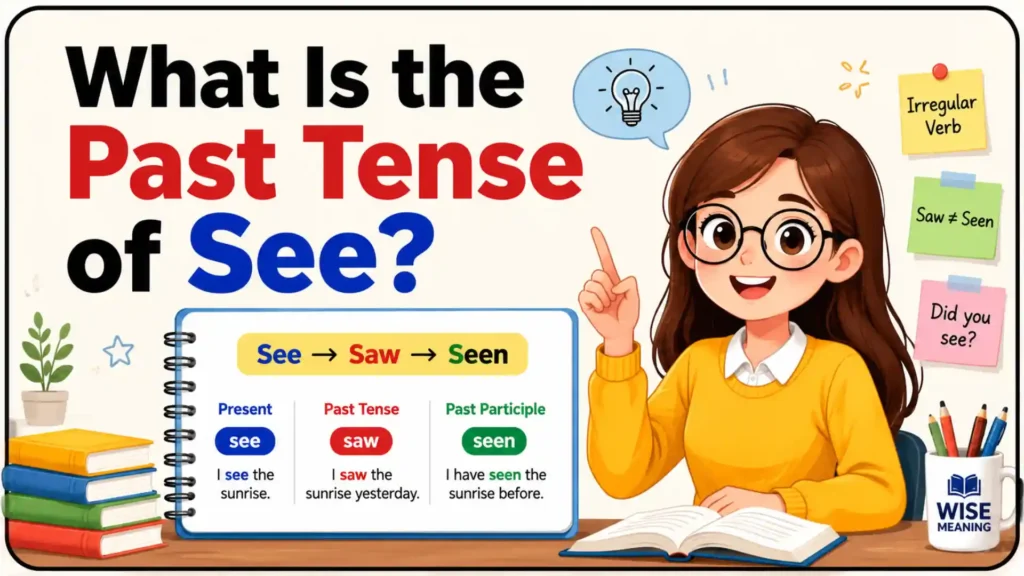
The past tense of “see” is “saw.” The verb see is an irregular verb, so it does not become seed by adding -ed. Instead, its simple past form changes completely to saw. We use saw when we describe an action that happened and finished in the past.
For example, “I saw my teacher yesterday” tells us that the seeing happened yesterday. The basic verb forms are see → saw → seen. Remember that saw expresses the simple past, while seen works as the past participle. This distinction helps prevent many common grammar mistakes.
See, Saw, and Seen: The Three Forms of See
The three main verb forms of see are see, saw, and seen. We use see as the base or present form, saw as the simple past, and seen as the past participle. You may also see sees with he, she, or it, and seeing as the present participle.
| Verb Form | Word | Example |
| Base/Present | see | I see the park. |
| Third-person present | sees | She sees the park. |
| Simple past | saw | I saw the park yesterday. |
| Present participle | seeing | We are seeing the park now. |
| Past participle | seen | I have seen the park before. |
This see saw seen pattern is one of the most important things to remember.
Is Saw the Past Tense of See?
Yes, saw is the past tense of see. When you need the simple past of see, use saw. English calls see an irregular verb because it does not form its past tense with the regular -ed ending. Compare walk → walked with see → saw.
The change in form may feel unusual, but it follows the normal pattern of an irregular verb. For example, you can say “I saw a bird in the garden,” “She saw her friend at school,” or “We saw the movie last night.” All three sentences describe completed actions that happened in the past.
When to Use Saw
Use saw when you describe a completed action at a definite time in the past. Common time expressions include yesterday, last night, last week, two days ago, and in 2020. For example, “I saw him yesterday” clearly places the action in the past.
You can also use saw in questions and negative sentences, but remember an important rule: after did or did not, use the base verb see, not saw. For example, say “Did you see the doctor?” and “I did not see her.” This rule makes past-tense questions and negatives much easier to form correctly.
When to Use Seen
Seen is the past participle of see, not the simple past form. In most standard English sentences, seen needs a helping verb or auxiliary verb such as have, has, or had. For example, “I have seen that movie,” “She has seen the report,” and “They had seen the warning before they left.”
The form seen often appears in perfect tenses, such as the present perfect and past perfect. A common mistake is to use seen by itself as the past tense. Instead of saying “I seen him yesterday,” use “I saw him yesterday.” Use seen with the appropriate helping verb.
Saw vs. Seen: What Is the Difference?
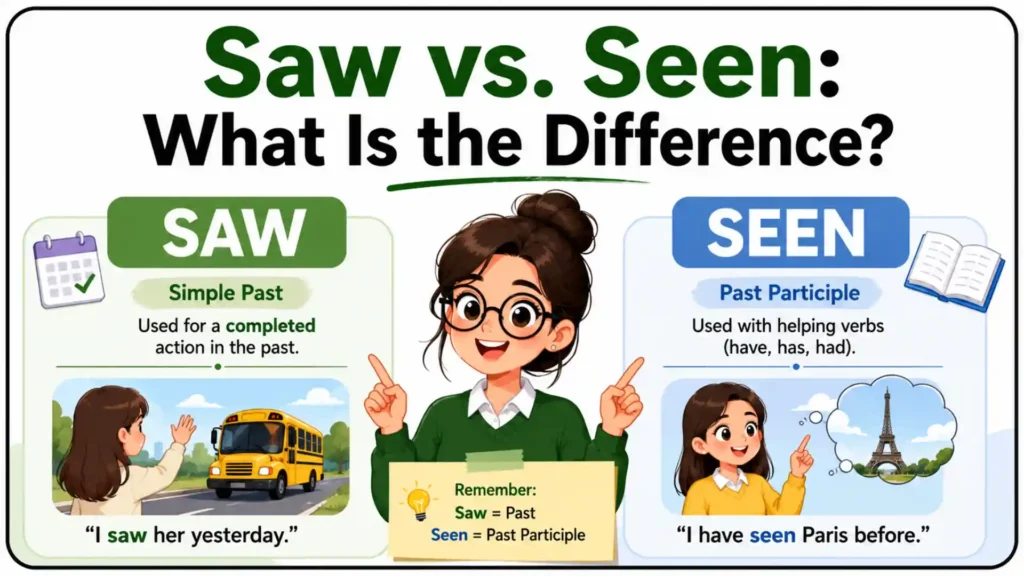
The easiest way to understand saw vs. seen is to remember this rule: saw = simple past, while seen = past participle. Use saw for a completed past action: “I saw Sarah yesterday.” Use seen with a helping verb: “I have seen Sarah before.”
You Might Also Like That: Snow Bunny Meaning
These forms do not normally replace each other. Compare “He saw the film last night” with “He has seen the film before.” The first sentence uses the simple past for a finished event at a specific past time. The second uses the present perfect for an experience connected to the present. This difference explains most saw or seen questions.
I Saw vs. I Have Seen
“I saw” and “I have seen” can both describe seeing something, but they show different time ideas. Use I saw when you focus on a completed past event, especially with a finished time such as yesterday, last week, or two hours ago.
Use I have seen when you talk about past experience without giving a finished past time, or when the experience connects to the present. For example, “I saw that movie last night” gives a specific past time, while “I have seen that movie before” talks about experience. Understanding this contrast makes the past tense and past participle of see much easier.
Did You See or Did You Saw?
The correct question is “Did you see?”, not “Did you saw?” This rule often confuses English learners because did already shows the past tense. After did, use the base form of the verb, which is see.
For example, say “Did you see John yesterday?”, “Did she see the message?”, or “Did they see the accident?” Do not say “Did you saw John?” in standard English. The same rule applies to negative sentences: “I did not see him” is correct, while “I did not saw him” is incorrect. Remember the pattern: did + see, not did + saw.
Is “I Seen It” Correct?
In standard English, “I seen it” is not the correct way to use the past tense of see. The correct sentence is “I saw it.” The word seen is a past participle, so it normally needs a helping verb. For example, you can say “I have seen it,” “I had seen it,” or “She has seen it.” Therefore, compare these forms:
“I saw it yesterday” ✅, “I have seen it before” ✅, and “I seen it yesterday” ❌. Some dialects may use seen differently in informal speech, but learners should follow standard English in formal writing, schoolwork, and professional communication.
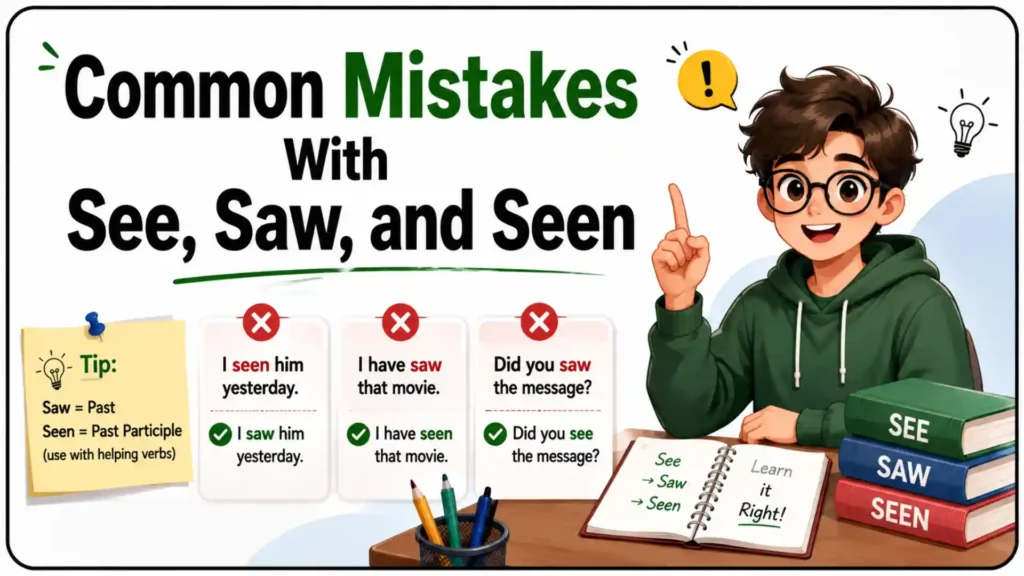
Common Mistakes With See, Saw, and Seen
Learners often make mistakes when they confuse the simple past with the past participle. One common error is “I seen him yesterday,” which should be “I saw him yesterday.” Another is “I have saw that movie,” which should be “I have seen that movie.”
You should also avoid “Did you saw her?” and use “Did you see her?” The same pattern applies to had: say “I had seen it before,” not “I had saw it.” A useful memory trick is simple: see = present, saw = simple past, seen = past participle. Keeping this three-part pattern in mind can prevent most errors.
You Might Also Like That: FYI Meaning
Past Tense of See in Different Sentence Types
You can use see and saw in several sentence structures. In an affirmative sentence, say “I saw the doctor yesterday.” For a negative sentence, use did not + see: “I did not see the doctor.” For a question, use did + see: “Did you see the doctor?”
You can also use seen in perfect constructions: “I have seen the doctor before.” These patterns show how the verb changes depending on the structure. The key is to remember that saw works directly as the simple past, while see returns after did. This makes questions and negatives much easier to build.
See in Other Tenses
Although the main question concerns the past tense of see, knowing a few other forms can help you understand the verb better.
| Tense | Example |
| Present | I see her every day. |
| Simple past | I saw her yesterday. |
| Present perfect | I have seen her before. |
| Past perfect | I had seen her earlier. |
| Present continuous | I am seeing her today. |
| Past continuous | I was seeing her regularly. |
| Future | I will see her tomorrow. |
These examples show why see saw seen is only part of the full verb system. The correct form depends on the tense and sentence structure. Learning these patterns also helps you use the verb naturally instead of memorizing one form by itself.
See, Saw, Seen Quick Reference Chart
Use this chart whenever you need a fast reminder of the see verb forms:
| Form | Correct Word | Basic Use | Example |
| Base form | see | Present / after did | Did you see him? |
| Present | see | I/you/we/they | We see him often. |
| Third-person present | sees | he/she/it | She sees him daily. |
| Simple past | saw | Completed past action | I saw him yesterday. |
| Present participle | seeing | Continuous forms | We are seeing him now. |
| Past participle | seen | Perfect forms | I have seen him before. |
The most important line is see → saw → seen. If you remember that sequence and the role of each form, you can answer most questions about the past form of see correctly.
Frequently Asked Questions About the Past Tense of See
What is the past tense of see?
The past tense of see is saw.
What is the past tense of see?
The past tense of see is “saw.” Example: “I saw my teacher yesterday.” The three main forms are see – saw – seen.
What are the 3 forms of see?
The three forms are see (V1), saw (V2), seen (V3). “See” is the base form, “saw” is the simple past, and “seen” is the past participle.
You Might Also Like That: Plurals of Ox and Fox Explained
Is it “I saw” or “I seen”?
The correct simple past form is “I saw.” You normally cannot use “seen” alone as the simple past. For example, say “I saw the movie yesterday,” not “I seen the movie yesterday.”
Is “seen” or “saw” correct?
Both are correct but used differently. Saw is the simple past, while seen is the past participle and normally follows an auxiliary verb such as have, has, or had. Example: “I saw her” vs. “I have seen her.”
What is the difference between see and saw?
See is the present/base form, while saw is the simple past form. Example: “I see him every day” and “I saw him yesterday.”
What is the past participle of see?
The past participle of see is “seen.” It is used with auxiliary verbs: “I have seen that movie” or “She had seen the message.”
What is the simple past tense of see?
The simple past tense of see is “saw.” Example: “We saw a beautiful sunset last evening.”
How do you use “see” in the past perfect tense?
Use had seen for the past perfect. Example: “I had seen the movie before my friends recommended it.” The structure is had + seen.
Which is correct: “sees” or “see’s”?
Sees is correct when the subject is he, she, or it in the present tense: “She sees the doctor every month.” See’s is not the standard spelling for this verb form.
What is the past participle of see?
The past participle of see is seen.
Is saw the past tense of see?
Yes. Saw is the simple past form.
Is seen the past tense of see?
No. Seen is the past participle.
Should I say “Did you see” or “Did you saw”?
Say “Did you see?” because did takes the base verb.
Is “I seen it” correct?
Not in standard English when you mean the simple past. Say “I saw it.”
Should I say “I saw” or “I have seen”?
Use I saw for a completed past event and I have seen for a past experience or an action connected to the present.
What are the three forms of see?
The main forms are see, saw, seen.
Final Thought
Learning the past tense of see becomes simple when you remember the pattern see → saw → seen. The key is not only memorizing the forms but also understanding how each one works in a sentence.
Use saw for the simple past and seen with the correct helping verb in perfect constructions. Once you understand the difference between saw and seen, along with the rule did + see, you can use this irregular verb confidently in everyday, academic, and professional English.