

Have you ever wondered why the plural of ox is oxen, but the plural of fox is foxes? At first glance, both words seem similar, so it’s natural to expect them to follow the same grammar rule. However, English has a mix of regular plural nouns and irregular plural nouns, and these two animals are perfect examples of that difference. Understanding ox vs. fox plural rules can help you avoid common grammar mistakes and improve your writing.
In this guide, you’ll learn the plurals of ox and fox, the grammar rules behind each form, and why ox becomes oxen while fox becomes foxes. We’ll also explore the Old English plural pattern, compare oxen vs. foxes, share practical sentence examples, and explain why forms like oxes and foxen aren’t considered correct in modern English. By the end, you’ll know exactly what the plural of ox and fox is and how to use both words confidently in everyday writing and conversation.
Quick Answer
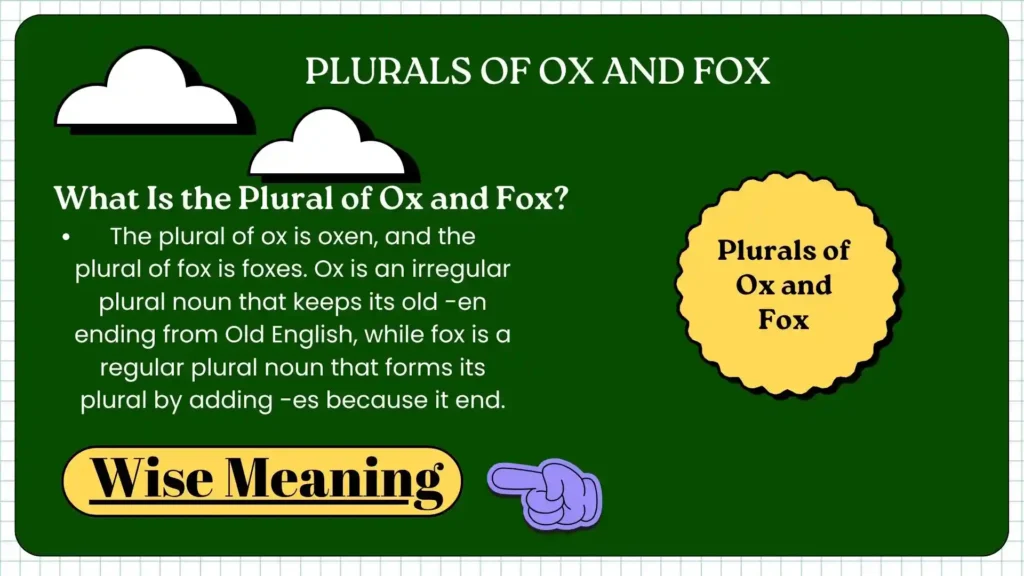
The plural of ox is oxen, and the plural of fox is foxes. Ox is an irregular plural noun that keeps its old -en ending from Old English, while fox is a regular plural noun that forms its plural by adding -es because it ends in -x. So, the correct forms are ox → oxen and fox → foxes.
TL:DR
If you only need the key takeaway, here’s the answer:
- ✅ Plural of ox = oxen
- ✅ Plural of fox = foxes
The word ox is an irregular noun, so it changes to oxen instead of adding -s or -es. In contrast, fox follows the standard English plural rule for words ending in -x, so its plural is foxes. Remember this simple rule: Ox → Oxen (irregular) and Fox → Foxes (regular). This will help you avoid common grammar mistakes and use both words correctly in writing and conversation.
You Might Also Like That: Grammar Meaning
What Is the Plural of Ox and Fox?
The Correct Plural Forms
The plural of ox is oxen, while the plural of fox is foxes. Although both words are animal names, they follow different English plural rules. Ox keeps an old plural form that has been used for centuries, whereas fox follows the standard rule for nouns ending in -x. If you’re ever unsure what is the plural of ox and fox, remember that oxen is the only correct plural for ox, and foxes is the correct plural for fox in both American and British English.
| 📝 Singular | ✅ Plural | 📚 Type |
| Ox | Oxen | Irregular |
| Fox | Foxes | Regular |
Why Do Ox and Fox Have Different Plural Forms?
Regular vs. Irregular Nouns
Many people ask, “Why is the plural of ox oxen but the plural of fox foxes?” The answer lies in the history of English. Ox is an irregular noun that kept its old -en ending from Old English. On the other hand, fox became part of the regular plural system, where words ending in -x simply add -es. This difference is why oxen vs. foxes follow separate grammar rules even though the words look similar.
You Might Also Like That: What Does WYF Mean
Grammar Rule Behind Ox → Oxen
Why Does Ox Become Oxen?
The word ox follows an old grammar pattern that is no longer common in modern English. Long ago, several nouns formed their plurals by adding -en, and oxen is one of the few that survived. This is why oxes is considered incorrect in standard English. Learning this grammar rule for ox and fox plurals helps you understand that not every noun follows the same pattern. Oxen remains the accepted plural in dictionaries, classrooms, and professional writing.
Grammar Rule Behind Fox → Foxes
Why Does Fox Become Foxes?
Unlike ox, the word fox follows a regular rule. When a noun ends in -x, you usually add -es to make it plural. That is why fox becomes foxes. The same rule applies to words like box, tax, mix, and fix. Since fox is a regular plural noun, there is no reason to use foxen. Remembering this simple rule makes it easier to form plurals for many similar English words.
Ox vs. Fox Plural Comparison
Side-by-Side Comparison
The table below makes it easy to understand the difference between oxen and foxes.
| 🐂 Singular | 🐂 Plural | 📖 Rule | ⭐ Type |
| Ox | Oxen | Uses the old -en ending | Irregular |
| Fox | Foxes | Add -es after -x | Regular |
Although both words describe animals, they belong to different grammar groups. Ox is a historical exception, while fox follows today’s standard English plural rules.
You Might Also Like That: Grammar Meaning
Sentence Examples Using Oxen and Foxes
Examples with Oxen
Reading examples is one of the easiest ways to remember correct grammar.
- 🐂 The oxen pulled the heavy cart across the field.
- 🐂 Two oxen worked together on the farm.
- 🐂 The farmer cared for his oxen every day.
Examples with Foxes
- 🦊 The foxes searched for food after sunset.
- 🦊 Several foxes were seen near the forest.
- 🦊 The foxes quickly disappeared into the trees.
These examples show how oxen and foxes are naturally used in everyday English.
Common Mistakes to Avoid
Incorrect vs. Correct Forms
Many English learners make mistakes because they try to apply one rule to every noun.
❌ Oxes
✅ Oxen
❌ Foxen
✅ Foxes
Another common mistake is thinking that ox and fox should have similar plurals because they rhyme. English grammar does not always work that way. Learning these differences helps you write more accurately and confidently.
Why Does English Have Irregular Plurals?
A Brief History
English has changed over hundreds of years. Many old plural forms disappeared, but a few remained in everyday use. Oxen is one of those surviving forms. Most modern nouns now follow the easier -s or -es pattern, but some words still keep their historical spelling. This is why English has both regular plural nouns and irregular plural nouns. Knowing a little history makes these grammar rules much easier to understand and remember.
You Might Also Like That: IYKYK Meaning
Regular vs. Irregular Plural Nouns
Understanding the Difference
Regular nouns follow simple spelling rules, while irregular nouns change in different ways.
| ✅ Regular Plurals | ⭐ Irregular Plurals |
| Box → Boxes | Ox → Oxen |
| Bus → Buses | Child → Children |
| Church → Churches | Goose → Geese |
| Brush → Brushes | Mouse → Mice |
| Dish → Dishes | Tooth → Teeth |
Learning these patterns helps you recognize regular and irregular plural nouns more quickly.
Words Ending in X That Take -ES
Similar Examples
The word fox is not the only noun ending in -x. Many similar words also take -es in the plural.
- 📦 Box → Boxes
- 🦊 Fox → Foxes
- 💰 Tax → Taxes
- 🔧 Fix → Fixes
- 🧪 Mix → Mixes
Whenever you see a noun ending in -x, adding -es is usually the correct grammar rule.
Is “Oxes” Ever Correct?
The Short Answer
No. In modern English, oxes is not accepted as the standard plural of ox. Dictionaries, grammar books, and style guides all recognize oxen as the correct form. While you might occasionally see oxes in informal writing or mistakes online, it should not be used in academic, professional, or everyday standard English. If you want to write correctly, always choose oxen.
Is “Foxen” a Real Word?
A Common Question
Some people wonder whether foxen is a real word because ox becomes oxen. In modern English, the answer is no. The correct plural is always foxes. Although foxen has appeared in old literature and playful writing, it is not considered standard English today. If you’re writing for school, work, or online content, always use foxes.
Quick Memory Trick
An Easy Way to Remember
Here is a simple trick to remember the correct plurals:
🧠 Ox = Old Rule = Oxen
🦊 Fox Ends in X = Add ES = Foxes
This quick memory tip makes it easy to recall the correct forms without thinking about complicated grammar rules. The more often you use these words in sentences, the easier they become to remember.
You Might Also Like That: Grammar Meaning
Frequently Asked Questions
What Is the Plural of Fox?
The plural of fox is “foxes.” Example: Two foxes were running through the field.
What Is the Plural Form of Ox?
The plural of ox is “oxen.” Example: The farmer kept several oxen on the farm.
What Are Two Ox Called?
Two or more ox are called oxen. For example: “Two oxen were pulling the cart.”
What Is the Collective Noun for Oxen?
A group of oxen can be called a team of oxen, especially when they work together. The exact term can depend on the context.
What Is the Plural of Ox and Goose?
The plural forms are ox → oxen and goose → geese. Both are irregular plurals because they do not simply take -s.
Is There a Plural for Ox?
Yes. The plural of ox is oxen. “Oxes” is not the usual standard plural in modern English.
What Is Oxen vs Ox?
Ox is the singular form, while oxen is the plural form. For example, “one ox” and “three oxen.”
What Are 5 Plural Nouns?
Five common plural nouns are cats, books, children, mice, and oxen. Some use regular endings, while others have irregular plural forms.
What Is the Plural of Sheep?
The plural of sheep is also sheep. For example, “one sheep” and “five sheep.”
What Is the Plural of Deer?
The plural of deer is usually deer. For example, “one deer” and “several deer.”
What Is the Plural of Mouse?
The plural of mouse is mice. For example, “one mouse” but “two mice.”
What Is the Plural of Fish?
The plural of fish is usually fish. Fishes can also be used when referring to different species of fish.
You Might Also Like That: IYKYK Meaning
Is “Foxen” Correct?
No. “Foxen” is not the standard plural of fox. The correct plural form is “foxes.”
Is It “2 Fox” or “2 Foxes”?
The correct form is “2 foxes.” Because fox is a countable noun, it normally takes the plural -es after a number greater than one.
Why Is the Plural of Ox “Oxen”?
Oxen is an irregular plural that comes from an older English plural pattern. Unlike regular nouns, ox does not form its plural by simply adding -s.
What Are the Singular and Plural Forms of Ox?
The singular is “ox,” while the plural is “oxen.”
You Might Also Like That: TS Meaning in Text
What Is the Plural of Fox and Ox in English?
In English, the plural forms are fox → foxes and ox → oxen. Fox has a regular plural ending, while ox has an irregular plural.
Are “Foxes” and “Oxen” Both Correct?
Yes. Foxes is the correct plural of fox, and oxen is the correct plural of ox.
Is “Oxes” Correct?
In standard English, the usual plural of ox is “oxen,” not “oxes.” Example: The oxen pulled the wagon.
What Is the Plural Possessive of Ox?
The plural possessive form is “oxen’s” when referring to something belonging to the oxen. Example: The oxen’s shelter was large.
What is the plural of fox?
The correct plural of fox is foxes.
Why is the plural of ox “oxen”?
Because ox follows an old Old English plural pattern that uses -en.
Why isn’t the plural of fox “foxen”?
Because fox follows the regular grammar rule for words ending in -x, so it becomes foxes.
Is “oxes” correct?
No. Oxen is the only correct plural in standard English.
Is “foxes” always correct?
Yes. Foxes is the accepted plural form in both American and British English.
Conclusion
The plurals of ox and fox are easy to remember once you understand the grammar behind them. Ox is an irregular plural noun, so its plural is oxen, while fox is a regular plural noun that becomes foxes by adding -es. Even though the words sound similar, they follow different rules because of the history of the English language.
Whenever you write or speak, remember this simple rule: Ox → Oxen and Fox → Foxes. By learning the difference between regular and irregular plural nouns, practicing with examples, and avoiding common mistakes like oxes or foxen, you’ll use these words correctly and confidently in every situation.