
Have you ever wondered what subjective means? The subjective meaning refers to something based on personal opinions, feelings, experiences, or beliefs rather than facts alone. For example, saying “Chocolate ice cream tastes the best” is a subjective opinion because everyone has different tastes.
Understanding the subjective definition helps you tell the difference between subjective and objective statements in everyday life. Whether you’re writing an essay, sharing your thoughts, or judging something, knowing how personal perspectives shape opinions can help you communicate clearly. In this guide, you’ll discover simple definitions, real-life examples, and practical ways to recognize subjective language.
📘 Quick Answer: What Does Subjective Mean?
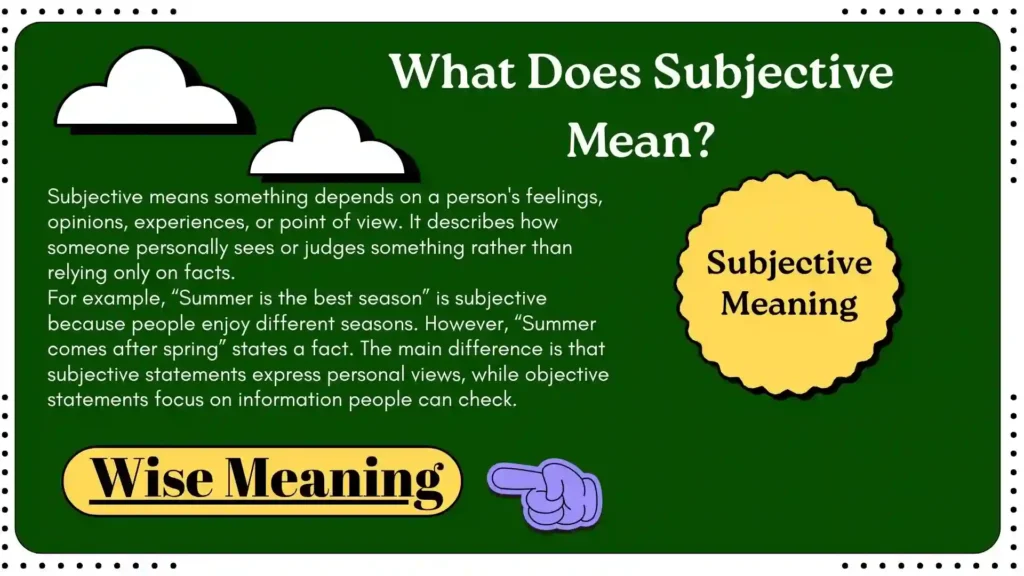
Subjective means something depends on a person’s feelings, opinions, experiences, or point of view. It describes how someone personally sees or judges something rather than relying only on facts.
For example, “Summer is the best season” is subjective because people enjoy different seasons. However, “Summer comes after spring” states a fact. The main difference is that subjective statements express personal views, while objective statements focus on information people can check.
📌 TL;DR: Subjective Meaning at a Glance
- 💭 Subjective meaning: Based on personal feelings, opinions, or experiences.
- ⚖️ Subjective vs. objective: Subjective expresses personal views; objective focuses on facts.
- ❤️ Subjective opinion: A personal judgment that others may not share.
- ✍️ Subjective writing: Writing that includes personal thoughts and interpretations.
- 🧠 Subjective experience: Something a person feels or experiences personally.
- 🎯 Easy example: “Pizza tastes amazing” is subjective because taste differs between people.
You Might Also Like That: KMS Meaning in Text
📖 Subjective Meaning in Simple Words
The subjective meaning in simple words is something that depends on how a person thinks or feels. People have different tastes, backgrounds, and experiences, so they may form different opinions about the same thing.
For example, one person might love rainy weather, while another finds it unpleasant. Both express subjective views because their statements reflect personal preferences. Subjective does not mean wrong. It simply means the judgment comes from an individual’s perspective rather than an agreed-upon standard.
📚 What Is the Definition of Subjective?
The subjective definition describes something influenced by personal feelings, opinions, or experiences. In English, subjective is an adjective that describes judgments, views, statements, and experiences.
🔊 Subjective Pronunciation and Word Forms
In American English, pronounce subjective as sub-JEK-tiv (/səbˈdʒek.tɪv/). Stress the second syllable.
| Word | Meaning |
| Subjective | Based on personal perspective |
| Subjectively | From a personal point of view |
| Subjectivity | The quality of being subjective |
| Subjectiveness | Another noun for subjective quality |
Example: “She judged the painting subjectively because she loved its colors.”
💭 What Makes Something Subjective?
Something becomes subjective when personal feelings, preferences, or experiences influence how someone describes or judges it. Two people can observe the same thing but reach different conclusions.
For example, one student may find a math test easy, while another finds it difficult. Their experiences shape their judgments. Neither opinion alone proves how difficult the test is for everyone.
- ❤️ Feelings: Happiness, sadness, excitement
- 🎨 Preferences: Favorite colors, food, music
- 🧠 Experiences: Personal memories and reactions
- 💬 Beliefs: Individual ideas and values
🌟 30 Subjective Examples in Everyday Life
Subjective examples appear in daily conversations, reviews, schoolwork, and personal decisions. They show how people describe the world through their own experiences.
🍕 Subjective Opinions About Food and Music
- Pizza tastes better than burgers.
- Chocolate is the best dessert.
- Jazz music sounds relaxing.
- This soup tastes too salty.
- Rock music is more exciting.
- Coffee smells wonderful.
- Vanilla ice cream tastes boring.
- This restaurant serves delicious food.
- That song sounds beautiful.
- Spicy food tastes amazing.
🎓 Subjective Statements at School and Work
- Math is the hardest subject.
- This lesson is interesting.
- Our teacher explains things well.
- Homework feels stressful.
- Reading is more fun than writing.
- This office looks beautiful.
- Monday is the worst workday.
- This project feels easy.
- Group work is enjoyable.
- That presentation was excellent.
🎬 Subjective Examples in Reviews
- This movie is amazing.
- The ending was disappointing.
- That actor gave a great performance.
- This book is boring.
- The hotel feels comfortable.
- This phone looks stylish.
- The game is exciting.
- That dress looks elegant.
- The painting is beautiful.
- This vacation was unforgettable.
These subjective statements express personal judgments that other people may not share.
⚖️ Subjective vs. Objective: Key Differences
The main difference between subjective and objective lies in how people support their statements. Subjective statements express personal opinions or experiences. Objective statements focus on facts that people can check through evidence.
A subjective opinion can still have good reasons behind it. However, objective claims depend on information that others can independently verify.
| Subjective statement 💭 | Objective statement 📊 |
| This cake tastes delicious. | This cake contains chocolate. |
| The movie is boring. | The movie lasts 120 minutes. |
| Blue is the prettiest color. | The sky often appears blue. |
| Math is difficult. | Two plus two equals four. |
| This bag is expensive. | This bag costs $100. |
🔍 How to Tell if a Statement Is Subjective
You can identify a subjective statement by checking whether it expresses someone’s personal judgment. Words such as best, beautiful, boring, delicious, and amazing often signal subjective language.
However, these words alone do not always settle the question. You must examine what the statement claims and how someone could support it.
🧠 Look for Personal Judgment
Ask yourself whether two people could reasonably disagree because of their preferences or experiences.
📊 Check Whether the Claim Can Be Tested
Ask whether reliable evidence could confirm the claim. If it describes a measurable fact, it is usually objective.
Example: “The room feels cold” describes a personal experience. “The room temperature is 65°F” reports a measurable condition.
🔄 Can a Statement Be Both Subjective and Objective?
Yes! A sentence can contain both subjective and objective information. This happens when someone combines a personal judgment with a fact.
For example, “This beautiful house has four bedrooms” includes two kinds of information. Beautiful expresses a subjective opinion, while four bedrooms describes a fact someone can check.
Consider another example: “The expensive phone costs $900.” The price is objective, but calling the phone expensive depends on a person’s budget and expectations.
Recognizing these mixed statements helps you separate personal interpretation from factual details.
🤔 Is Subjective the Same as Biased?
Subjective and biased are related words, but they do not mean exactly the same thing. Subjective describes a personal point of view. Biased describes a preference or influence that may prevent someone from judging fairly.
For example, saying “I prefer cats to dogs” expresses a subjective preference. However, giving a friend’s work a higher score only because they are your friend may show bias.
A subjective opinion can be thoughtful and fair. Personal experiences influence many judgments, but that influence does not automatically make them unfair or unreliable.
✅ Can a Subjective Opinion Be True?
A subjective opinion can accurately describe someone’s personal experience. For example, “I feel nervous before exams” may truthfully describe how that person feels, even though another student feels confident.
However, personal opinions do not automatically prove claims about everyone. Saying “This is the best school in America” requires clear standards and evidence before anyone can judge the claim.
Remember that subjective does not mean false. It means personal perspective plays an important role. Some subjective judgments also draw on strong facts and careful reasoning.
✍️ How to Make Subjective Writing More Objective
You can make subjective writing more objective by replacing vague opinions with specific, checkable information. This approach helps readers understand the reasons behind your statements.
For example, instead of writing “The restaurant is terrible,” explain what happened: “Our food arrived 40 minutes after we ordered.” The second sentence gives readers a specific detail.
📝 Replace Vague Opinions With Specific Details
| Subjective writing | More objective writing |
| The room is huge. | The room measures 300 square feet. |
| The test was hard. | The test included 50 questions. |
| The car is fast. | The car reached 60 mph in 5 seconds. |
| The book is long. | The book contains 600 pages. |
📊 Separate Evidence From Personal Interpretation
Present the facts first, then explain your opinion. This keeps your writing clear without removing your personal voice.
🌍 When Is Subjective Information Useful?
Subjective information helps people understand feelings, preferences, and personal experiences. It matters when facts alone cannot explain what someone likes, dislikes, or experiences.
For example, customer reviews tell businesses how people feel about their products. Teachers use student feedback to understand classroom experiences. Friends share personal opinions when recommending books or movies.
Subjective information also supports creative writing, interviews, and surveys. Although personal views may differ, they can still provide useful insights.
Key point: Use subjective information to understand people’s experiences, and use objective evidence to check factual claims.
🧠 Subjective Meaning in Different Subjects
The word subjective appears in several academic subjects. Its main idea remains connected to personal experience, but each subject uses the term differently.
✍️ Subjective Meaning in Writing and Psychology
In writing, subjective language expresses opinions, feelings, and personal interpretations. In psychology, subjective experience refers to what someone personally feels or perceives, such as happiness, discomfort, or fear.
📚 Subjective Meaning in Philosophy and Grammar
In philosophy, subjective often describes experiences or judgments connected to an individual’s perspective.
In grammar, the subjective case, also called the nominative case, describes pronouns that serve as sentence subjects.
Example: “She enjoys reading.” Here, she is a subject pronoun.
📗 Subjective Synonyms, Antonyms, and Word Forms
Learning subjective synonyms and antonyms helps you choose accurate words in different situations. Some related terms describe personal viewpoints, while others suggest stronger judgment or bias.
| Synonyms or related words | Antonyms or contrasting words |
| Personal | Objective |
| Individual | Impersonal |
| Opinion-based | Fact-based |
| Interpretive | Factual |
| Biased (in some contexts) | Unbiased |
| Personal-perspective-based | Evidence-based |
Example: “Her review was subjective because she focused on her personal experience.”
Use biased carefully. It can suggest unfair judgment, while subjective does not necessarily carry that meaning.
🚫 Common Mistakes When Using Subjective
People sometimes confuse subjective meaning with false information, unfair judgment, or emotional behavior. These ideas can overlap, but they are not identical.
Avoid these common mistakes:
- ❌ Subjective means wrong: Personal experiences can be genuine.
- ❌ Subjective means biased: A personal viewpoint is not always unfair.
- ❌ Subjective means emotional: Personal judgments can involve careful thinking.
- ❌ Objective means everyone agrees: People can disagree about facts.
- ❌ Opinions never need evidence: Strong opinions often use facts and reasoning.
Memory trick: Subjective focuses on the subject, or the person experiencing something. Objective focuses on the object of examination and evidence.
📝 Subjective vs. Objective Practice Quiz
Test your understanding of subjective and objective statements with these quick questions.
Choose subjective or objective:
- Chocolate tastes better than vanilla.
- Earth travels around the Sun.
- This movie is boring.
- Water freezes at 32°F under standard atmospheric pressure.
- Summer is the best season.
- The book contains 250 pages.
- That painting looks beautiful.
- The meeting started at 9 AM.
- This chair feels uncomfortable.
- A triangle has three sides.
✅ Answer Key
| Question | Answer |
| 1 | Subjective |
| 2 | Objective |
| 3 | Subjective |
| 4 | Objective |
| 5 | Subjective |
| 6 | Objective |
| 7 | Subjective |
| 8 | Objective |
| 9 | Subjective |
| 10 | Objective |
Tip: Look for personal feelings or judgments. Then ask whether someone could check the claim using evidence.
❓ Frequently Asked Questions About Subjective
What does subjective mean in simple terms?
Subjective means something depends on personal feelings, opinions, or experiences rather than only on independently checkable facts.
What is an example of subjective?
“Winter is the most beautiful season” is subjective because people have different preferences.
What is the difference between subjective and objective?
Subjective describes personal perspectives. Objective describes judgments or information based on facts and evidence.
Is subjective a fact or an opinion?
Subjective statements often express opinions, but they can also describe genuine personal experiences.
Does subjective mean biased?
No. Subjective means personal, while biased suggests an influence that may affect fairness.
Can subjective statements be true?
Yes. A statement about someone’s genuine feelings can be accurate even when others have different experiences.
What is subjective meaning in psychology?
In psychology, subjective experience describes how a person personally feels, thinks, or perceives something.
How do you use subjective in a sentence?
You could say, “Her opinion about the movie was subjective because she judged it through her personal taste.”
🎯 Final Thoughts
Understanding the subjective meaning and definition helps you recognize the difference between personal opinions and objective facts. Subjective statements reflect individual feelings, experiences, and viewpoints, while objective statements focus on information people can verify.
Both types of information matter in everyday communication. When you understand subjective vs. objective, you can express your opinions more clearly, evaluate information carefully, and choose the right words for your writing. Remember, a subjective opinion is not automatically wrong—it simply reflects a personal perspective.