
Have you ever expected one thing to happen, but the exact opposite occurred? That situation may involve irony. The simple irony meaning is a contrast between what someone says and means, what people expect and what happens, or what an audience knows and what a character knows. For example, a fire station catching fire can show situational irony because it contrasts with the station’s purpose.
Understanding what is irony becomes easier when you explore real-life situations. In this guide, you’ll discover the meaning of irony, its three main types—verbal irony, situational irony, and dramatic irony—and clear irony examples. You’ll also learn the difference between irony and sarcasm, how irony works in literature, and how to recognize it in everyday conversations.
⚡ Quick Answer: What Is Irony?
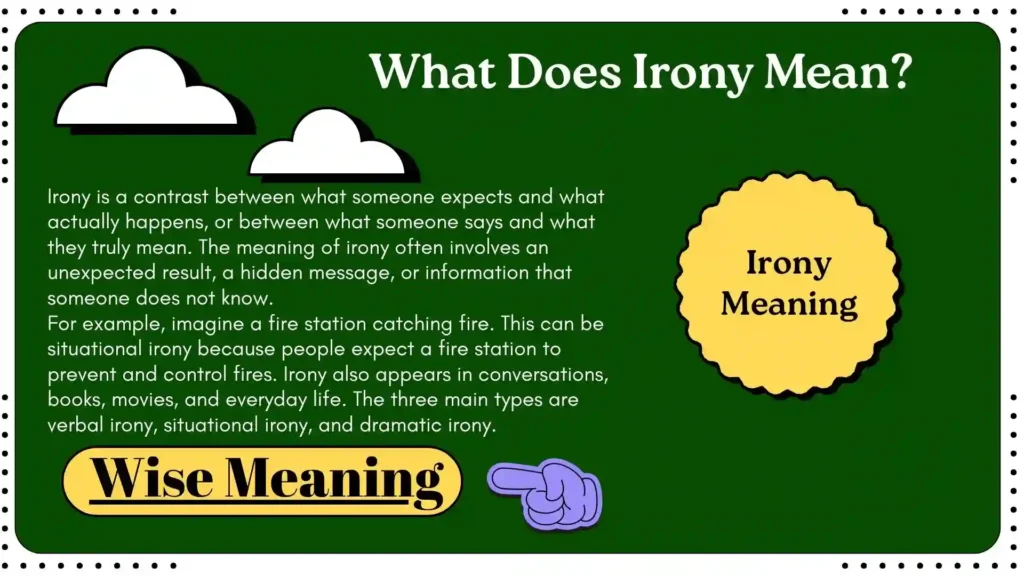
Irony is a contrast between what someone expects and what actually happens, or between what someone says and what they truly mean. The meaning of irony often involves an unexpected result, a hidden message, or information that someone does not know.
For example, imagine a fire station catching fire. This can be situational irony because people expect a fire station to prevent and control fires. Irony also appears in conversations, books, movies, and everyday life. The three main types are verbal irony, situational irony, and dramatic irony.
📌 TL;DR: Irony Meaning at a Glance
Irony meaning becomes easier to understand when you focus on the difference between expectations and reality.
- 🎯 Irony: A meaningful contrast between what people expect and what happens, or between words and their intended meaning.
- 💬 Verbal irony: Someone says something but means something different, often the opposite.
- 🔄 Situational irony: An event contrasts sharply with what people reasonably expect.
- 🎭 Dramatic irony: The audience knows something important that a character does not.
- 😏 Sarcasm: A form of verbal expression that often uses irony to mock or criticize.
- 📚 Irony examples: Common in literature, conversations, movies, and everyday situations.
You Might Also Like That: WYA Meaning
📖 What Is Irony? Meaning in Simple Words
The irony definition describes a situation or statement that creates a meaningful contrast. In simple words, irony happens when reality differs from expectations or when words carry a different intended meaning. People use irony to create humor, express feelings, or highlight surprising truths.
For example, imagine a swimming instructor who fears water. The contrast between the instructor’s job and personal fear may create situational irony. However, not every unusual event is ironic. True irony usually involves a clear connection between the expectation and the unexpected reality.
🔍 How Does Irony Work?
Irony works through contrast. It makes readers or listeners notice a difference between what they believe should happen and what actually happens. This difference can create humor, surprise, sadness, or suspense.
For example, a person might spend hours preparing a speech about being organized but forget to bring their notes. The result contrasts with the message of the speech.
🧠 Three Elements That Help Create Irony
- Expectation: What someone reasonably believes.
- Reality: What actually happens.
- Contrast: The meaningful difference between the two.
These elements help explain many examples of situational irony, although verbal and dramatic irony work differently.
🎭 The Three Main Types of Irony
Writers and teachers commonly explain three main types of irony: verbal, situational, and dramatic. Each type creates a different kind of contrast. Understanding these differences helps you identify irony in literature, movies, and real conversations.
The following table explains the types of irony with simple examples. Remember that the same story can contain more than one type. Writers often combine them to create humor, tension, or surprising endings.
| Type | Meaning | Simple Example |
| 💬 Verbal irony | Words differ from intended meaning | Saying “Lovely weather!” during a storm |
| 🔄 Situational irony | Reality contrasts with expectations | A fire station catches fire |
| 🎭 Dramatic irony | Audience knows more than a character | Viewers know a character is walking into a trap |
💬 Verbal Irony: Meaning and Examples
Verbal irony happens when someone says something but intends a different meaning, often the opposite. People use it in conversations, jokes, and stories. Their tone or the situation usually helps others understand the hidden message.
For example, imagine someone arriving completely soaked after walking through heavy rain. Their friend says, “What beautiful weather!” The friend clearly does not mean the weather is beautiful.
🗣️ Verbal Irony Examples
- “Great timing!” when someone arrives very late.
- “What a peaceful place!” inside a noisy room.
- “That went perfectly!” after a plan fails.
Verbal irony does not always involve sarcasm or criticism.
🔄 Situational Irony: Meaning and Examples
Situational irony occurs when an event produces a result that sharply contrasts with what people reasonably expect. The outcome often connects directly to the purpose, role, or actions involved in the situation.
For example, imagine a professional burglar installing expensive security equipment at home, only to lose their own valuables to a thief. The contrast between the burglar’s actions and personal experience creates situational irony.
🌟 Situational Irony Examples
- A fire station catches fire.
- A traffic safety instructor receives a ticket for reckless driving.
- A professional cleaner has an extremely messy home.
Each example works because the result contrasts with an important expectation.
🎬 Dramatic Irony: Meaning and Examples
Dramatic irony happens when readers or viewers know important information that a character does not. Writers use this technique to create suspense, humor, fear, or sadness.
For example, imagine watching a movie where the audience sees a thief hiding behind a door. The main character enters the room without knowing the danger. Viewers understand the situation before the character does.
📚 Dramatic Irony Examples
- Viewers know a character’s friend is secretly an enemy.
- Readers know a letter contains false information, but its recipient trusts it.
- An audience knows two characters love each other while both believe their feelings are unreturned.
🌎 20 Everyday Examples of Irony
Irony in everyday life often appears in workplaces, schools, conversations, and unexpected situations. Some examples make people laugh, while others reveal serious problems.
To recognize real-life examples of irony, look for a meaningful contrast rather than an ordinary surprise. The examples below illustrate situations that can be ironic when the surrounding circumstances support the contrast.
🏠 Everyday Situations
- A fire station catches fire.
- A dentist forgets to brush their teeth.
- A professional organizer constantly loses important documents.
- A swimming coach fears swimming.
- A driving instructor repeatedly breaks traffic rules.
- A weather expert forgets an umbrella during a storm.
- A computer security expert falls for a basic online scam.
- A spelling teacher misspells the word spelling.
- A fitness trainer refuses to exercise.
- A restaurant known for fast service becomes famous for long delays.
💬 Ironic Statements
- “Wonderful!” after dropping a birthday cake.
- “Perfect weather!” during heavy rain.
- “You’re so early!” when someone arrives an hour late.
- “What a quiet room!” during a loud party.
- “Excellent planning!” after someone forgets the tickets.
- “This is relaxing!” while standing in a crowded line.
- “Great job!” after someone accidentally deletes a file.
- “How convenient!” when an elevator breaks.
- “That was easy!” after struggling for hours.
- “What a lovely surprise!” after discovering an unwanted mess.
Remember: Tone and context determine whether these statements express genuine praise or verbal irony.
📚 Irony in Literature, Movies, and Stories
Irony in literature helps writers create tension, humor, and emotional moments. Authors often use dramatic irony when readers understand a secret that characters have not discovered. They may also use situational irony to create meaningful twists.
In Shakespeare’s Romeo and Juliet, the audience knows Juliet is not truly dead, but Romeo believes she has died. This creates dramatic irony and contributes to the tragedy.
🎥 Why Writers Use Irony
- Suspense: Readers know danger is approaching.
- Humor: Events or statements create amusing contrasts.
- Emotion: Characters act without knowing important truths.
- Meaning: Unexpected outcomes reveal deeper ideas.
Irony can make a story more memorable.
😏 Irony vs. Sarcasm: What’s the Difference?
Irony and sarcasm often appear together, but they do not mean exactly the same thing. Irony involves a contrast between words, expectations, or knowledge. Sarcasm usually expresses mockery, criticism, or sharp humor.
For example, someone might say, “Fantastic job!” after a coworker makes a careless mistake. The statement can express both verbal irony and sarcasm.
| Feature | Irony | Sarcasm |
| Main purpose | Create or reveal contrast | Often mock or criticize |
| Always hurtful? | No | No, but often sharp |
| Common forms | Verbal, situational, dramatic | Usually spoken or written remarks |
| Example | A fire station catches fire | “Brilliant move!” after a mistake |
Key difference: Sarcasm can use irony, but not all irony is sarcastic.
⚖️ Irony vs. Coincidence, Satire, and Paradox
People sometimes confuse irony with coincidence, satire, and paradox. These ideas can overlap, but each has a different meaning.
A coincidence involves events happening together without an obvious planned connection. Satire uses humor or criticism to expose problems. A paradox appears contradictory but may express a deeper truth.
| Concept | Simple meaning | Example |
| Irony | Meaningful contrast | A safety expert ignores safety rules |
| Coincidence | Unexpected connection | Two friends wear identical shirts |
| Satire | Criticism through humor | A comedy mocks dishonest leaders |
| Paradox | Seeming contradiction | “Less is more” |
A surprising coincidence does not automatically become irony.
🧠 How to Identify Irony in Any Situation
Learning how to identify irony helps you understand jokes, stories, and conversations. First, examine what someone says or what people reasonably expect. Next, compare that expectation with the actual meaning or result.
For example, imagine a teacher who constantly reminds students to arrive early but repeatedly arrives late. The teacher’s actions contrast with the lesson.
✅ Three Questions to Identify Irony
- What should someone reasonably expect?
- What actually happens or what does the speaker mean?
- Does the difference create a meaningful contrast?
If you can explain that contrast clearly, you may have found irony.
❌ Common Mistakes: What Is Not Irony?
One common mistake involves calling every unexpected event ironic. However, surprise, bad luck, and coincidence do not automatically create irony. The event needs a meaningful contrast involving expectations, words, or knowledge.
For example, losing your keys is usually bad luck. Losing your keys while teaching a class about keeping personal belongings organized may create situational irony.
🚫 Common Misunderstandings
- Unexpected events: Not every surprise is ironic.
- Bad luck: An unfortunate event alone is not necessarily irony.
- Coincidence: Two related events happening together may lack ironic contrast.
- Sarcasm: Not every sarcastic remark uses clear verbal irony.
- Humor: Irony can be sad or serious.
📝 Irony Practice Quiz With Answers
Test your understanding of irony meaning and examples with these five questions. Choose the best answer before checking the explanations.
Question 1: What Is Verbal Irony?
A. Saying exactly what you mean
B. Saying something while intending a different meaning
C. Forgetting an important event
D. Making a random prediction
Answer: B. Verbal irony creates a contrast between the speaker’s words and intended meaning.
Question 2: Which Example Shows Situational Irony?
A. A bird flies across the sky
B. A child eats breakfast
C. A fire station catches fire
D. A student opens a book
Answer: C. A fire station exists to help control fires, making the event a meaningful contrast.
Question 3: What Is Dramatic Irony?
A. A character tells a joke
B. The audience knows something a character does not
C. Two people wear matching clothes
D. Someone laughs loudly
Answer: B. Dramatic irony depends on a difference in knowledge.
Question 4: Is Irony Always Funny?
A. Yes
B. No
Answer: B. Irony can create humor, suspense, sadness, or tragedy.
Question 5: Which Statement Best Explains Irony?
A. Every surprising event is ironic
B. Irony always means sarcasm
C. Irony involves a meaningful contrast
D. Irony only appears in books
Answer: C. A meaningful contrast lies at the heart of irony.
❓ Frequently Asked Questions About Irony
What Is Irony in Simple Words?
Irony happens when words, expectations, or knowledge contrast with their intended meaning or actual outcome.
What Are the Three Types of Irony?
The three main types are verbal irony, situational irony, and dramatic irony.
What Is an Example of Irony?
A fire station catching fire can illustrate situational irony because the event contrasts with the station’s purpose.
Is Irony Always Funny?
No. Irony can be humorous, serious, sad, or tragic, depending on the situation.
What Is the Difference Between Irony and Sarcasm?
Irony involves contrast. Sarcasm usually uses sharp or mocking language and may involve verbal irony.
What Does Ironic Mean?
Ironic describes something that involves irony, especially a meaningful contrast between expectations and reality.
Can Irony Be Unintentional?
Yes. Situational irony can occur without anyone planning the unexpected outcome.
How Do You Use Irony in a Sentence?
You can write, “It was ironic that the professional organizer could never find her own keys.” The sentence highlights a contrast between her profession and behavior.
🎯 Final Thoughts
Understanding irony meaning becomes simple when you recognize the contrast between expectations and reality, words and intentions, or audience and character knowledge. The three main types—verbal, situational, and dramatic irony—help explain how this literary device works in different situations.
Whether you encounter irony in everyday life, conversations, books, or movies, always look for the meaningful difference that makes something ironic. Remember that not every surprise or coincidence qualifies as irony. With practice, you can identify irony examples, understand hidden meanings, and use irony correctly in your own writing.