
Have you ever stopped while writing because you were unsure whether to use lose or loose? You are not alone. These two words look almost the same, but they have very different meanings. The main difference between lose and loose is simple: lose usually works as a verb, while loose usually works as an adjective.
Understanding lose vs loose becomes much easier when you learn their meanings, pronunciation, and common uses. In this guide, you will see clear lose vs loose examples, simple memory tricks, common spelling mistakes, and everyday sentences. By the end, you will know exactly when to use lose or loose without second-guessing yourself.
Lose vs Loose Quick Answer
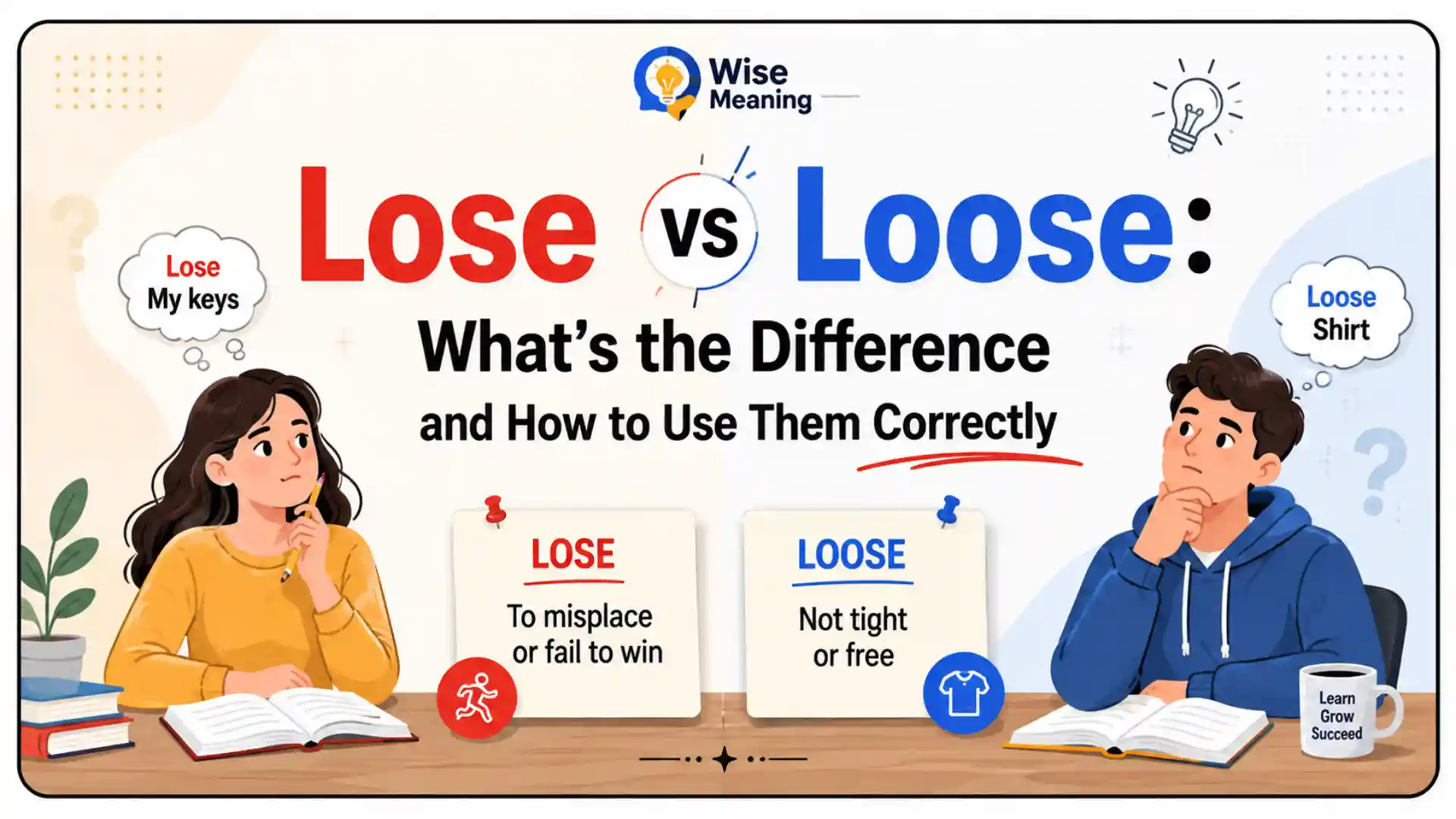
The easiest way to understand loose vs lose is to look at what each word does in a sentence. Lose usually shows an action. It means to stop having something, fail to keep something, or fail to win. For example, you can lose your keys, lose a game, or lose your temper.
Loose, on the other hand, usually describes something that is not tight or securely fixed. You can have a loose tooth, loose shirt, or loose screw. If you remember that lose = action and loose = not tight, you can avoid most common grammar mistakes.
TL;DR — Lose vs Loose
If you only remember a few things about lose vs loose, remember these key points:
- Lose is usually a verb.
- Loose is mainly an adjective.
- Lose means to misplace, fail to keep, or fail to win.
- Loose means not tight, firm, or secure.
- Lose ends with a z sound.
- Loose ends with an s sound.
- Correct: lose weight.
- Correct: loose clothing.
- Think: Lose loses an O.
- Think: Loose has extra room and an extra O.
These simple rules can help you choose the right word quickly.
Lose vs Loose at a Glance
A quick comparison can make the lose and loose difference much easier to understand.
| Word | Part of Speech | Meaning | Pronunciation | Example |
|---|---|---|---|---|
| Lose | Verb | Stop having, fail to keep, or fail to win | /luːz/ | Don’t lose your phone. |
| Loose | Mainly adjective | Not tight, fixed, or secure | /luːs/ | This shirt feels loose. |
The key difference comes from both grammar and meaning. Lose describes what someone does, while loose usually describes the condition of something. This simple rule answers many questions about lose or loose spelling and correct usage.
What Does Lose Mean?
The meaning of lose changes slightly depending on the situation, but it always works around the idea of no longer having, keeping, or winning something. Lose is a verb, so it usually describes an action.
You might lose your wallet if you cannot find it. A sports team can lose a game if it fails to win. Someone can also lose control, lose patience, or lose confidence. These examples show why understanding how to use lose matters. Whenever the sentence describes an action involving missing, failing, giving up, or no longer having something, lose is usually the correct word.
Lose Something You Had
You use lose when something you had is no longer in your possession or you cannot find it. For example, you might lose your keys, lose your phone, or lose an important document.
This meaning often causes confusion because people sometimes write loose your keys, which is incorrect. The correct form is lose your keys because the sentence describes an action. A useful test is to replace the word with misplace. If the sentence still makes sense, lose is probably correct. For example, “Don’t misplace your phone” has nearly the same idea as “Don’t lose your phone.”
Lose a Game or Competition
You also use lose when someone fails to win a game, match, contest, or competition. For example, “Our team might lose the game tonight” uses lose correctly.
A common spelling mistake is writing loose the game. That is incorrect because loose does not normally mean “fail to win.” If you are deciding between lose a game or loose a game, always choose lose a game. The same rule works with other competitions. You can lose a race, lose a match, lose an election, or lose a contest because all of these examples describe an action.
Lose Control, Temper, or Focus
The word lose also appears in many everyday expressions. You can lose control, lose your temper, lose focus, or lose your patience. These phrases do not usually describe losing a physical object, but the basic idea stays similar: you stop keeping or maintaining something.
For example, “Try not to lose your temper” means you should remain calm. “I started to lose focus during the meeting” means your attention became weaker. These examples help explain why lose has many uses beyond objects and competitions. In each case, it still acts as a verb.
What Does Loose Mean?
The meaning of loose usually relates to something that is not tight, firm, fixed, or securely attached. Unlike lose, the word loose most often works as an adjective.
You might wear a loose shirt, notice a loose tooth, or tighten a loose screw. The word can also describe things that are free or not closely controlled. Understanding how to use loose becomes easier when you ask one question: “Am I describing the condition of something?” If the answer is yes, and that thing is not tight or secure, loose is usually the correct choice.
Loose Clothing
We often use loose to describe clothing that does not fit tightly around the body. For example, you can wear loose pants, a loose shirt, or a loose dress.
This gives us an easy way to understand loose vs lose. If someone says, “These jeans are too loose,” they are describing how the jeans fit. The word acts as an adjective. However, if someone says, “I don’t want to lose my jeans,” they mean they do not want to misplace them. These examples show how one extra o changes both the spelling and the meaning.
Loose Objects
You can also use loose when something is not securely attached or fixed in place. Common examples include a loose tooth, loose screw, loose wire, and loose handle.
For example, “The screw is loose” means the screw needs tightening. “My tooth feels loose” means the tooth moves more than it should. In both examples, loose describes the condition of an object. This is why loose is mainly an adjective. When you are unsure about loose or lose, check whether the word describes something that feels unstable, slack, or not tightly held.
Loose as a Verb
Although loose usually works as an adjective, it can also function as a verb in less common situations. As a verb, loose can mean to release, free, or let something go.
For example, someone may loose an arrow from a bow. You may also see older or formal writing where a person “looses” something from restraint. However, this usage is much less common in everyday English. Most readers should remember the simpler rule: lose is normally a verb, while loose is normally an adjective. That rule will guide you correctly in almost every common situation.
Lose vs Loose Pronunciation
The lose vs loose pronunciation difference helps many people remember the correct spelling. Both words begin with the same long “oo” sound, but their final sounds are different.
Lose sounds like looz and ends with a z sound. It rhymes with choose and shoes. Loose sounds like loos and ends with an s sound. It rhymes with goose and moose. If you are learning how to pronounce lose and loose, focus on the final sound. This small pronunciation difference can help you connect the correct spelling with the correct meaning.
Why Do People Confuse Lose and Loose?
People commonly confuse lose and loose because the words look almost identical. Both contain the letters l, o, s, and e, and the only visible difference is the extra o in loose.
The pronunciation can also make the words confusing for English learners because both start with the same long “oo” sound. On top of that, spelling patterns in English do not always follow simple rules. This makes lose vs loose spelling harder to remember at first. The good news is that the meanings are very different. Once you connect lose with action and loose with not tight, the difference becomes much easier.
How to Remember Lose vs Loose
One of the easiest ways to remember lose vs loose is to focus on the extra o. Think of loose as having extra room because it has an extra letter. Something loose also has extra space and is not tight.
Another memory trick is this: lose loses an o. Since lose means to stop having something, imagine the word itself has “lost” one of its two o’s. These simple ideas can help with how to remember lose and loose. You can also remember the grammar rule: lose = action, while loose = description. Together, these tricks make the difference easy to recall.
Lose vs Loose Examples in Sentences
Seeing lose and loose in a sentence makes the difference clearer than memorizing definitions alone.
| Lose Examples | Loose Examples |
|---|---|
| Don’t lose your ticket. | My shirt feels loose. |
| We may lose the game. | The screw is loose. |
| She does not want to lose her job. | He has a loose tooth. |
| Try not to lose your temper. | Her hair hung loose. |
| I always lose track of time. | These pants are too loose. |
These lose vs loose examples show the central rule: lose describes an action, while loose usually describes a condition.
Common Lose vs Loose Mistakes
Most lose vs loose grammar mistakes happen because writers focus on spelling instead of meaning. Before choosing a word, ask what the sentence actually says.
A simple check can prevent these mistakes. If you mean misplace, fail to win, or stop having, use lose. If you mean not tight or secure, use loose.
Lose Weight or Loose Weight: Which Is Correct?
The correct phrase is lose weight, not loose weight. This is one of the most common spelling questions connected with lose vs loose.
You use lose because losing weight describes an action or change. The word loose would describe something that is not tight. For example, after someone loses weight, their old clothes might become loose. This creates a useful sentence to remember: If you lose weight, your clothes may become loose. That one example clearly shows the difference between both words.
Loose Clothes or Lose Clothes?
Both phrases can be correct, but they mean very different things. Loose clothes means clothing that does not fit tightly. Lose clothes means to misplace or no longer have clothing.
For example, “I prefer loose clothes in summer” describes the fit of the clothing. However, “Be careful not to lose your clothes while traveling” describes an action. This comparison is useful because it shows how grammar changes the meaning. If the word describes the clothes, use loose. If someone performs an action and stops having the clothes, use lose.
Loose Tooth or Lose a Tooth?
A loose tooth is a tooth that moves because it is no longer firmly fixed. To lose a tooth means the tooth comes out or is no longer present.
For example, a child might say, “I have a loose tooth.” Later, the child might say, “I lost my tooth.” These expressions describe two different stages. Loose describes the condition of the tooth, while lose describes the action or result of no longer having it. This is one of the easiest examples for understanding the difference between lose and loose because both meanings can appear in the same situation.
Lose a Game or Loose a Game?
The correct phrase is lose a game. You should not write loose a game when you mean failing to win.
For example, “Our team might lose the game” uses the verb lose because the sentence describes an action. The word loose usually describes something that is not tight, so it does not fit this meaning. You can also lose a race, lose a match, or lose a competition. If you can replace the word with “fail to win,” then lose is the correct choice. This simple test can help you avoid a very common spelling mistake.
Lose Your Mind or Loose Your Mind?
The correct expression is lose your mind, not loose your mind. The phrase usually means to become extremely upset, confused, excited, or unable to think calmly.
You will find the same pattern in other common expressions, such as lose your temper, lose control, lose focus, and lose patience. In each phrase, lose acts as a verb. The word describes someone no longer maintaining a certain state. If you are unsure whether to write lose or loose in an expression, check whether the phrase describes losing control, attention, patience, or another ability. If it does, choose lose.
Lose, Lost, Loss, and Losing
The words lose, lost, loss, and losing belong to the same word family, but they do not all play the same grammatical role.
| Word | Type | Example |
|---|---|---|
| Lose | Verb | Don’t lose your keys. |
| Lost | Past tense/adjective | I lost my keys. |
| Losing | Verb form | She is losing patience. |
| Loss | Noun | The team suffered a loss. |
Remember that lose is the base verb, while lost shows past action. Loss is a noun, and losing describes an ongoing action. Knowing these forms also helps prevent spelling confusion.
Loose, Looser, Loosest, and Loosen
The word loose also has several related forms. Knowing them can help you understand the difference between loose vs loosen and other similar words.
Loose describes something that is not tight. Looser means more loose, while loosest means the most loose. Loosen is a verb that means to make something less tight.
For example, “This shirt is loose,” “That shirt is even looser,” and “Please loosen the knot.” These words all come from the same idea, but their grammar changes. This is why paying attention to the sentence structure matters.
Loose vs Loosen: What’s the Difference?
The difference between loose and loosen is mainly grammatical. Loose usually works as an adjective, while loosen works as a verb.
For example:
“The knot is loose.” “Please loosen the knot.”
In the first sentence, loose describes the knot. In the second sentence, loosen describes the action of making the knot less tight. If you are unsure which word to use, ask whether you are describing a condition or an action. Use loose for the condition and loosen for the action. This simple comparison makes the distinction easy to remember.
Common Phrases With Lose
The verb lose appears in many everyday English expressions. Learning these phrases can improve both grammar and vocabulary.
Common examples include:
- lose your temper
- lose your mind
- lose control
- lose track of time
- lose touch
- lose heart
- lose sleep
- lose your way
- lose count
- lose sight of something
In all these expressions, lose keeps the idea of no longer having, maintaining, or controlling something. These phrases also show why the word appears so often in everyday speech. If the phrase describes an action or change, lose usually fits naturally.
Common Phrases With Loose
The word loose also appears in many common phrases. Most of them connect with the ideas of freedom, lack of tightness, or lack of control.
Examples include:
- loose change
- loose tooth
- loose screw
- loose fit
- loose cannon
- let loose
- break loose
- hang loose
For example, loose change means small coins, while a loose cannon describes someone who behaves unpredictably. The phrase break loose means to escape or become free. These expressions show that loose can have broader meanings, but the idea of freedom or lack of tight control often remains.
Is Loose Always an Adjective?
No. Loose most commonly works as an adjective, but it can serve other grammatical roles in certain contexts. As an adjective, it describes something that is not tight, fixed, or restricted.
English speakers sometimes use loose as a verb meaning to release or set free. For example, someone may loose an arrow. You may also see rare noun or adverb uses in older or specialized writing. However, beginners do not need to focus heavily on these uncommon forms. For everyday grammar, remember this simple rule: loose is usually an adjective, and that rule will work in most situations.
Is Lose Always a Verb?
Lose functions as a verb in normal modern English. It describes an action such as misplacing something, failing to win, or no longer keeping something.
You can lose a wallet, lose a game, lose patience, or lose your way. The form changes depending on tense and subject: lose, loses, losing, lost. Unlike loose, which can work in several grammatical roles, lose stays strongly connected to verb usage. This makes the distinction easier to remember. If your sentence needs an action word meaning “fail to keep,” “fail to win,” or “misplace,” lose is almost certainly the word you need.
Lose vs Loose for Kids and English Learners
If you are learning English, you can use one very simple rule to understand lose vs loose:
Lose = something you do. Loose = something you describe.
You can lose your pencil, but your shoelace can be loose. You can lose a game, but your shirt can feel loose. This simple action-versus-description rule works in most everyday situations. English learners can also remember the sound difference: lose ends with a z sound, while loose ends with an s sound. With a little practice, choosing the correct word becomes much easier.
Lose vs Loose Mini Quiz
Test your understanding with this short lose vs loose quiz. Choose the correct word for each sentence.
- Don’t \_\_\_ your wallet.
- My shoe feels \_\_\_.
- Our team could \_\_\_ the match.
- This tooth is \_\_\_.
- I want to \_\_\_ weight.
- lose
- loose
- lose
- loose
- lose
If you got all five correct, you already understand the main rule. Remember that lose usually describes an action, while loose usually describes something that is not tight, secure, or firmly attached.
Frequently Asked Questions
What Is the Main Difference Between Lose and Loose?
The main difference between lose and loose is their meaning and grammatical role. Lose usually works as a verb and means to stop having something, fail to keep something, or fail to win. Loose mainly works as an adjective and means not tight or securely attached. For example, you can lose your keys, but your shirt can be loose.
Is It Lose Weight or Loose Weight?
The correct phrase is lose weight. Lose describes the action of reducing weight. Loose weight is incorrect when you mean becoming lighter. However, after you lose weight, your clothes may become loose.
How Do You Remember Lose vs Loose?
Remember that loose has an extra O, just like something loose has extra room. You can also remember the phrase lose loses an O. Another easy rule is lose = action and loose = description.
Is Loose a Verb or Adjective?
Loose is mainly an adjective, as in “a loose shirt” or “a loose screw.” It can also work as a verb meaning to release or set free, but that usage is much less common in everyday English.
What Is the Past Tense of Lose?
The past tense of lose is lost. For example, “I lose my keys often” becomes “I lost my keys yesterday.” The present participle is losing, and the noun form is loss.
Is It Lose Your Mind or Loose Your Mind?
The correct phrase is lose your mind. Lose works as a verb and describes no longer maintaining calm or clear thinking. Loose your mind is incorrect in normal modern usage.
Is It Loose Tooth or Lose Tooth?
Use loose tooth when you describe a tooth that moves. Use lose a tooth when the tooth comes out or is no longer there. For example, “I have a loose tooth, and I may lose it soon.”
Final Thoughts
The difference between lose and loose becomes simple once you focus on meaning instead of spelling. Lose usually describes an action, such as failing to win, misplacing something, or no longer keeping something. Loose usually describes something that is not tight, secure, or firmly attached.
When you feel unsure, remember two easy tricks: lose loses an O, and loose has extra room because it has an extra O. Whether you are writing about losing weight, a loose tooth, or trying not to lose your keys, these simple rules will help you choose the correct word with confidence.