
Have you ever heard someone say “unfortunately” and wondered what it really means or how to use it correctly? The meaning of unfortunately is simple, but many English learners still struggle with its grammar, sentence placement, and punctuation. Whether you are writing an email, speaking in a conversation, or improving your English vocabulary, understanding this common adverb can help you express negative situations clearly and politely. In this guide, you will learn the unfortunate meaning, its pronunciation, usage, examples, synonyms, and grammar in an easy-to-follow way.
If you have searched for what does unfortunately mean, unfortunately definition, or how to use unfortunately, you are in the right place. This article explains everything in plain English with real-life examples and practical tips. You will also discover unfortunately synonyms, common mistakes to avoid, and the difference between unfortunately, sadly, and regrettably. By the end, you will know how to use unfortunately naturally and confidently in both spoken English and written English.
Quick Answer
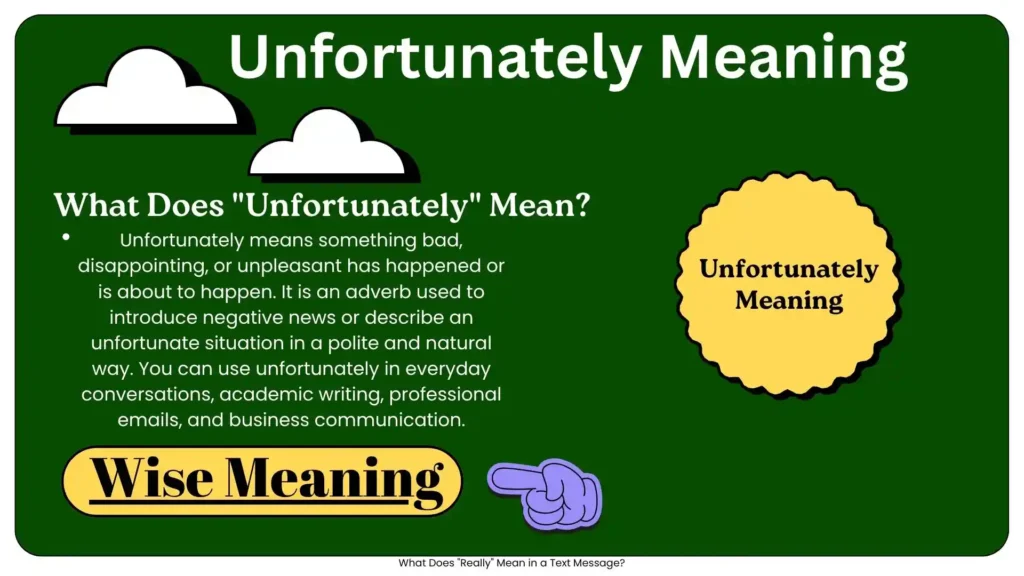
Unfortunately means something bad, disappointing, or unpleasant has happened or is about to happen. It is an adverb used to introduce negative news or describe an unfortunate situation in a polite and natural way. You can use unfortunately in everyday conversations, academic writing, professional emails, and business communication.
It most commonly appears at the beginning of a sentence followed by a comma, but it can also be placed in the middle or at the end when appropriate. Common synonyms include sadly, regrettably, and unluckily, while fortunately and luckily are its opposite words. Example: Unfortunately, we missed the last train because of heavy traffic.
TL;DR
Unfortunately is an adverb used to introduce bad, disappointing, or unfavorable news in a polite and natural way. It most often appears at the beginning of a sentence followed by a comma, although it can also be used in the middle or at the end of a sentence. Common synonyms include sadly, regrettably, disappointingly, and unluckily, while fortunately and luckily are its opposite words. Whether you’re writing an email, an essay, or having an everyday conversation, “unfortunately” helps express negative situations clearly and professionally. Understanding its meaning, grammar, punctuation, and sentence placement will help you use it confidently in both spoken and written English.
You Might Also Like That: What Does Really Mean in Text
What Does “Unfortunately” Mean?
The meaning of unfortunately is something bad, disappointing, or unpleasant has happened or is going to happen. People use this word to introduce negative news in a polite and natural way. Since unfortunately is an adverb, it describes the whole situation instead of a single noun or verb. It often appears at the beginning of a sentence, but you can also place it in the middle.
📖 Quick Definition
| Word | Meaning |
| Unfortunately | Used to introduce bad or disappointing news. |
Example: Unfortunately, the train arrived late, so we missed the meeting.
Pronunciation of Unfortunately
Many learners search for how to pronounce it unfortunately because the word looks long. It is pronounced as un-FOR-chuh-nit-lee in everyday speech. Native speakers often say it smoothly instead of stressing every syllable. Listening to the pronunciation several times and repeating it aloud will help you speak more naturally.
🔊 Pronunciation Tips
- ✔️ Break it into small parts.
- ✔️ Speak slowly at first.
- ✔️ Practice with complete sentences.
- ✔️ Listen to native English speakers.
The more you hear and say the word, the easier it becomes to use it confidently in spoken English.
Is “Unfortunately” an Adverb?
Yes. Unfortunately is an adverb. It tells the reader or listener that something negative or unexpected happened. Instead of describing a person or object, it describes the whole idea in a sentence. This makes it useful in both spoken English and written English.
📝 Part of Speech
| Word | Part of Speech | Purpose |
| Unfortunately | Adverb | Introduces bad or disappointing news. |
Understanding that unfortunately is an adverb helps you place it correctly in sentences and avoid common grammar mistakes.
How to Use Unfortunately Correctly
You can use unfortunately in many situations where you need to share bad news politely. It works well in conversations, emails, reports, and stories. The word creates a smooth transition before explaining a negative outcome.
Instead of overusing it, use unfortunately only when it truly fits the situation. This makes your writing sound natural and sincere.
You Might Also Like That: Grammar Meaning
At the Beginning of a Sentence
The most common position is at the beginning, followed by a comma. This structure is clear and easy to understand.
Examples
- Unfortunately, we missed the bus.
- Unfortunately, the event was canceled.
- Unfortunately, I forgot my wallet.
⭐ This is the most common and natural sentence placement.
In the Middle of a Sentence
You can also place unfortunately in the middle when it fits the sentence naturally. This style is common in formal writing and reports.
Examples
- The project was, unfortunately, delayed.
- She unfortunately missed the interview.
- We unfortunately could not attend.
At the End of a Sentence
Ending a sentence with unfortunately is less common but still correct in casual conversation.
Examples
- We lost the game, unfortunately.
- They couldn’t come, unfortunately.
- The weather changed, unfortunately.
Example Sentences Using Unfortunately
Reading examples is one of the best ways to understand how to use them unfortunately. These examples show different situations where the word fits naturally.
Everyday Conversation
- Unfortunately, I cannot join you today.
- Unfortunately, the restaurant was closed.
- Unfortunately, it started raining.
Academic Writing
- Unfortunately, the research did not support the theory.
- Unfortunately, several students missed the deadline.
Professional Emails
- Unfortunately, we cannot approve your request.
- Unfortunately, the meeting has been postponed.
Business Communication
- Unfortunately, the shipment arrived late.
- Unfortunately, the product is out of stock.
💡 These unfortunately sentence examples help you use the word with confidence.
Synonyms of Unfortunately
Sometimes you may want to avoid repeating the same word. In these situations, you can use a synonym of unfortunately. Each synonym has a slightly different tone, so choose one that matches your sentence.
📚 Common Synonyms
| Synonym | Best Used For |
| Regrettably | Formal writing |
| Sadly | Emotional situations |
| Unluckily | Bad luck |
| Disappointingly | Unmet expectations |
| Alas | Literary or dramatic writing |
Using different words makes your writing more interesting while keeping the same meaning.
You Might Also Like That: Too Cute vs To Cute
Antonyms of Unfortunately
An antonym has the opposite meaning. The opposite of unfortunately describes a positive or lucky situation. These words are useful when you want to share good news.
🌟 Common Antonyms
- Fortunately
- Luckily
- Happily
Example
❌ Unfortunately, the flight was canceled.
✅ Fortunately, another flight was available.
Learning both synonyms and antonyms improves your English vocabulary and helps you choose the right word for every situation.
Unfortunately vs. Similar Words
Several words have meanings close to unfortunately, but they are not always interchangeable. Understanding these small differences makes your writing more natural.
Unfortunately vs Sadly
Sadly usually expresses emotion or personal feelings, while unfortunately simply introduces bad news.
Unfortunately vs Regrettably
Regrettably sounds more formal and often appears in business letters or official announcements.
Unfortunately vs Unluckily
Unluckily focuses on bad luck. Unfortunately it is broader and works for almost any negative situation.
📌 Choosing the right word improves both communication and writing.
Common Mistakes When Using Unfortunately
Many learners make small mistakes when using unfortunately. One common error is using it for positive news. Another is forgetting the comma when the word starts a sentence. Some people also repeat it too often, making their writing sound unnatural.
❌ Incorrect: Unfortunately, I won the prize.
✅ Correct: Fortunately, I won the prize.
⭐ Quick Tips
- ✔️ Use it only for negative situations.
- ✔️ Add a comma after it at the beginning of a sentence.
- ✔️ Avoid repeating it in every paragraph.
Grammar Rules for Unfortunately
Good grammar helps your writing stay clear and professional. Unfortunately usually comes before the main message, especially when introducing disappointing news. In formal writing, it may appear in the middle of a sentence with commas.
📝 Grammar Checklist
| ✔️ Do | ❌ Don’t |
| Use it as an adverb | Use it as a noun |
| Add a comma at the beginning | Forget punctuation |
| Place it naturally | Force it into every sentence |
Following these simple grammar rules will make your writing easier to read.
Collocations and Common Phrases
Native speakers often use unfortunately in common phrases. Learning these expressions helps you sound more fluent in everyday English.
✨ Popular Collocations
- Unfortunately for us…
- Unfortunately for me…
- Unfortunately, there was…
- Unfortunately, we couldn’t…
- Unfortunately enough…
- Unfortunately, it happened again.
Using these phrases naturally improves both spoken English and written English without making your sentences sound repetitive.
Can You Start a Sentence with Unfortunately?
Yes. You can absolutely start a sentence with unfortunately. In fact, this is the most common way to use it. Remember to place a comma after the word before continuing with the sentence.
Examples
- Unfortunately, our plans changed.
- Unfortunately, nobody answered.
- Unfortunately, the shop was closed.
⭐ Starting a sentence with unfortunately immediately prepares the reader for disappointing information and creates a smooth transition.
Is Unfortunately Formal or Informal?
The word unfortunately works in both formal and informal situations. You can use it in conversations with friends, school assignments, business reports, and professional emails. Its meaning stays the same, but the surrounding language may change depending on the situation.
📌 Where You Can Use It
- 🎓 School writing
- 💼 Business communication
- 📧 Professional emails
- 🗣️ Everyday conversation
- 📰 Articles and reports
Because it is polite and clear, it fits almost every type of communication.
When Should You Avoid Using Unfortunately?
Although unfortunately it is useful, you should not use it for every negative situation. Repeating the word too often can make your writing sound dull or overly negative. Sometimes another expression, such as sadly, regrettably, or a direct statement, works better.
💡 Choose the word that best matches the tone and context. Using a variety of expressions keeps your writing natural, engaging, and easier to read.
You Might Also Like That: Grammar Meaning
Frequently Asked Questions
❓ What does unfortunately mean?
It means something disappointing, unpleasant, or negative has happened.
What Does “Unfortunately” Mean?
“Unfortunately” means that something is regrettable, disappointing, or unlucky. It is commonly used when giving bad news or describing an unwanted situation.
What Is “Unfortunately” Used For?
“Unfortunately” is used to introduce negative, disappointing, or regrettable information. Example: Unfortunately, the store was closed.
What Does “Unfortunately So” Mean?
“Unfortunately so” means that something is true, even though it is undesirable or disappointing. Example: “Is the meeting canceled?” “Unfortunately so.”
What Does It Mean When Someone Says “Unfortunately”?
When someone says “unfortunately,” they usually signal that the information that follows is negative, disappointing, or regrettable.
What Is a Better Word for “Unfortunately”?
Depending on the context, alternatives include regrettably, sadly, unhappily, sadly enough, and to my regret. The best choice depends on the tone and sentence.
What Is the Meaning of “Unfortunately” in English?
In English, unfortunately is an adverb used to express that something happened in an unwanted, disappointing, or regrettable way.
What Is the Meaning of “Unfortunately” for Kids?
For kids, unfortunately simply means “sadly” or “something bad happened.” Example: Unfortunately, I lost my toy.
What Is the Opposite of “Unfortunately”?
The opposite of “unfortunately” is generally “fortunately” or “luckily,” which introduces a positive or favorable situation.
How Do You Use “Unfortunately” in a Sentence?
“Unfortunately” usually appears at the beginning of a sentence or before the negative information. Example: Unfortunately, we missed the bus.
❓ Is unfortunately an adverb?
Yes. It is an adverb that introduces bad news.
❓ Can I start a sentence with unfortunately?
Yes. This is the most common sentence structure.
❓ What is another word for unfortunately?
Some common synonyms include sadly, regrettably, unluckily, and disappointingly.
❓ What is the opposite of unfortunately?
The opposite words are fortunately, luckily, and happily.
Final Thoughts
Now you know the unfortunate meaning, how to use it correctly, and why it is such an important word in English vocabulary. Whether you are writing an email, preparing an assignment, or speaking in everyday conversation, unfortunately helps you introduce disappointing news politely and clearly. By understanding its pronunciation, grammar, sentence placement, synonyms, and example sentences, you can use it with confidence in both spoken English and written English. Practice using it in real situations, and it will soon become a natural part of your communication.