

The past tense of seek is “sought.” If you have ever wondered whether to use seeked or sought, you are not alone. Seek is an irregular verb, so it does not form its past tense by simply adding -ed. Instead, it changes to sought. For example, we say, “I seek advice when I need help,” but “I sought advice from my teacher yesterday.” Understanding the past tense of seek, along with its past participle and other verb forms, can help you use this common English verb correctly.
In this guide, we will explain the seek past tense, the past participle of seek, and the complete seek verb forms with clear examples. You will also learn why sought is correct instead of seeked, how to use seek, sought, and seeking in different sentences, and which common mistakes to avoid. Whether you are a student, writer, or English learner, these simple explanations will make seek conjugation much easier to understand.
Quick Answer: What Is the Past Tense of Seek?
The past tense of seek is sought. The verb seek is an irregular verb, so you cannot form its past tense by adding -ed. For example, “I seek advice” changes to “I sought advice yesterday.” The word sought also works as the past participle of seek, which means you can use it with helping verbs such as has, have, and had.
💡 Quick answer: Seek → Sought → Sought
If you remember these three forms, you can use the seek past tense correctly in most situations. ❌ Seeked is not the standard past form of seek.
TL;DR 📌
- 🔤 Past tense of seek: sought
- 📚 Past participle of seek: sought
- 📝 Three main forms: seek → sought → sought
- 🔄 Present participle: seeking
- 👤 Third-person singular: seeks
- ❌ Incorrect: seeked
- ❌ Incorrect: soughted
- ✅ Correct: “She sought help from her teacher.”
- 💡 Remember: Seek is an irregular verb, so it does not take -ed to form its past tense.

You Might Also Like That: Past Tense of See
Seek Verb Forms at a Glance
The main seek verb forms are easy to remember once you see them together. The base form is seek, the simple past is sought, and the past participle is also sought. The present participle is seeking, while the third-person singular form is seeks. This simple seek conjugation table can help students and English learners quickly understand the different forms.
| Verb Form | Word | Example |
|---|---|---|
| Base form | seek | I seek advice. |
| Simple past | sought | I sought advice yesterday. |
| Past participle | sought | I have sought advice. |
| Present participle | seeking | I am seeking advice. |
| Third-person singular | seeks | She seeks answers. |
V1, V2, and V3 Forms
For learners who use the V1, V2, V3 system, the answer is simple: V1 = seek, V2 = sought, and V3 = sought. So, the three main forms of seek are seek → sought → sought. Remembering this pattern helps you avoid the common mistake of writing seeked when you need the past form of seek or the past participle.
What Does Seek Mean?
The verb seek usually means to look for, search for, or try to get something. You can seek help, advice, information, permission, or a solution. For example, “She seeks advice from her teacher” means she looks for advice. The word can also mean trying to achieve something, such as success or approval. In simple English, seek often has a meaning close to “look for,” but it can sound more formal in some situations.
Seek + “To” Verb
You can use seek + to + verb when someone tries or attempts to do something. For example, “The company seeks to improve its service” means the company tries to improve its service. In the past, you can say, “The company sought to improve its service.” This useful pattern appears in formal, academic, and professional writing. 📚 Learning this structure can help you understand why seek and sought appear in many different sentence patterns.
You Might Also Like That: What Does BTA Mean in Text?
Why Is the Past Tense of Seek “Sought”?
The past tense of seek is sought because seek belongs to the group of irregular verbs. Regular verbs usually form their past tense by adding -ed, such as work → worked or help → helped. Irregular verbs do not follow that simple pattern. Instead, they may change their spelling completely. With seek, the vowel and ending change to create sought. This may seem unusual at first, but many common English verbs follow irregular patterns.
| Regular Verb | Past Form | Irregular Verb | Past Form |
|---|---|---|---|
| help | helped | seek | sought |
| work | worked | see | saw |
| play | played | go | went |
So, avoid adding -ed to seek. The correct form is always sought when you need its standard past form. ✅

You Might Also Like That: Snow Bunny Meaning
Is It Seeked or Sought?
One of the most common questions about this verb is “Is it seeked or sought?” The correct answer is sought. ❌ Seeked does not work as the standard past tense of seek in modern English. People sometimes use seeked because regular verbs often take -ed, but seek follows an irregular pattern. Once you learn seek → sought, the difference becomes much easier to remember.
| Incorrect ❌ | Correct ✅ |
|---|---|
| She seeked help. | She sought help. |
| He seeked advice. | He sought advice. |
| They seeked a solution. | They sought a solution. |
What About “Soughted”?
You should also avoid soughted. The word sought already gives you the correct past and past participle forms, so adding -ed again is unnecessary. ❌ “She soughted help” is incorrect. Instead, write “She sought help.” Think of sought as a complete irregular form that does not need another ending. 📝 This small rule can prevent one of the easiest mistakes when using the seek past tense.
What Is the Past Participle of Seek?
The past participle of seek is also “sought.” This point often confuses English learners because the simple past and past participle look exactly the same. For example, “I sought help yesterday” uses sought as the simple past. In “I have sought help before,” sought works as the past participle. The form stays the same, but its grammatical role changes depending on the sentence and the helping verb.
| Use | Example |
|---|---|
| Simple past | I sought help yesterday. |
| Present perfect | I have sought help. |
| Past perfect | I had sought help. |
How to Use Sought in Different Tenses
The word sought can appear in several tense structures because it works as both the simple past and past participle. The helping verb tells you which tense the sentence uses. For the simple past, you can say, “She sought advice.” For the present perfect, say, “She has sought advice.” For the past perfect, say, “She had sought advice.” This makes sought a very useful form in everyday, academic, and professional English.
| Tense | Example |
|---|---|
| Simple past | She sought advice. |
| Present perfect | She has sought advice. |
| Past perfect | She had sought advice. |
| Future perfect | She will have sought advice. |
Seek vs. Sought: What’s the Difference?
The main difference between seek and sought comes from time and grammatical use. Seek works as the base form and present form, while sought works as the simple past and past participle. For example, “I seek new opportunities” describes a present or general action. “I sought new opportunities last year” describes a completed past action. Understanding this simple difference will help you choose the right form without guessing.
| Seek | Sought |
|---|---|
| Base/present form | Past/past participle |
| I seek advice. | I sought advice. |
| She seeks help. | She sought help. |
Sought in the Passive Voice
You can also use sought in passive sentences. In this structure, something receives the action rather than performing it. For example, “The team sought a solution” is active, while “A solution was sought by the team” is passive. You can also say, “Help was sought after the accident.” 💡 Notice that sought does not change after was or were. This makes the passive form easy to use once you understand the basic verb pattern.
Common Mistakes When Using Seek
You Might Also Like That: Good Communication
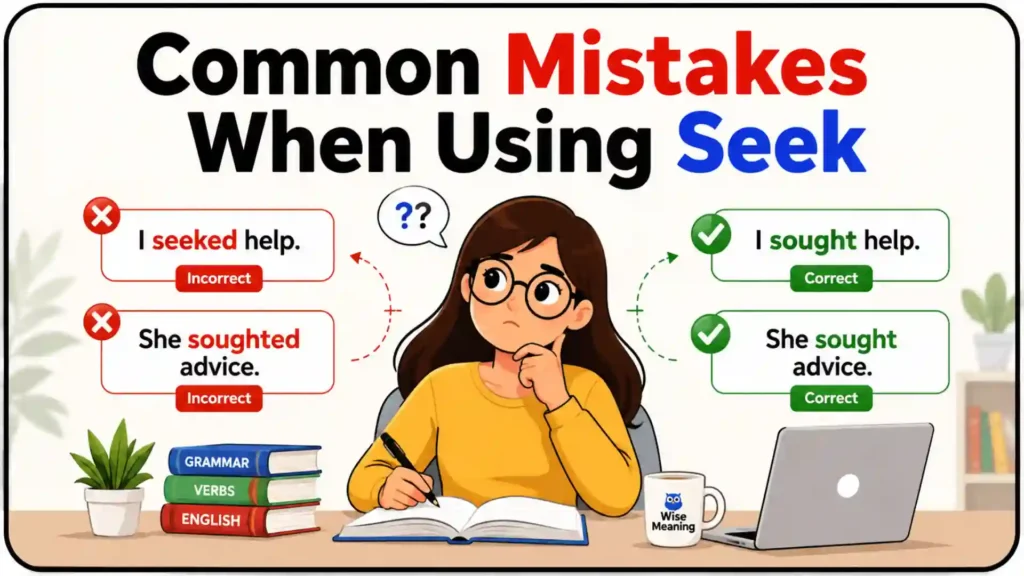
English learners often make a few simple mistakes with this irregular verb. The most common one is using seeked instead of sought. Another mistake involves adding -ed after sought, creating the incorrect form soughted. Some learners also use seek when they need a completed past action. Paying attention to the time of the action and the helping verb can help you choose the correct form. ✍️
- ❌ She seeked help. → ✅ She sought help.
- ❌ He has seeked advice. → ✅ He has sought advice.
- ❌ They soughted a solution. → ✅ They sought a solution.
- ❌ Yesterday, I seek help. → ✅ Yesterday, I sought help.
Seek vs. Search vs. Look For
The words seek, search, and look for can have similar meanings, but they do not always sound the same. Look for is common in everyday conversation. Search often suggests looking carefully for something. Seek can sound more formal and often appears with ideas such as advice, help, approval, or opportunities. For example, “I am looking for my keys,” “The police searched the building,” and “She sought advice from an expert” all sound natural in their own contexts. 🔎
Examples of Seek and Sought in Sentences
Examples make the seek verb forms easier to remember. Notice how the form changes according to the time and structure of each sentence. These examples also show common expressions such as seek advice, seek help, seek information, and seek opportunities.
- 📚 I seek advice before making important decisions.
- 💡 She sought help from her teacher yesterday.
- 🔎 They seek information online.
- 🏆 He sought new opportunities after graduation.
- 🛠️ We sought a solution to the problem.
- 🤝 She has sought professional advice.
- 🎯 The company seeks to improve its service.
- 🌱 They are seeking better opportunities.
How to Pronounce Seek and Sought
The pronunciation of seek and sought is also different, so English learners should not treat them as if they simply change spelling. Seek sounds like “seek,” while sought has a different vowel sound. The exact pronunciation can vary slightly between English accents. 🎧 When learning the past tense of seek, practice the written form and pronunciation together. Saying a few short sentences aloud, such as “I seek help” and “I sought help,” can make the difference easier to remember.
Quick Reference: Seek vs. Sought vs. Seeking
Use this table whenever you need a quick reminder of the main seek verb forms. The easiest pattern to memorize is seek → sought → sought.
| Word | Function | Example |
|---|---|---|
| seek | Base/present form | I seek advice. |
| sought | Simple past | I sought advice. |
| sought | Past participle | I have sought advice. |
| seeking | Present participle | I am seeking advice. |
| seeks | Third-person singular | She seeks advice. |
Frequently Asked Questions
What is the past tense of seek?
The past tense of seek is sought. For example, “I sought help yesterday.” Remember that seek is an irregular verb, so you should not add -ed.
Is seeked a word?
You should not use seeked as the standard past tense of seek. The correct form is sought. For example, write “She sought advice,” not “She seeked advice.”
You Might Also Like That: Sic Meaning
Is “sought” correct grammar?
Yes, sought is grammatically correct. It is the correct past tense and past participle of seek. Example: “She sought professional advice.”
Is “sought” the same as “seek”?
They are forms of the same verb but are used differently. Seek is the base/present form, while sought is used for the past tense and past participle.
How do you use “seek” in a sentence?
Use seek for a present or general action. Example: “People often seek advice before making an important decision.”
Is “seek for” or “seek” correct?
Usually, seek is used directly with an object, so “seek help” or “seek advice” is correct. “Seek for” is generally unnecessary in standard English.
What does “to sought” mean?
“To sought” is incorrect because sought is already a past form. The infinitive is “to seek.” For example, say “I want to seek help,” not “I want to sought help.”
How do you use the word “sought”?
Use sought when describing something someone looked for, tried to obtain, or attempted to achieve. Example: “The company sought new ways to improve its service.”
Is “saught” a correct spelling?
No. “Saught” is a misspelling. The correct spelling is sought, pronounced similarly to “sort” in many varieties of English.
What does “sought” mean?
Sought can mean looked for, tried to find, requested, or attempted to obtain something. Its exact meaning depends on the sentence.
What is the present tense of seek?
The present/base form is seek. For example: “I seek better opportunities.” With he, she, or it, use seeks.
What is the past perfect tense of seek?
The past perfect form is had sought. Example: “They had sought several solutions before choosing one.”
What is the past participle of seek?
The past participle of seek is sought. You can use it with has, have, or had, as in “I have sought help” or “They had sought advice.”
What are the three forms of seek?
The three main forms are seek, sought, sought. In the V1/V2/V3 pattern, seek = V1, sought = V2, and sought = V3.
Is sought both past tense and past participle?
Yes. Sought works as both the simple past and past participle. “She sought help” uses the simple past, while “She has sought help” uses the past participle.
What is the present participle of seek?
The present participle of seek is seeking. Use it with forms of be, such as “I am seeking advice” or “They were seeking answers.”
What Is the Past Tense of Seek?
The past tense of seek is “sought.” For example: She sought help from her teacher.
You Might Also Like That: SFW Meaning Explained
What Is the V1, V2, and V3 of Seek?
The three forms are: V1: seek, V2: sought, V3: sought. “Seek” is the base form, while “sought” is used as both the past tense and past participle.
Is “Seeked” the Past Tense of Seek?
No. “Seeked” is not the standard past tense of seek. The correct form is “sought.”
Is It “Sought Out” or “Seeked Out”?
The correct expression is “sought out.” “Seeked out” is incorrect in standard English. Example: They sought out a better solution.
What Does “He Sought” Mean?
“He sought” means “he looked for,” “he tried to find,” or “he attempted to obtain” something. Example: He sought advice from an expert.
What Is the Past Tense of Seek in a Sentence?
The past tense sought describes an action that happened in the past. Example: She sought answers after the meeting.
How Do You Pronounce “Sought”?
“Sought” is pronounced /sɔːt/ in many varieties of English and sounds similar to “sort.”
What Are Examples of the Past Tense of Seek?
Here are a few examples:
- I sought help when I needed it.
- She sought a new opportunity.
- They sought advice from their coach.
What Is the Future Tense of Seek?
The future form is “will seek.” Example: We will seek a better solution tomorrow.
Why is seek an irregular verb?
Seek is irregular because it does not form its past tense by adding -ed. Instead, it changes to sought. This pattern is common among many English irregular verbs.
How do you use sought in a sentence?
You can use sought for a completed past action or with helping verbs in perfect tenses. For example, “She sought advice yesterday” and “She has sought advice before” are both correct.
Final Thought
The easiest way to remember the past tense of seek is to memorize the three main forms together: seek → sought → sought. ✅ The word sought works as both the simple past and the past participle, while seeking serves as the present participle. Most importantly, avoid seeked and soughted in standard English. Once you understand these forms and practice them in simple sentences, using seek, sought, and seeking becomes much easier and more natural.