
Have you ever seen someone write “You’re capping” or “No cap” and wondered what they meant? The capping meaning can change depending on the context. In modern slang, people often use capping when they talk about lying, exaggerating, or making a claim they do not believe is true. However, the word also has general English and technical meanings, so context matters.
In this guide, you’ll learn what capping means in slang, texting, and social media, along with common phrases such as “stop capping,” “you’re capping,” and “no cap.” We’ll also explain its standard English uses, examples, origin, and other meanings in simple language.
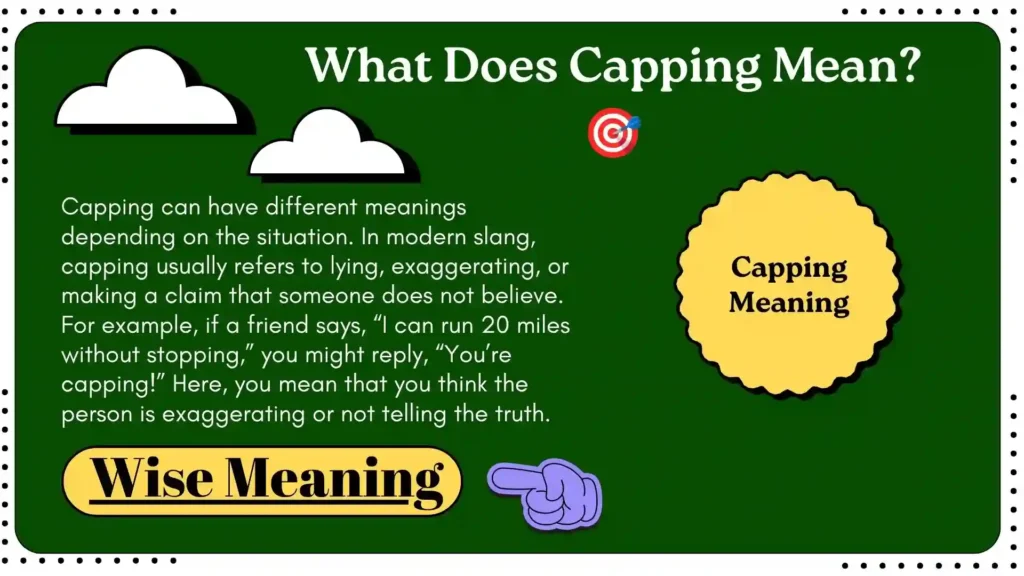
Quick Answer: What Does Capping Mean? 🎯
Capping can have different meanings depending on the situation. In modern slang, capping usually refers to lying, exaggerating, or making a claim that someone does not believe. For example, if a friend says, “I can run 20 miles without stopping,” you might reply, “You’re capping!” Here, you mean that you think the person is exaggerating or not telling the truth.
However, capping also has general English and technical meanings. It can describe putting a cap or cover on something, setting a limit, or a mining term. So, always check the context before deciding what capping means. 🧢
| Expression | Meaning |
| Capping | Lying, exaggerating, or another context-based meaning |
| You’re capping | You’re probably lying or exaggerating |
| Stop capping | Stop lying or exaggerating |
| No cap | Honestly; I’m telling the truth |
| Capping off | Finishing or completing something |
| Capping in mining | A technical term related to overburden |
TL;DR 📌
- 🧢 Capping in slang usually means lying, exaggerating, or making a claim that someone does not believe.
- 📱 In texting, “you’re capping” usually means “you’re lying” or “I don’t believe you.”
- 🛑 “Stop capping” means stop lying or exaggerating.
- 💬 “No cap” means honestly, seriously, or without lying.
- 🔍 Cap, capping, capped, and cappin’ are related forms, but their use can change with context.
- 📚 In standard English, capping can mean putting a cover on something or setting a limit.
- ⛏️ In mining, capping has a technical meaning related to overburden.
- ⚠️ The best way to understand capping meaning is to check the context and surrounding words.
You Might Also Like That: What Does NGL Mean in Chat
What Does Capping Mean in Slang? 🗣️
The capping meaning in slang depends on how someone uses the word. In casual speech, capping often describes making a false or exaggerated claim. If someone tells you something that sounds unbelievable, you might say, “You’re capping.” In simple terms, you are saying, “I don’t believe you.” People commonly use this slang in conversations with friends, online chats, and social media.
The word cap connects closely with capping. Cap can describe a lie or false claim, while capping describes the act of making that claim. You may also see the informal spelling “cappin’.” Merriam-Webster also records a separate African American English slang noun sense of capping, showing why the word can have more than one slang use. 🧢
What Does Capping Mean in Texting? 📱
The capping meaning in text usually comes from casual slang. When someone writes “You’re capping” in a text message, they usually mean that the other person is lying, exaggerating, or saying something hard to believe. For example, one friend might text, “I finished the whole project in ten minutes,” and the other could reply, “Bro, you’re capping.”
Texting makes the expression especially common because people prefer short, informal words. You may see “stop capping,” “don’t cap,” “that’s cap,” or “no cap” in messages. The exact meaning depends on the conversation, but these phrases usually express disbelief, honesty, or exaggeration.
What Does “You’re Capping” Mean? 🤔
“You’re capping” is an informal phrase that usually means “You’re lying” or “You’re exaggerating.” People often use it when they hear a claim that sounds unbelievable. For example, if your friend says, “I won a race against a professional athlete,” you might jokingly say, “You’re capping!” The phrase does not always sound serious.
You Might Also Like That: Situationship Meaning
Examples of “You’re Capping”
- 🗣️ “You said you met ten celebrities? You’re capping!”
- 📱 “You finished that book in one hour? You’re capping.”
- 😂 “You ate all that food by yourself? You’re capping!”
The phrase can sound playful, doubtful, or confrontational, depending on the speaker and situation.
What Does “Stop Capping” Mean? 🛑
“Stop capping” means “Stop lying” or “Stop exaggerating.” People normally use it in informal conversations, texting, and social media. If someone makes a claim that you do not believe, you can say, “Stop capping!” For example, if your friend says they never use social media even though you often see them online, you might jokingly respond, “Stop capping.”
You may also see similar expressions such as “quit capping” and “don’t cap.” These phrases have nearly the same purpose. The tone can range from friendly teasing to a serious challenge, so the relationship between the speakers matters.
What Does “No Cap” Mean? 🧢
“No cap” has an opposite relationship to capping. It usually means “I’m telling the truth,” “I’m being honest,” or “I’m serious.” People add it to a statement when they want others to know that they are not exaggerating. For example, “That was the best concert I’ve ever seen, no cap” means the speaker genuinely believes the concert was the best.
You can think of the expressions this way:
- Cap = a lie or false claim
- Capping = lying or exaggerating
- No cap = telling the truth
This makes no cap one of the most useful related slang terms to understand.
Capping vs. Cap: What’s the Difference? 🔍
Cap and capping come from the same word, but they work differently in a sentence. Cap can act as a noun or verb, depending on the context. In slang, it can refer to a lie or false claim. Capping is the -ing form of the verb and describes the action.
| Word | Simple meaning | Example |
| Cap | A lie or false claim | “That’s cap.” |
| Capping | Lying or exaggerating | “You’re capping.” |
| Capped | Lied or exaggerated | “He capped about it.” |
| Cappin’ | Informal spelling of capping | “Stop cappin’.” |
| No cap | Honestly | “No cap, it was great.” |
Examples of Capping in Text and Conversation 💬
Seeing capping examples can make the meaning much easier to understand. In everyday conversation, people often use the word when they doubt someone’s statement. The expression usually works best in casual communication, especially among friends.
You Might Also Like That: GIF Meaning
Here are a few natural examples:
- Friend: “I can memorize 100 words in one minute.”
- You: “You’re capping!”
Another example:
- A: “I got the highest score in the class.”
- B: “No way. Stop capping.”
On social media, someone might comment, “That’s cap 🧢,” when they think a post contains an exaggerated or false claim.
Is Capping Always About Lying? ⚠️
No. Capping does not always mean lying. Context plays an important role because the word has several meanings in English. In modern slang, it can suggest lying or exaggerating, but dictionaries also record other uses. Merriam-Webster lists capping as the present participle of cap and also has a separate slang noun sense.
This distinction matters because a person may use capping in a sentence about limits, covers, or another subject. The Reddit discussion about the word also shows how confusing the term can become when someone encounters it in a real conversation. Therefore, look at the words around capping before choosing its meaning.
What Does Capping Mean in Standard English? 📚
In standard English, capping can simply function as the present participle of “cap.” The verb cap can mean putting a cover on something or placing a limit on something. For example, “They are capping the bottle” means they are putting a cap on the bottle. Similarly, “The company is capping expenses” means it is setting a maximum amount.
This general meaning differs from the slang use. Cambridge presents capping mainly as the -ing form of cap, with examples covering limits and other everyday or technical situations. This is why the sentence itself provides the key clue.
You Might Also Like That: Snow Bunny Meaning
Capping Meaning in Business and Everyday English 💼
In business and everyday English, capping often means setting a limit or maximum. Companies, governments, and organizations can cap prices, costs, fees, salaries, or benefits. For example, “The company is capping delivery charges at $20” means the charge cannot go above $20.
Common examples include:
- 💰 Capping costs — setting a maximum cost
- 🏷️ Capping prices — limiting how high prices can go
- 💼 Capping salaries — setting a salary limit
- 📊 Capping benefits — setting a maximum benefit amount
- 🔢 Capping a number — preventing a number from going beyond a limit
In these situations, capping has nothing to do with slang or lying.
What Does Capping Mean in Mining? ⛏️
Capping also has a technical meaning in mining. Dictionary.com lists capping as a mining noun connected with overburden, which refers to the material that lies above a deposit or resource being mined. This meaning is very different from the slang expression used in texting.
Because most everyday readers are unlikely to encounter this meaning, you do not need to give it a large section. However, mentioning it helps create a complete capping definition. If you see capping in a mining report, textbook, or technical document, do not automatically assume that the writer means lying or exaggerating. The subject gives you the answer.
Where Did the Slang Term Capping Come From? 🧩
The history of capping slang is connected to African American English and older forms of verbal competition. Merriam-Webster records a slang noun sense of capping connected with a ritualized exchange of insults and relates it to practices such as joning and playing the dozens.
Modern internet culture has helped related expressions such as cap, capping, and no cap spread widely across social media, texting, music, and casual conversation. However, it is better to avoid claiming that the modern slang meaning has one simple origin. The word has developed through different uses over time.
Is Capping Formal or Informal? ✍️
When capping means lying or exaggerating, it is informal slang. People commonly use it in texting, social media, casual conversations, gaming chats, and messages between friends. It can make a conversation sound relaxed and natural, but it does not usually belong in formal writing.
For professional or academic situations, choose clearer words such as:
- lying
- exaggerating
- making a false claim
- making an unsupported statement
- giving inaccurate information
For example, instead of writing “The report is capping,” a formal sentence could say, “The report makes an unsupported claim.”
Common Mistakes When Using Capping ⚠️
One common mistake is assuming that capping always means lying. The word has several meanings, so context matters. Another mistake involves confusing cap, capping, capped, and no cap. These expressions relate to one another, but they do not work exactly the same way.
Avoid these mistakes:
- ❌ Treating every use as slang
- ❌ Using slang in formal writing
- ❌ Assuming no cap means the same as capping
- ❌ Ignoring the surrounding sentence
- ❌ Confusing capping with capping off
- ❌ Assuming the word has only one definition
A little attention to context can prevent most misunderstandings.
Capping Meaning vs. Similar Words 🔎
Capping can overlap with words such as lying, exaggerating, joking, bluffing, and boasting, but they do not always mean exactly the same thing. Lying usually means giving false information intentionally. Exaggerating means making something seem bigger, better, worse, or more extreme than it really is. Joking may involve saying something untrue without intending to deceive.
| Word | Basic meaning |
| Capping | Informal claim that someone is lying or exaggerating |
| Lying | Giving false information |
| Exaggerating | Making something seem greater than it is |
| Joking | Saying something for humor |
| Bluffing | Trying to make someone believe something untrue |
| Boasting | Talking proudly about yourself or achievements |
Understanding these differences helps you choose the right word.
Frequently Asked Questions About Capping ❓
What does capping mean in text?
In text messages, capping usually means lying or exaggerating, especially when someone doubts another person’s claim.
What does capping mean in slang?
In slang, capping can refer to making a false or exaggerated claim. Its exact meaning depends on context.
What does “you’re capping” mean?
“You’re capping” usually means “You’re lying” or “I don’t believe you.”
What does “stop capping” mean?
“Stop capping” means “Stop lying or exaggerating.”
What does “no cap” mean?
“No cap” means “I’m telling the truth” or “I’m being serious.”
Is capping slang?
Yes, capping has an informal slang use, but it also has general English and technical meanings.
Is capping rude?
It can sound rude or confrontational when used seriously, but friends often use it playfully.
Is capping formal English?
The slang use is informal, so you should generally avoid it in academic and professional writing.
What is the difference between cap and capping?
Cap is the root word, while capping is its -ing form. In slang, both can relate to false or exaggerated claims.
What does capping mean in mining?
In mining, capping can refer to overburden, a technical meaning unrelated to internet slang.
Final Thought 💡
The simplest capping meaning depends on context. In modern slang and texting, capping commonly refers to lying, exaggerating, or making a claim that someone does not believe. Expressions such as “you’re capping,” “stop capping,” and “no cap” are especially common in casual communication. 🧢
However, capping can also have standard English and technical meanings, including putting a cover on something, setting a limit, or referring to overburden in mining. When you see the word, check the surrounding sentence first. That small step will help you understand whether the writer means slang, a general English use, or a technical term.