
Have you ever been talking to someone regularly, and then they suddenly stop replying without explaining why? You send a message, wait, check your phone again, and still hear nothing. If the person had been meaningfully communicating with you and then unilaterally stopped communicating without an explanation, you may be experiencing what is commonly called ghosting. 👻
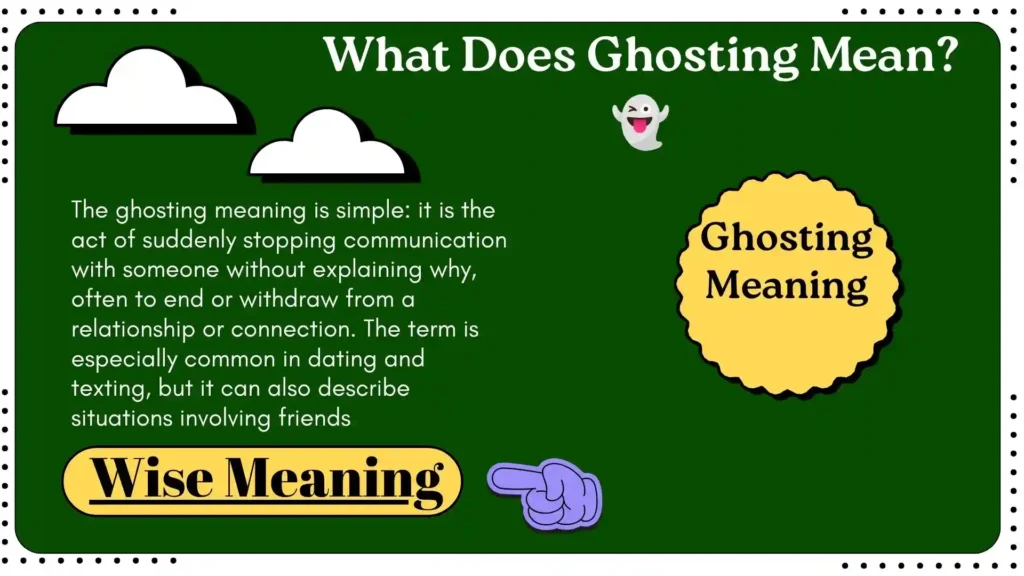
The ghosting meaning is simple: it is the act of suddenly stopping communication with someone without explaining why, often to end or withdraw from a relationship or connection. The term is especially common in dating and texting, but it can also describe situations involving friends, family members, coworkers, employers, or online contacts. Major dictionaries such as Cambridge, Oxford, and Collins recognize this communication-related meaning.
Quick Answer ⚡
Ghosting means suddenly stopping communication with someone without giving an explanation. 👻
In dating or texting, someone may ghost you by:
- 📱 Stopping replies to your messages
- 📞 Ignoring your calls
- 💬 Disappearing from a conversation
- 🚫 Blocking or removing you
- 👀 No longer acknowledging you online or sometimes in person
- 🤐 Ending contact without clearly saying the relationship is over
For example:
“We were texting every day, and then she completely disappeared. I think she ghosted me.”
TL;DR 📝
- 👻 Ghosting meaning: Suddenly stopping communication without an explanation.
- 💬 Ghosting in texting: Someone stops responding to your messages and does not explain why.
- ❤️ Ghosting in dating: A person ends or withdraws from romantic communication by disappearing rather than communicating directly.
- 👥 Ghosting can happen in friendships: It is not limited to romantic relationships.
- 💼 Workplace ghosting: Someone may stop responding during a hiring, work, or professional process.
- 📱 Social media ghosting: Someone may stop interacting, replying, or acknowledging your messages.
- ⏳ There is no universal number of days that automatically makes something ghosting.
- 🚫 A delayed reply is not automatically ghosting.
- 🔄 Breadcrumbing and orbiting are different behaviors, even though they can overlap with ghosting.
- 🛡️ Ghosting can sometimes be used for personal safety, especially when direct contact feels unsafe.
- 🗣️ Ghosted = the person who was ignored.
- 👻 Ghoster = the person who stopped communicating.
You Might Also Like That: Simp Meaning Explained
What Does Ghosting Mean? 👻
Ghosting is an informal term for suddenly ending or withdrawing from a relationship or ongoing connection by stopping communication without giving an explanation.
Oxford defines the relationship meaning as ending a personal relationship by suddenly stopping all communication without explanation. Cambridge similarly describes it as a way of ending a relationship by suddenly stopping communication.
A useful way to understand the word is:
Communication → Connection → Sudden silence → No explanation
For example:
“They used to message me every night, but now they don’t respond at all.”
That could be ghosting if the communication has effectively ended without an explanation.
However, not every unanswered message is ghosting. Someone may be busy, sick, traveling, dealing with a personal problem, or simply not have seen the message. The context matters.
What Does Ghosting Mean in Texting? 📱
In texting, ghosting usually means someone stops replying after there has already been an ongoing conversation or connection.
For example:
You: “Hey, are we still meeting tomorrow?”
Them: No reply
You: “Everything okay?”
Them: No reply
If this continues and the person effectively disappears from the relationship without explanation, people may describe the behavior as ghosting.
Ghosting can be especially confusing in texting because digital communication makes it easy to see that someone has received or interacted with messages while still giving no explanation for the silence.
Ghosting vs Simply Being Busy ⏳
This is one of the most important distinctions.
A person taking several hours or even a day to reply does not automatically mean they are ghosting you.
Ghosting generally involves a broader pattern of unilateral communication withdrawal, not merely one slow response. A 2025 theoretical analysis describes ghosting as a sudden or gradual but ultimately final communication stop occurring after meaningful two-way communication.
So:
“They replied after six hours.”
is not automatically ghosting.
But:
“We had regular conversations for weeks, and they suddenly stopped responding altogether without explanation.”
is much closer to the established meaning of ghosting.
What Does Ghosting Mean in Dating? ❤️👻
Ghosting in dating happens when someone abruptly disappears from a romantic or dating connection instead of communicating that they no longer want to continue.
It can happen after:
- 💬 Several days of texting
- ☕ One date
- ❤️ Several dates
- 💕 A developing relationship
- 📱 Matching on a dating app
- 🗣️ Regular calls or video chats
- 💑 A longer romantic relationship
Oxford specifically notes that ghosting can happen after only one date or a few texts, as well as after several months of dating.
A simple example is:
“We went on three dates and talked every day. Then he stopped answering every message. He ghosted me.”
Dating is often associated with ghosting because digital communication makes it easy to end contact without having a face-to-face conversation. Research and relationship organizations describe ghosting as a common relationship-dissolution strategy, particularly in online and short-term romances.
What Does It Mean When Someone Ghosts You? 🤔
When someone ghosts you, it means they have apparently chosen to stop communicating without directly telling you that they want to end or pause the relationship.
However, ghosting does not tell you exactly why the person disappeared.
People can have different reasons for withdrawing, including:
- 😬 Avoiding an uncomfortable conversation
- 🗣️ Not knowing how to communicate rejection
- 😟 Fear of confrontation
- 💔 Losing interest
- 🧠 Feeling overwhelmed
- 🚪 Wanting distance
- 🛡️ Protecting themselves from an uncomfortable or unsafe situation
- 📱 Finding digital communication easier to abandon than to explain
Research does not support one universal explanation for why people ghost. Different situations and relationships can involve different motives. Studies have examined factors such as communication, relationship dynamics, conflict, and individual differences.
So it is better not to assume:
“They ghosted me, so they must hate me.”
The silence tells you that communication stopped. It does not automatically reveal the person’s private reason.
You Might Also Like That: What Does Ion Mean
Common Signs of Ghosting 🚩
Ghosting can look different from one situation to another, but common signs include:
Communication Suddenly Stops 📵
Someone who previously communicated regularly suddenly stops responding.
Messages Remain Unanswered 💬
You send normal follow-up messages, but there is no response.
Calls Are Ignored 📞
The person stops answering calls or returning them.
Online Contact Disappears 🌐
They may remove, block, unfollow, or otherwise stop interacting with you online.
There Is No Explanation 🤐
Instead of saying they need space or no longer want contact, they simply disappear.
The Silence Becomes Ongoing ⏳
The important point is the pattern, rather than one missed message.
A research-based definition developed from responses from 499 young adults describes ghosting as suddenly ignoring or stopping communication without telling the other person why.
How Long Does It Take Before It Is Ghosting? ⏰
There is no universal time limit for ghosting.
You may see online advice saying that three days, one week, or another exact period automatically counts as ghosting. That is too simplistic.
The meaning depends on:
- How frequently you normally communicated
- How established the relationship was
- Whether the person normally replied quickly
- Whether they gave any explanation
- Whether the silence appears temporary or final
- Whether you made reasonable attempts to communicate
For example, if someone normally replies once every few days, a two-day gap may not be unusual.
But if two people have been talking every day and one suddenly disappears for an extended period after previously being highly responsive, the situation may reasonably be described as ghosting.
The communication pattern matters more than a stopwatch. ⏳
Ghosting Can Happen in Friendships Too 👥
Ghosting is not limited to dating.
A friend can also ghost someone by suddenly stopping communication without explaining why.
For example:
“We had been close friends for years, but she suddenly stopped answering my calls and messages.”
Friendship ghosting can be especially confusing because there may be no obvious breakup or rejection conversation.
Research on ghosting has expanded beyond romantic relationships to friendships and other types of interpersonal connections.
Ghosting in the Workplace 💼
The word ghosting is also used in professional situations.
For example:
“The company ghosted me after my interview.”
This means the company stopped communicating with the applicant without giving an expected update.
It can also describe:
- 👔 Employers disappearing after interviews
- 📄 Recruiters stopping communication
- 💼 Candidates disappearing during hiring
- 🤝 Clients no longer responding
- 📧 Professionals ignoring repeated messages
Dictionary.com now includes workplace ghosting as a recognized informal use, including abandoning a job without notice and refusing further contact.
The workplace meaning is therefore broader than romantic ghosting.
Ghosting on Social Media 📲
Social media has made ghosting easier to notice because communication can happen through many channels.
Someone might:
- Stop replying to DMs
- Stop answering calls
- Unfollow you
- Remove you as a follower
- Block you
- Stop interacting with your messages
- Continue appearing online while avoiding direct communication
But seeing someone online does not automatically prove that they are ghosting you.
A person can be active on social media while dealing with something private or simply not being ready to communicate.
The term should describe a broader pattern of unexplained withdrawal rather than being used for every unanswered DM.
What Is Soft Ghosting? 👻
Soft ghosting is a less complete form of communication withdrawal.
Instead of completely disappearing, a person may give extremely limited interaction, such as:
- 👍 Reacting to a message without replying
- ❤️ Liking a message but not continuing the conversation
- Giving one-word responses
- Slowly reducing communication
- Repeatedly avoiding direct conversation
The term is used informally, and definitions can vary.
This is why it is useful to distinguish soft ghosting from the clearer research definition of ghosting, which focuses on communication being stopped or effectively ended without explanation.
You Might Also Like That: Scrap or Scrape
Ghosting vs Breadcrumbing vs Orbiting 🔄
These terms are often mixed together, but they describe different patterns.
| Term | Main meaning |
|---|---|
| Ghosting 👻 | Communication suddenly or gradually stops without explanation |
| Breadcrumbing 🍞 | Someone gives occasional attention without meaningful progress |
| Orbiting 🪐 | Someone stops direct communication but continues limited online interaction |
| Benching 🪑 | Someone keeps another person as a possible future option |
| Slow fading 🌫️ | Communication gradually decreases rather than stopping suddenly |
A 2025 academic analysis specifically distinguishes ghosting from related behaviors such as orbiting and breadcrumbing.
For example:
Ghosting:
“They completely disappeared.”
Orbiting:
“They stopped messaging me but still watch every story.”
Breadcrumbing:
“They disappear for days, then send a random ‘hey’ to keep the connection alive.”
These patterns can overlap, but they are not identical.
Why Do People Ghost? 🤔
There is no single reason why people ghost.
A person may ghost because they:
Want to Avoid an Uncomfortable Conversation 😬
Telling someone directly that you are no longer interested can feel difficult.
Do Not Know How to Reject Someone 🗣️
Some people may choose silence because they do not know how to communicate a clear rejection.
Feel Overwhelmed 🧠
Personal stress or emotional circumstances may affect someone’s ability or willingness to communicate.
Have Lost Interest 💔
A person may decide they no longer want the relationship but avoid explaining the decision.
Want to Create Distance 🛑
Someone may deliberately stop communication because they want the relationship to end.
Are Trying to Protect Their Safety 🛡️
This is an important exception.
If someone feels threatened, harassed, controlled, or unsafe, cutting off communication can be a reasonable safety boundary. In such situations, people should not assume that a direct explanation is always necessary.
Research also shows that ghosting is more complicated than simply labeling every ghoster as uncaring. A 2024 experimental study found that people who ghosted could still care about the other person’s well-being, showing why motives should not automatically be inferred from the behavior alone.
What Does Being Ghosted Feel Like? 💭
Being ghosted can be confusing because the person does not receive a clear ending.
Research has found that ghosting can involve uncertainty, negative emotions, and reduced sense of closure. A 2025 experimental study found that participants who experienced ghosting reported negative emotions and continued attachment to the person compared with those who received explicit rejection.
People may wonder:
“Did I do something wrong?”
“Are they coming back?”
“Why did they stop talking?”
“Should I message them again?”
The absence of an explanation can leave more questions than a direct rejection would.
That does not mean every person reacts the same way. People respond to ghosting differently depending on the relationship, circumstances, and individual experience.
You Might Also Like That: SYAU Meaning in Text
How to Respond to Ghosting 💬
If someone suddenly stops communicating, you do not have to keep sending message after message.
A simple approach is:
Send one reasonable follow-up → Give them space → Decide what the silence means for your next step.
For example:
“Hey, just checking in. If you don’t want to continue talking, that’s okay. I just wanted to know.”
If there is still no response, repeatedly contacting the person may not provide the closure you are looking for.
It can be healthier to recognize that silence itself may be information about the person’s willingness to continue the connection, even if it does not explain their reason.
Can Ghosting Ever Be Okay? 🛡️
The answer depends heavily on the situation.
In ordinary dating or friendship situations, people may prefer a clear and respectful message rather than disappearing.
But personal safety changes the situation.
If someone is threatening, harassing, abusive, controlling, or making another person feel unsafe, that person does not owe them a detailed explanation before ending contact.
In those circumstances, blocking, disengaging, or disappearing from communication can be part of protecting personal safety.
This is an important distinction because simple internet advice such as “you should always explain before leaving” does not fit every real-life situation.
How to Avoid Ghosting Someone 🗣️
If you no longer want to continue talking to someone and it is safe to communicate directly, a short honest message can be enough.
You do not need to write a long explanation.
Examples:
“I don’t think we’re a good match, but I wish you well.”
“I’ve enjoyed talking with you, but I don’t want to continue this relationship.”
“I don’t think I want to take this connection further. Take care.”
Clear communication can be more respectful than simply disappearing when a direct message is safe and appropriate.
Where Did the Word Ghosting Come From? 👻📚
The word ghosting comes from the image of someone disappearing like a ghost.
The modern relationship meaning became widely associated with dating and online communication during the 2010s. Dictionary.com traces the modern dating sense through earlier uses and notes that the exact origin is not completely certain. It points to a 2007 Urban Dictionary entry using ghost for cutting ties with someone and connects the later popularity of the term with the growth of online dating and apps such as Tinder.
Some academic sources give different dates for when the term was coined or began being used in relationship research, which is why it is better to avoid claiming one exact “first use” as settled fact.
The metaphor itself is easy to understand:
A person disappears from your communication as if they became a ghost. 👻
Ghosting Has More Than One Meaning ⚠️
The relationship meaning is not the only meaning of ghosting.
In technology and visual contexts, ghosting can refer to a faint duplicate or secondary image appearing on a screen or image. Oxford and Dictionary.com both record this technical or visual meaning.
Ghosting can also refer to ghostwriting in certain contexts, although this is a separate use of the word. Cambridge lists “ghosting” as writing material for another person to publish under their name, as well as the communication-related meaning.
So the context matters:
| Context | Ghosting meaning |
|---|---|
| ❤️ Dating | Ending contact without explanation |
| 💬 Texting | Suddenly stopping communication |
| 👥 Friendship | Disappearing from a friendship without explanation |
| 💼 Workplace | Stopping professional communication |
| 📱 Social media | Withdrawing from online communication |
| 📺 Technology | A faint secondary image |
| ✍️ Writing | Ghostwriting-related use |
For everyday slang searches, however, ghosting usually refers to disappearing from a relationship or conversation without explanation.
Ghost, Ghosted, Ghosting and Ghoster 👻
These forms are related but grammatically different.
Ghost
Ghost can be used as a verb:
“He decided to ghost her.”
Meaning: He decided to stop communicating with her without explanation.
Ghosted
Ghosted is the past tense:
“She ghosted me.”
Meaning: She stopped communicating with me without explanation.
Ghosting
Ghosting is the noun or -ing form:
“Ghosting can be confusing.”
Meaning: The act or behavior of suddenly stopping communication.
Ghoster
Ghoster informally refers to the person who does the ghosting.
“The ghoster never explained what happened.”
The person who experiences it may be called the ghosted person or, informally, the ghostee.
Common Ghosting Examples 💬
Dating Example ❤️
“We went on two dates and talked every night. Then he stopped replying completely. He ghosted me.”
Friendship Example 👥
“My friend suddenly stopped answering all my messages. I think I’m being ghosted.”
Texting Example 📱
“We were having a great conversation, then she disappeared and never replied again.”
Workplace Example 💼
“The recruiter promised to contact me after the interview but never responded to my follow-up emails.”
This may be described as workplace ghosting.
Social Media Example 📲
“He stopped replying to my DMs but kept appearing online.”
That could be described as ghosting depending on the broader pattern, although online activity alone does not prove someone’s intention.
Is Ghosting the Same as Ignoring Someone? 🤔
Not always.
Ignoring someone can be temporary or intentional, and it does not necessarily mean the relationship has ended.
Ghosting generally describes a more significant communication withdrawal where a person stops responding without explanation, often effectively ending the connection.
Think of it this way:
Ignoring = not responding.
Ghosting = withdrawing from the relationship or communication without explanation.
The distinction is especially important because a single unanswered message is not enough to establish ghosting.
Is Ghosting Always Intentional? 🧠
The word describes the observable communication behavior, not necessarily the person’s private intention.
Someone may intentionally decide to disappear.
Another person may stop communicating because of circumstances the other person does not know about.
Therefore, saying:
“They are ghosting me.”
describes how the communication appears from your side.
It does not necessarily prove:
“They deliberately want to hurt me.”
This distinction is important in both everyday language and research. Studies have examined ghosting as a communication and relationship-dissolution behavior, but motives can vary between situations.
Collective Data: Ghosting at a Glance 📊
| Key point | What it means |
|---|---|
| Core meaning | Ending or withdrawing from communication without explanation |
| Most common context | Dating and personal relationships |
| Other contexts | Friendships, family, work, online communities |
| Main feature | Unilateral communication stop |
| Exact time limit | No universal number of days |
| Not automatically ghosting | One late reply or missed message |
| Related terms | Breadcrumbing, orbiting, slow fading |
| Past tense | Ghosted |
| Person who ghosts | Ghoster |
| Main metaphor | Disappearing like a ghost |
| Formal writing | Usually use clearer wording instead |
You Might Also Like That: Unaccessible vs Inaccessible
FAQs About Ghosting ❓👻
What is the simple meaning of ghosting?
Ghosting means suddenly stopping communication with someone without explaining why. It is especially common as a term for dating and relationship situations.
What does ghosting mean in texting?
In texting, ghosting means someone who previously communicated with you stops responding and does not explain the disappearance.
What does it mean when someone ghosts you?
It means the person has apparently withdrawn from communication without giving you an explanation. However, their exact reason cannot be known from the silence alone.
Is ghosting only for dating?
No. Ghosting can happen in dating, friendships, family relationships, workplaces, and online interactions.
How long without a reply is considered ghosting?
There is no fixed number of hours or days. The relationship’s normal communication pattern and the overall behavior matter more than an exact time limit.
Is not replying for one day ghosting?
Not necessarily. One day without a reply can happen for many ordinary reasons. Ghosting generally involves a more substantial pattern of unexplained withdrawal.
What is soft ghosting?
Soft ghosting is an informal term for reducing communication or giving minimal interaction instead of completely disappearing.
What is the opposite of ghosting?
There is no single official opposite term. In ordinary language, the opposite would be clear and direct communication, such as honestly telling someone that you want to end or pause the relationship.
Conclusion 💡👻
Ghosting means suddenly stopping communication with someone without giving an explanation. The term is most commonly used for dating and personal relationships, but it can also describe communication disappearing between friends, coworkers, employers, and online contacts.
The most important thing to remember is that ghosting is more than simply replying late. It generally involves a meaningful connection followed by a unilateral and unexplained communication stop. Recent research emphasizes this distinction and also separates ghosting from related behaviors such as breadcrumbing and orbiting.
So when someone says:
“I got ghosted.” 👻
they usually mean:
“The person suddenly stopped communicating with me without telling me why.”
Understanding the term is simple, but real-life situations can be much more complicated. Context, communication patterns, relationship history, and personal safety all matter. 💬🛡️