
Seeing “IMO” pop up in a text or comment and not knowing what it means can leave you a little confused about the tone of the message. IMO is one of the most common abbreviations in texting and online slang, and it’s simpler than it looks once you know the basic rule behind it.
This guide covers the core IMO meaning in text, how it differs from IMHO, where it shows up across platforms like TikTok and Twitter/X, whether it’s appropriate at work, and a few other meanings the letters can carry outside of texting.
Quick Answer
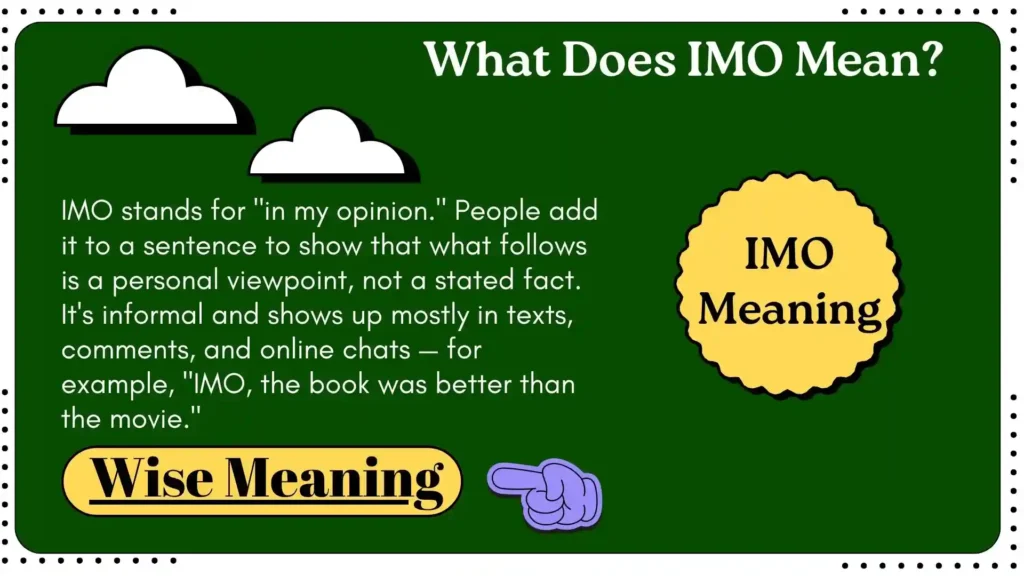
IMO stands for “in my opinion.” People add it to a sentence to show that what follows is a personal viewpoint, not a stated fact. It’s informal and shows up mostly in texts, comments, and online chats — for example, “IMO, the book was better than the movie.”
TL;DR
- Main meaning: “In my opinion”
- Part of speech: Initialism used as a sentence adverb/interjection
- Formality: Informal — fine for texts and casual chats, too casual for most emails
- Close cousin: IMHO (“in my humble opinion”), a slightly softer version
- Common mistake: Assuming IMO always means “in my opinion” — it also stands for the International Maritime Organization
- Tone: Neutral to friendly, not inherently rude
You Might Also Like That: Grammar Meaning
What Does IMO Mean?
In texting and internet slang, IMO means “in my opinion.” It’s an initialism people type before or after a statement to flag that what they’re saying is a personal take rather than an established fact. Major dictionaries, including Merriam-Webster, recognize this as a standard definition of the abbreviation.
People reach for IMO because it does two things at once: it saves time compared to spelling out “in my opinion,” and it softens a statement by signaling that the writer knows other people might see things differently.
Example sentences
- IMO, the sequel was better than the original.
- That restaurant is overpriced, IMO.
- IMO, we should leave earlier to beat traffic.
IMO Meaning in Text: How People Actually Use It
IMO meaning in text works the same way whether it shows up in a group chat, a comment section, or a DM. It usually sits at the very start or the very end of a sentence, and it’s almost always written in casual, lowercase-friendly conversation.
| Position in sentence | Example |
|---|---|
| At the start | IMO, that show got worse after season two. |
| At the end | That show got worse after season two, IMO. |
| Standalone reply | IMO. |
Capitalization doesn’t change the meaning — “imo” and “IMO” are both common. Many style guides simply recommend capitalizing initialisms so they don’t read like typos.
IMO vs. IMHO: What’s the Difference?
These two get mixed up constantly, so here’s the actual distinction:
| Abbreviation | Full form | Tone |
|---|---|---|
| IMO | In My Opinion | Neutral, direct |
| IMHO | In My Humble Opinion | Slightly softer, more self-deprecating |
Functionally, they’re interchangeable. IMHO adds a touch of humility to the same basic idea, which is why some people use it when they’re about to disagree with someone or share a stronger take.
IMO Across Different Platforms
The core IMO meaning in text doesn’t change from app to app, but the tone can shift depending on where you see it.
- Texting (iMessage/SMS): Casual, often used between friends to soften an opinion.
- TikTok and Instagram comments: Frequently used to share a take on a video or trend without sounding like a demand.
- Twitter/X and Reddit: Can appear in debates as a way to frame a statement as personal rather than absolute.
- Work chat tools (Slack, Teams): Occasionally used in casual internal channels, but it’s still an informal marker.
You Might Also Like That: Grammar Meaning
Is IMO Rude or Aggressive?
On its own, IMO is not rude. It actually tends to soften a statement rather than sharpen it, since it openly frames the sentence as one person’s view instead of a universal fact. Tone comes from the rest of the sentence and the context, not from the abbreviation itself. “IMO, tacos are better than burgers” reads very differently from a sentence that’s already blunt or dismissive before IMO gets added — the abbreviation isn’t what creates the edge.
Is IMO Okay to Use at Work?
IMO is generally too informal for client emails, reports, or formal messages. It fits better in casual team chats where shorthand is already common. If you want to express the same idea more formally, consider these alternatives:
| Informal | Formal alternative |
|---|---|
| IMO, we should push the deadline. | In my view, we should consider pushing the deadline. |
| IMO this design works better. | I believe this design is the stronger option. |
Other Meanings of IMO
Outside of texting, IMO has a completely different, well-established meaning: the International Maritime Organization, a United Nations agency that regulates international shipping and maritime safety. Merriam-Webster lists both meanings side by side, since context makes clear which one applies. You’ll rarely confuse the two in practice — a text from a friend obviously isn’t referring to a UN shipping agency, and a shipping news article obviously isn’t sharing a personal opinion.
Common Mistakes to Avoid
- Using IMO in formal writing. It reads as too casual for emails, cover letters, or professional reports.
- Assuming it only means “in my opinion.” In maritime, shipping, or UN-related contexts, IMO usually refers to the International Maritime Organization.
- Overusing it in a single message. Adding IMO to every sentence in a paragraph gets repetitive fast.
- Confusing IMO with IMHO and assuming they mean different things. They express the same basic idea with a slightly different tone.
Related Abbreviations
- IMHO – In My Humble Opinion
- TBH – To Be Honest
- NGL – Not Gonna Lie
- AFAIC – As Far As I’m Concerned
Frequently Asked Questions
What does IMO mean in a text message?
IMO means “in my opinion.” It’s added to a sentence to show the statement is a personal view rather than a fact.
Is IMO the same as IMHO?
They mean the same thing in practice. IMHO stands for “in my humble opinion” and simply adds a slightly more modest tone.
Is it rude to say IMO?
No. IMO generally softens a statement by acknowledging it’s a personal opinion. Any perceived rudeness usually comes from the rest of the message, not the abbreviation.
Can IMO mean something other than “in my opinion”?
Yes. IMO can also stand for the International Maritime Organization, a United Nations agency focused on shipping regulations and maritime safety.
Should I capitalize IMO?
Either capitalized or lowercase is widely accepted. Capitalizing it can make it easier to recognize as an abbreviation rather than a typo.
Is IMO appropriate for work emails?
It’s best avoided in formal emails and reports. Use full phrases like “in my view” or “I believe” instead in professional writing.
Where did IMO come from?
Like many texting abbreviations, IMO grew out of early online chat and forum culture, where users looked for quick ways to flag personal opinions during fast-moving conversations.
Final Thoughts
At its core, the IMO meaning in text comes down to one simple idea: it flags a statement as a personal opinion rather than a stated fact. Whether you see it in a text, a TikTok comment, or a group chat, IMO is doing the same small job — softening a statement and reminding the reader that someone else might see things differently.
If you’re texting with friends or chatting casually online, IMO is a safe, widely understood way to share a take. Just save it for casual conversations, and reach for a full phrase like “in my view” when you’re writing something more formal.