
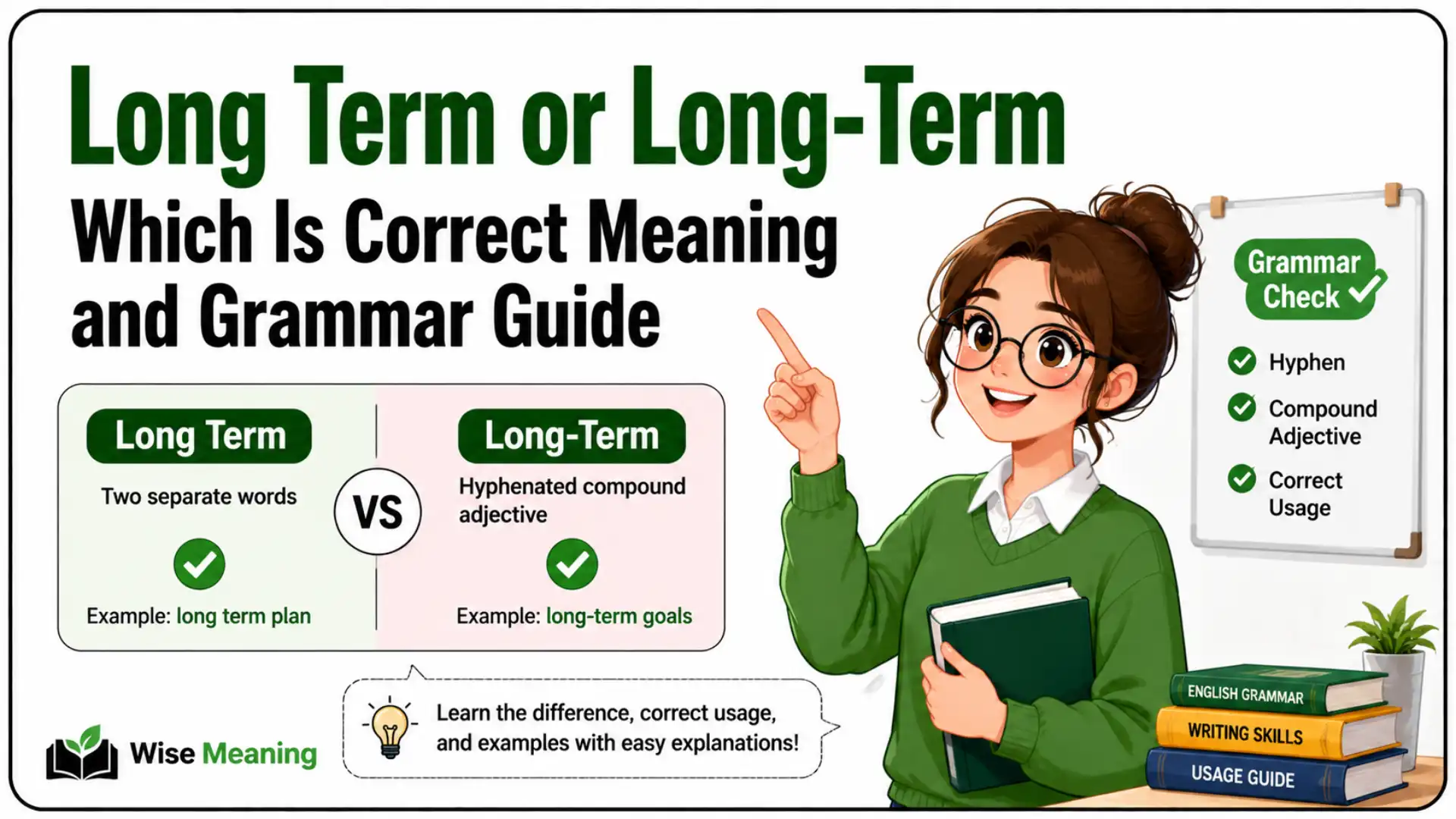
Have you ever paused while writing and wondered whether you should use long term, long-term, or even longterm? You’re not alone. Many English learners, students, professionals, and writers search for the long term meaning because they want to know the correct spelling, grammar, and usage. While these forms look similar, they do not always serve the same purpose. Understanding the difference can make your writing clearer, more professional, and grammatically correct.
In this guide, you’ll learn what does long term mean, the difference between long term vs long-term, when to use a hyphen, and why longterm is usually incorrect. You’ll also discover simple grammar rules, practical sentence examples, common mistakes, synonyms, and answers to frequently asked questions. Whether you’re writing a business email, an academic paper, or everyday messages, this easy-to-follow guide will help you use long term and long-term with confidence.
📌 Quick Answer
Long term means a long period of time or something that continues into the future. The correct spelling depends on how the phrase is used in a sentence. Use long term (two words) when it functions as a noun phrase, such as “In the long term, this plan will save money.” Use long-term (with a hyphen) when it comes before a noun as an adjective.
Such as “She made a long-term investment.” Avoid writing longterm as one word because it is not considered correct in standard English. A simple rule to remember is: if the phrase comes before a noun, use a hyphen; otherwise, write it as two separate words.
📌 TL;DR
- Long term refers to a long period of time or something that continues into the future.
- Use long-term (with a hyphen) before a noun, such as:
- ✅ long-term goal
- ✅ long-term investment
- Use long term (without a hyphen) when it acts as a noun phrase, such as:
- ✅ in the long term
- ✅ over the long term
- ❌ Longterm (one word) is not the correct spelling in standard English.
- 📝 Easy rule to remember: Use a hyphen before a noun; otherwise, use two separate words.
- ✔️ Following this rule helps you write clearly, correctly, and confidently in both formal and everyday English.
You Might Also Like That: Plurals of Ox and Fox Explained
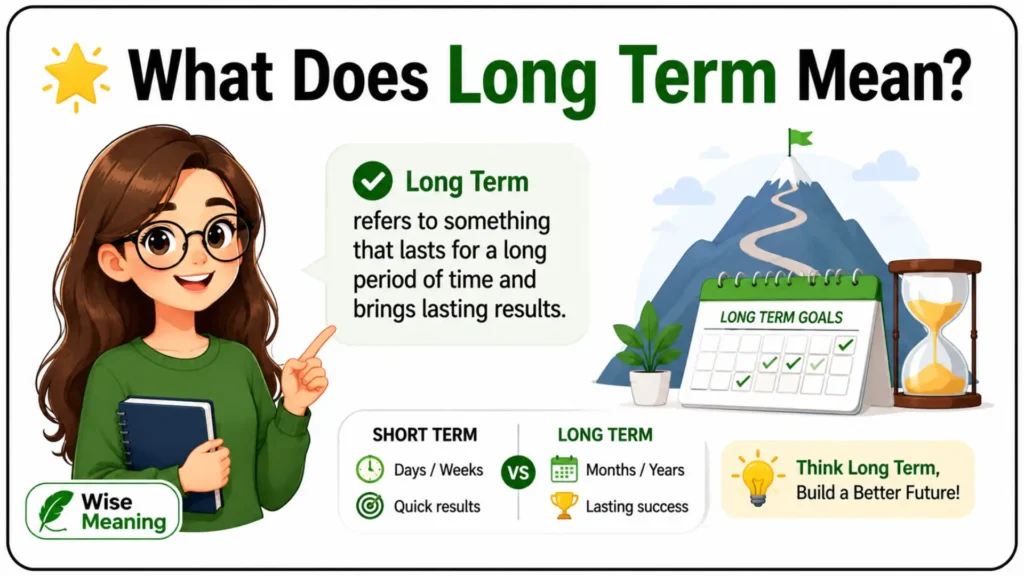
🌟 What Does Long Term Mean?
The long term meaning is a lengthy period of time rather than a short or immediate one. People use this phrase to talk about goals, plans, decisions, or results that happen over months or even years. Whether you discuss education, business, health, or relationships, long term focuses on future outcomes instead of quick results. 📖 Understanding what does long term mean also helps you choose the correct form—long term or long-term—depending on the sentence structure.
🔄 Long Term vs Long-Term
Many writers feel confused about long term vs long-term, but the difference is easy once you know the grammar rule. Long-term works as a compound adjective before a noun, while long term acts as a noun phrase or appears after a verb. This small punctuation change improves readability and makes your writing more professional. ✍️ If you are wondering is it long term or long-term, the answer depends on how you use the phrase.
📊 Quick Comparison Table
| Feature | Long Term | Long-Term |
| Part of speech | Noun phrase | Compound adjective |
| Uses a hyphen | ❌ No | ✅ Yes |
| Position | Usually after a verb or in a phrase | Before a noun |
| Example | We will benefit in the long term. | They created a long-term strategy. |
| Correct spelling | ✅ Yes | ✅ Yes |
💡 Tip: Never write longterm as one word in standard English.
✍️ When Should You Use Long-Term With a Hyphen?
Use long-term when it describes a noun. In this case, it works as a compound adjective, so the hyphen joins the two words to make the meaning clear. This grammar rule appears in formal writing, business reports, academic papers, and everyday English. ✅ If the phrase comes before the noun, add the hyphen. Following this simple rule makes your writing smoother and more accurate.
✅ Examples
- 📈 We need a long-term investment strategy.
- 🎯 She has a long-term goal to become a doctor.
- 💼 The company created a long-term business plan.
- ❤️ They are in a long-term relationship.
- 🏥 The patient requires long-term care.
Remember: If long-term directly describes a noun, always use the hyphen.
📝 When Should You Use Long Term Without a Hyphen?
Use long term without a hyphen when it acts as a noun phrase instead of describing another noun. You will often see it after a verb or in expressions like in the long term or over the long term. In these cases, the phrase stands on its own, so no hyphen is needed. ✅ Learning when to use long term correctly helps you avoid one of the most common grammar mistakes in English writing.
✅ Examples
- 📈 This decision will help us in the long term.
- 💰 We should think about the long term before investing.
- 🎓 The new study plan benefits students over the long term.
- 🌱 Healthy habits always pay off in the long term.
- 💼 Their efforts produced excellent results in the long term.

You Might Also Like That: Cancellation vs Cancelation
❌ Is “Longterm” One Word?
Many people search “Is longterm one word?” because they see different spellings online. The correct answer is no. Longterm is not the standard spelling in modern English. The accepted forms are long term and long-term, depending on the sentence. Most grammar references and professional style guides recommend avoiding longterm altogether. ⭐ If you want clear and correct writing, always choose the proper form based on grammar instead of combining the words into one.
⚠️ Common Spelling Mistakes
| ❌ Incorrect | ✅ Correct |
| longterm goal | long-term goal |
| longterm planning | long-term planning |
| in the longterm | in the long term |
| longterm effects | long-term effects |
💡 Easy Rule: Never write “longterm.” Use long-term before a noun and long term in all other appropriate situations.
🌍 Long Term in Different Contexts
The phrase long term appears in many situations, but its meaning always relates to the future. Understanding different contexts helps you use the expression naturally in conversations and writing. Whether you discuss business, education, healthcare, or relationships, long term describes plans, benefits, or results that develop over time. 📚 Seeing the phrase in real-life situations makes it easier to remember the correct grammar and spelling.
💼 Business
Companies create long-term strategies to achieve steady growth instead of focusing only on short-term profits.
💰 Finance
Many investors choose long-term investments because they may produce better returns over several years.
🎓 Education
Students set long-term academic goals to improve their skills and prepare for future careers.
🏥 Healthcare
Doctors often recommend long-term treatment or long-term care for ongoing medical conditions.
❤️ Relationships
A long-term relationship is built on trust, commitment, and shared goals for the future.
🚀 Career
Professionals create long-term career plans to gain experience, learn new skills, and achieve success.
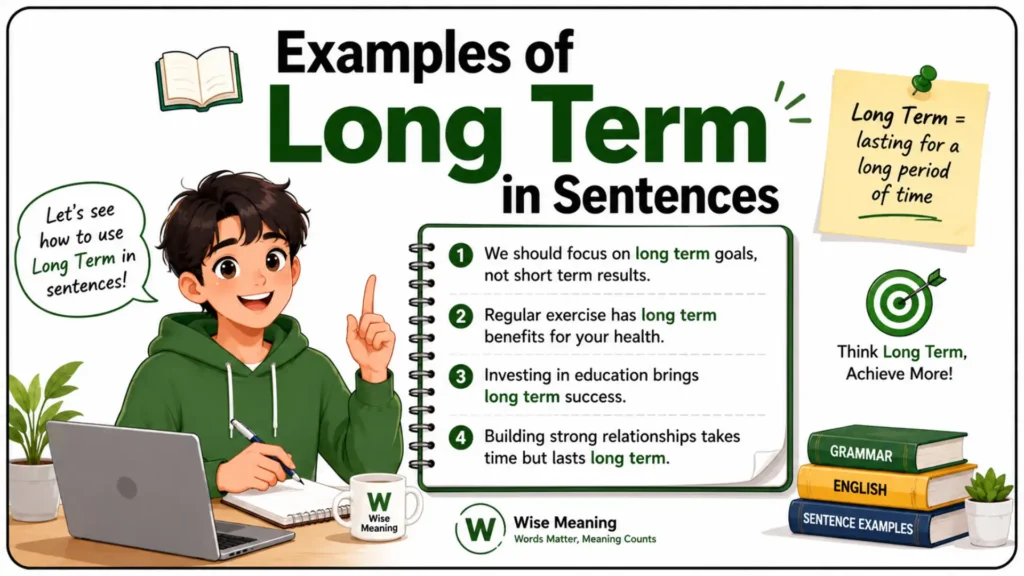
📖 Examples of Long Term in Sentences
Reading examples is one of the easiest ways to understand how to use long term correctly. Notice how long-term comes before a noun, while long term appears in phrases or after verbs. This simple pattern will improve your grammar and make your writing sound more natural.
- ✅ She developed a long-term plan for her business.
- ✅ We expect these changes to help in the long term.
- ✅ A long-term investment usually requires patience.
- ✅ The school encourages long-term learning habits.
- ✅ They discussed the long term before making a decision.
- ✅ Regular exercise supports long-term health.
- ✅ He wants a long-term career in engineering.
- ✅ Thinking in the long term leads to better decisions.
⚠️ Common Mistakes to Avoid
Many writers understand the long term meaning but still make grammar mistakes. Most errors happen because people forget the hyphen rule or write longterm as one word. Paying attention to sentence structure will help you avoid these common problems and improve your writing.
🚫 Mistakes and Corrections
| ❌ Incorrect | ✅ Correct |
| longterm plan | long-term plan |
| We need a long term plan. | We need a long-term plan. |
| The project helps in the long-term. | The project helps in the long term. |
| She made a long-term decision. | She made a long-term decision. |
💡 Remember: Use the hyphen only when long-term directly describes a noun. Otherwise, write long term as two separate words.
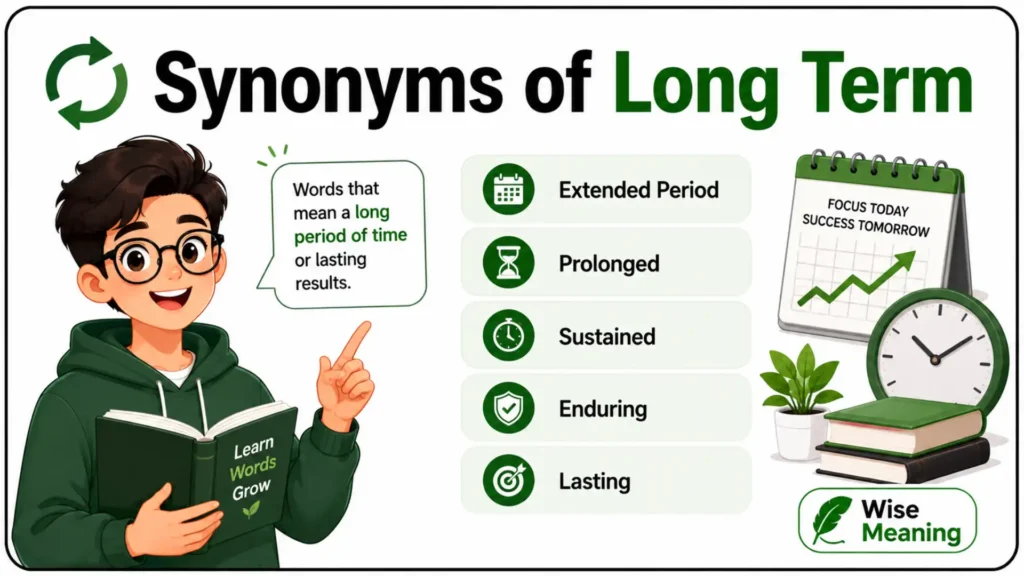
🔄 Synonyms of Long Term
Sometimes, you can replace long term with another word to avoid repetition. Using synonyms also makes your writing more natural and engaging. However, remember that not every synonym fits every sentence, so always choose one that matches the context. While long term often refers to something lasting for a long period, some alternatives focus on duration, while others emphasize future planning or continuous progress.
📋 Common Synonyms
| Synonym | Best Used For |
| Lasting | Something that continues for a long time |
| Enduring | Strong relationships or effects |
| Extended | Longer periods or schedules |
| Prolonged | Events or situations lasting longer than expected |
| Ongoing | Activities that continue without stopping |
| Sustained | Continuous effort or growth |
| Future-oriented | Planning and strategy |
| Long-lasting | Products, memories, or results |
💡 Tip: Use these synonyms naturally. For grammar explanations, keep using long term and long-term to maintain clarity.
You Might Also Like That: Cancellation vs Cancelation
⏳ Opposite of Long Term
Understanding the opposite of long term helps you use both expressions correctly. While long term focuses on future goals and lasting results, its opposites describe temporary situations or immediate outcomes. Choosing the right word depends on the time frame you want to express.
📋 Common Opposites
| Opposite | Meaning |
| Short term | Lasting a brief period |
| Short-term | Describes a noun before it |
| Temporary | Not permanent |
| Immediate | Happening right away |
| Brief | Lasting only a short time |
| Short-lived | Ending quickly |
📌 Example:
- ✅ We need a short-term solution for today’s problem.
- ✅ We should also think in the long term before making a final decision.
💬 Long Term in Popular English Phrases
Native English speakers use long term in many common expressions. Learning these phrases will improve both your speaking and writing skills. They also help you understand how the phrase naturally appears in business, education, finance, and everyday conversations.
🌟 Common Expressions
- 📈 In the long term – Over a long period of time.
- 🌍 Over the long term – Looking at future results.
- 🎯 Long-term goal – An objective that takes years to achieve.
- 💰 Long-term investment – Money invested for future growth.
- ❤️ Long-term relationship – A relationship that lasts for many years.
- 📚 Long-term success – Success built through patience and consistent effort.
- 🏥 Long-term care – Medical or personal care provided over an extended period.
💡 These expressions appear frequently in professional writing and everyday English, making them useful to learn.
📖 Style Guide Recommendations
Most professional writing guides follow the same grammar rule for long term and long-term. The exact wording may vary slightly, but the general recommendation remains consistent. Using the correct form improves readability and helps your writing look polished and professional. Whether you write emails, reports, blog posts, or academic papers, following this rule shows attention to detail.
✅ Best Practices
- ✍️ Use long-term before a noun.
- ✍️ Use long term after a verb or in phrases like in the long term.
- ✍️ Never write longterm as one word.
- ✍️ Stay consistent throughout your document.
- ✍️ Proofread your work before publishing.
⭐ Following these simple writing habits will help you avoid unnecessary grammar mistakes.
✅ Quick Grammar Checklist
Before you finish writing, use this simple checklist to make sure you have chosen the correct form. These quick reminders make it easy to remember the rule whenever you write long term or long-term.
✔️ Grammar Checklist
- ✅ Before a noun? Use long-term.
- ✅ After a verb? Use long term.
- ✅ Writing “in the long term”? No hyphen.
- ✅ Writing “long-term plan”? Add the hyphen.
- ✅ Writing “longterm”? ❌ Incorrect.
- ✅ Need professional writing? Follow the same rule consistently.
💡 Easy Memory Trick:
If it describes a noun, use a hyphen. If it stands alone, don’t.
❓ Frequently Asked Questions
Is it long term or long-term?
Both are correct. Use long-term before a noun and long term when the phrase stands alone or follows a verb.
Is longterm one word?
No. Long term is not the standard spelling in English. Use long term or long-term instead.
What does long term mean?
The long term meaning is a long period of time or something that continues into the future rather than ending quickly.
When should I use a hyphen?
Use a hyphen when long-term comes before a noun, such as long-term goal or long-term investment.
What is the difference between long term and long-term?
Long term is usually a noun phrase, while long-term is a compound adjective that describes a noun.
What is the opposite of long term?
Common opposites include short term, temporary, brief, and immediate.
Can I use long term in formal writing?
Yes. Both long term and long-term are accepted in formal writing when used according to the correct grammar rule.
🎯 Conclusion
Understanding the long term meaning becomes simple once you know the grammar behind it. The key difference is easy to remember: use long-term with a hyphen when it describes a noun, and use long term without a hyphen when it acts as a noun phrase or appears in expressions like in the long term. Avoid writing longterm, as it is not the standard spelling.
By following these simple rules, you can write with greater confidence and accuracy. Whether you’re discussing long-term goals, long-term investments, long-term care, or planning for the long term, using the correct form makes your writing clearer and more professional. Keep this guide as a quick reference whenever you’re unsure, and you’ll avoid one of the most common grammar mistakes with ease.