
Confusing your and you’re is one of the most common grammar mistakes in everyday English, especially in texts, chats, emails, and social media. Although both words sound the same, they have different meanings and uses. Your shows possession or a connection to someone, while you’re is the short form of you are.
The good news is that the difference between your vs you’re is simple once you know the basic rule. In this guide, you’ll learn when to use your or you’re, see clear examples, and discover an easy “you are” test that can help you choose the correct word every time.
Your vs You’re: Quick Answer
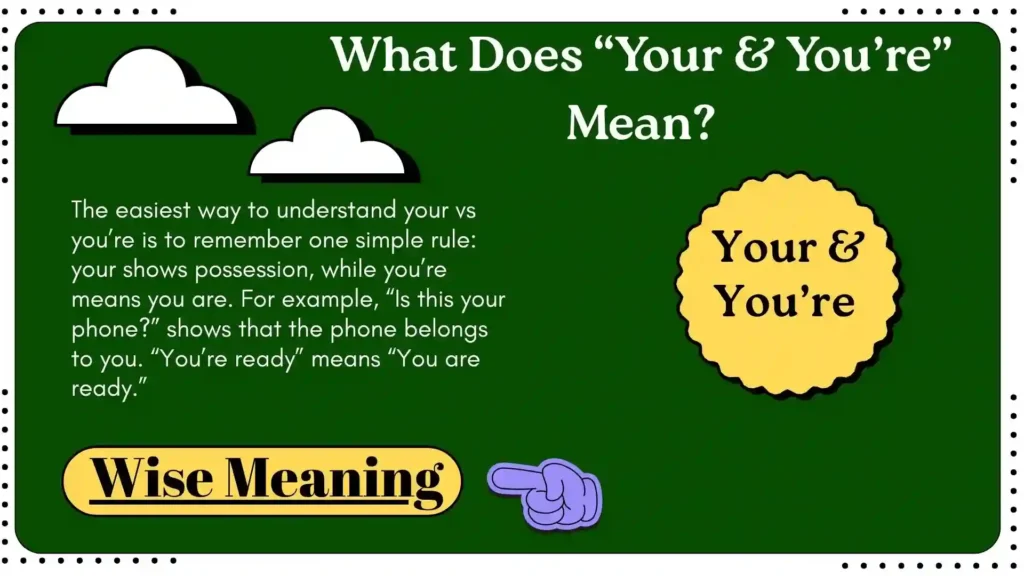
The easiest way to understand your vs you’re is to remember one simple rule: your shows possession, while you’re means you are. For example, “Is this your phone?” shows that the phone belongs to you. “You’re ready” means “You are ready.”
| Word | Meaning | Example |
| Your 🔑 | Shows possession | Your book is here. |
| You’re ✨ | Means “you are” | You’re very kind. |
If you are unsure which word to use, try replacing you’re with you are. If the sentence still makes sense, you’re is correct.
TL;DR
If you only remember two rules from this guide, remember these:
- 🔑 Your = possession or something connected to you.
- ✨ You’re = you are.
- Your usually comes before a noun: “your phone.”
- You’re can describe someone: “you’re happy.”
- Use the “you are” test whenever you feel unsure.
- “You’re welcome” is correct as a reply to “thank you.”
- “You’re right” means “you are correct.”
- “Your right” means a right or entitlement belonging to you.
These simple rules cover most everyday uses of your vs you’re.
You Might Also Like That: FOMO Meaning
What Does “Your” Mean?
Your is a possessive adjective or possessive determiner. It shows that something belongs to, relates to, or connects with the person being addressed. You normally place your before a noun, such as “your car,” “your friend,” or “your idea.” It does not mean “you are.”
For example, “I like your jacket” tells us that the jacket belongs to you. Other examples include your name, your house, your family, and your opinion. A useful way to remember the your meaning is: your = belongs to you 🔑.
How to Use “Your” in a Sentence
Use your when you want to show ownership or connection. It usually comes before a noun or noun phrase.
- Your phone is ringing. 📱
- I like your new shoes.
- What is your name?
- Please bring your notebook.
- I understand your concern.
Notice that each sentence connects something to the person you are speaking to. This is the main rule for correct usage of your. If the word does not mean possession or connection, check whether you’re might be the correct choice.
Examples of “Your”
Here are some simple your examples from everyday English:
- Is this your bag?
- I love your idea. 💡
- Where is your brother?
- Please check your email.
- What is your favorite movie?
- I remember your story.
In every example, your connects the person with a thing, person, idea, or quality. This makes it easy to spot your in a sentence. When you see your, ask yourself, “Does this show something connected to you?” If the answer is yes, your is probably correct.
What Does “You’re” Mean?
You’re is a contraction of you are. The apostrophe replaces the missing letter in the two-word form. For example, “You’re happy” means “You are happy.” The word can describe a person, action, feeling, condition, or situation.
The key part of the you’re meaning is always you are. If you can expand the word to “you are” and the sentence still makes sense, use you’re. This simple rule works in most everyday situations and makes the difference between your and you’re much easier to understand.
You Might Also Like That: Opp Meaning
How to Use “You’re” in a Sentence
Use you’re whenever the sentence means you are. It can come before an adjective, verb form, or other phrase.
- You’re very helpful. 😊
- You’re doing a great job.
- You’re ready for the test.
- You’re going to love this.
- You’re right about that.
Try expanding each sentence. For example, “You’re doing a great job” becomes “You are doing a great job.” Because the expanded sentence works, you’re is the correct form. This you are test provides a quick way to check your grammar.
Examples of “You’re”
Here are more examples showing you’re in a sentence:
- You’re my best friend.
- You’re very patient.
- You’re invited to the party. 🎉
- You’re making good progress.
- You’re always welcome here.
- You’re exactly where you need to be.
In each sentence, you can replace you’re with you are. This confirms that the contraction works correctly. Remember, you’re = you are. If “you are” sounds wrong after replacing the word, do not use you’re.
Your vs You’re: What’s the Difference?
The main difference between your and you’re comes down to grammar and meaning. Your shows possession or connection, while you’re is a contraction meaning you are. Although both words sound the same, they perform different jobs in a sentence.
| Feature | Your 🔑 | You’re ✨ |
| Meaning | Possession or connection | You are |
| Grammar | Possessive word | Contraction |
| Apostrophe | No | Yes |
| Example | Your phone | You’re ready |
| Easy test | Belongs to you | You are |
This comparison makes the your vs you’re difference clear. Their pronunciation may be similar, but their written forms and meanings are different.
When to Use “Your”
Use your when you talk about something that belongs to someone or connects to them. It normally comes before a noun, such as “your car,” “your answer,” or “your teacher.” It can also show relationships, opinions, traits, or other connections.
For example, “I like your style” describes something connected to you. “Where is your phone?” refers to a phone associated with you. 🔑 When deciding when to use your, look for a noun that follows it and ask whether the sentence shows possession or connection.
When to Use “You’re”
Use you’re when you mean you are. This form works when you describe someone or talk about what they are doing, feeling, or experiencing.
For example, “You’re tired” means “You are tired,” while “You’re learning quickly” means “You are learning quickly.” ✨ When deciding when to use you’re, simply expand it to you are. If the complete sentence sounds natural and keeps the intended meaning, you have found the correct word.
The “You Are” Test: An Easy Way to Tell Them Apart
The “you are” test is one of the easiest ways to choose between your or you’re. When you see you’re, replace it with you are. If the sentence still makes sense, keep you’re. If it sounds incorrect, use your instead.
You Might Also Like That: Rizz Meaning
Example:
❌ Your going home.
✅ You’re going home.
→ You are going home.
Example:
❌ You’re phone is ringing.
✅ Your phone is ringing.
💡 Quick trick: You’re = You are. Your = Belongs to you.
Your vs You’re Examples
Examples can make the your vs you’re rule much easier to remember. Look at how one small change can completely change the meaning.
| Incorrect | Correct | Why? |
| Your very kind. | You’re very kind. | You are very kind. |
| You’re car is new. | Your car is new. | The car belongs to you. |
| Your doing well. | You’re doing well. | You are doing well. |
| I like you’re idea. | I like your idea. | The idea is connected to you. |
| Your invited. | You’re invited. | You are invited. |
These your vs you’re examples show why checking the meaning matters more than how the words sound.
Common Your vs You’re Mistakes
People often confuse your and you’re because they sound alike. The mistake becomes especially common in fast texting, social media posts, and casual writing. The good news is that you can fix most errors by using the you are test.
Common mistakes include:
- ❌ Your amazing → ✅ You’re amazing
- ❌ Your going home → ✅ You’re going home
- ❌ You’re car → ✅ Your car
- ❌ Your invited → ✅ You’re invited
- ❌ You’re welcome → see the explanation below
Always check the meaning before choosing the spelling.
“Your Welcome” or “You’re Welcome”?
The correct phrase for responding to thank you is “you’re welcome.” Here, you’re means you are, so the phrase means “you are welcome.” For example: “Thanks for helping me.” → “You’re welcome!” 😊
Your welcome can appear in a sentence, but it has a different meaning. It would refer to a welcome that belongs or relates to someone. For example, “I appreciated your welcome when I arrived.” Here, your shows possession or connection. So, for the common polite reply, always choose you’re welcome.
“Your Right” or “You’re Right”?
Both your right and you’re right can be correct, but they have different meanings. You’re right means you are correct. For example, “I checked the answer, and you’re right.” ✨
Your right uses your to show possession or connection. It can refer to something belonging to you, such as “It is your right to speak.” The easiest way to check is to use the you are test. If “you are right” makes sense, use you’re right. If you mean a right that belongs to someone, use your right.
You Might Also Like That: TS Meaning in Text
Your vs You’re in Texting and Chat
The your vs you’re mistake often appears in texting, chat, and social media because people type quickly and may not stop to check grammar. For example, someone might write, “Your so funny 😂” when they mean “You’re so funny.”
In casual messages, people may understand the meaning even when the spelling is wrong. However, using the correct form still makes your writing clearer and more polished. ✉️ The same rule works everywhere: your = possession, while you’re = you are. Use the rule whether you are texting a friend or writing a professional message.
Why Do “Your” and “You’re” Sound the Same?
Your and you’re are commonly confused because they have the same or very similar pronunciation in standard English. Words that sound alike but have different meanings or spellings are called homophones.
This explains why people can choose the wrong form when writing. 👂 You may hear the correct word in your head, but the sound alone does not tell you which spelling to use. When writing, focus on the meaning and grammar, not just the sound. Ask: “Does this mean belongs to you, or does it mean you are?”
Your vs You’re vs Yours
It also helps to understand your vs you’re vs yours. Your shows possession and normally comes before a noun: “That is your book.” Yours also shows possession, but it usually stands alone: “That book is yours.”
You’re is different because it means you are. 🔑
- Your → Your phone is here.
- Yours → The phone is yours.
- You’re → You’re using the phone.
Understanding these three forms can prevent several common grammar mistakes and make possessive forms easier to recognize.
How to Remember Your vs You’re
You do not need a complicated grammar rule to remember the difference. Use this simple memory trick:
🧠 Your = belongs to you
✨ You’re = you are
For example, “Is this your jacket?” means the jacket belongs to you. “You’re wearing a jacket” means “You are wearing a jacket.”
Another useful trick is to look for the apostrophe in you’re. The apostrophe helps remind you that two words have been shortened: you + are = you’re. With a little practice, this rule becomes automatic.
You Might Also Like That: Elicit vs Illicit
Your vs You’re Practice Quiz
Test yourself by choosing your or you’re in each sentence:
- ___ very talented.
- Where is ___ backpack?
- I like ___ new haircut.
- ___ going to enjoy this movie.
- Is this ___ seat?
- ___ always welcome here.
- Did you bring ___ keys?
- I think ___ correct.
Answers
- You’re
- your
- your
- You’re
- your
- You’re
- your
- You’re
💡 If you can replace the blank with you are, choose you’re. Otherwise, check whether your shows possession.
Frequently Asked Questions
What is the difference between your and you’re?
Your shows possession or connection, while you’re is a contraction of you are. For example, “I like your shirt” shows that the shirt is connected to you. “You’re kind” means “You are kind.” 🔑✨
When should I use your or you’re?
Use your when you show possession or connection, such as “your car.” Use you’re when you mean you are, such as “you’re ready.” The you are test can help you choose.
Is “your welcome” or “you’re welcome” correct?
You’re welcome is correct when you respond to someone who says thank you. It means you are welcome. Your welcome can be grammatically correct in a different context when “your” shows possession.
How can I remember your and you’re?
Remember this simple rule: your = belongs to you 🔑 and you’re = you are ✨. If you can replace you’re with “you are,” the contraction is correct.
Can you’re always be replaced with you are?
In terms of meaning, you’re represents you are, so the two forms are interchangeable in most normal sentences. However, the full form “you are” may sound more formal or may add emphasis.
Final Thought
The difference between your and you’re looks confusing at first, but the rule stays simple. Your shows possession or connection, while you’re means you are. Once you understand these two meanings, you can avoid most common mistakes in writing.
Whenever you hesitate, stop and use the “you are” test. If “you are” works, choose you’re. If you mean something belongs or relates to someone, choose your. 🧠 With regular practice, choosing the right word will become natural.