
![Sic Meaning_ What Does [sic] Mean in Text, Writing, and Quotes](https://wisemeaning.com/wp-content/uploads/2026/08/Sic-Meaning_-What-Does-sic-Mean-in-Text-Writing-and-Quotes.webp)
Have you ever read a news article, book, research paper, or online post and noticed the word [sic] in brackets? If so, you may have wondered about the sic meaning, why writers use it, and whether it points out a mistake. Many people also search for sic meaning in text because they are unsure if it has a different meaning in text messages or social media.
The truth is that sic is not internet slang. Instead, it is a Latin word used in formal writing to show that a quoted sentence has been copied exactly as it appeared in the original source, even if it contains a spelling, grammar, or factual mistake. In this guide, you’ll learn what does sic mean, what does [sic] mean, how to use it correctly, when to avoid it, and see plenty of real-life examples.
⭐ Quick Answer
Sic is a Latin word that means “thus” or “so.” It appears as [sic] in square brackets to show that a quote has been copied exactly as it appeared in the original source, even if it contains a spelling, grammar, or factual mistake. In other words, [sic] tells readers that the error belongs to the original writer, not the person quoting it.
If you’re searching for sic meaning or what does [sic] mean, this is the simplest explanation. In text messages, sic is uncommon and usually keeps this same editorial meaning rather than acting as internet slang.
📌 TL;DR
- Sic is a Latin word meaning “thus” or “so.”
- [sic] is placed in square brackets to show that a quotation has been copied exactly as it appeared in the original source, including any spelling, grammar, or factual mistakes.
- It tells readers that the error belongs to the original writer, not the person quoting the text.
- You will commonly see [sic] in books, newspapers, research papers, legal documents, and academic writing.
- Sic meaning in text is usually the same as its editorial meaning—it is not a common texting slang.
- Use [sic] only when preserving the original wording is important. Avoid using it to mock someone’s mistakes or when paraphrasing instead of quoting directly.

You Might Also Like That: Past Tense of See
📖 What Does Sic Mean?
The sic meaning is straightforward. It comes from Latin and means “thus” or “so.” Writers place [sic] after a word or sentence in a quotation to show that it has been copied exactly, including any mistakes or unusual wording. This practice helps preserve the original wording while making it clear that the mistake is not the editor’s.
You will often see [sic] in books, newspapers, academic writing, legal documents, and journalism. It supports quotation accuracy and keeps the quoted material true to the original source. That is why sic in writing remains an important editorial tool.
💬 What Does Sic Mean in Text?
Many people search for sic meaning in text or what does sic mean in text messages because they think it might be texting slang. In reality, sic is not a common chat abbreviation like LOL or BRB. Instead, it usually keeps its editorial meaning even in emails, messages, or social media posts.
For example, someone may quote another person’s message and add [sic] after a mistake to show they copied it exactly. Although this happens occasionally, most casual conversations never use [sic]. If you see it in a text, it almost always refers to the original wording, not a hidden slang meaning.
📝 Why Is Sic Written Inside Brackets?
📌 The Purpose of Square Brackets
The square brackets around [sic] tell readers that the word was added by the person quoting the text, not by the original author. This small detail prevents confusion and improves quotation accuracy.
Without brackets, readers might think sic was part of the original sentence. The brackets clearly show it is an editorial note explaining that the quotation has been copied exactly. This is why almost every professional publication writes [sic] instead of simply sic.
🌍 Where Did the Word Sic Come From?
The word sic comes from Latin, where it means “thus” or “so.” For centuries, scholars, editors, and writers have used it to preserve the original spelling and wording of quotations. As publishing became more organised, [sic] became a standard editorial practice.
Today, style guides and publishers still recommend [sic] when writers need to reproduce a quotation exactly. Its long history explains why it continues to appear in research papers, books, newspapers, court documents, and academic writing around the world.
✅ How to Use [sic] Correctly
✍️ Basic Rules
Use [sic] only when quoting someone’s exact words and the original contains a mistake or unusual wording. Place [sic] immediately after the error inside square brackets. Avoid changing the quoted text before adding it.
📚 Formatting Tips
Most style guides recommend keeping [sic] in lowercase and inside brackets. Whether it should be italicised depends on the publication’s style guide. The most important rule is to preserve the original source text without silently correcting mistakes.
![✅ How to Use [sic] Correctly](https://wisemeaning.com/wp-content/uploads/2026/08/✅-How-to-Use-sic-Correctly-1024x576.webp)
You Might Also Like That: IGH Mean in Text Explained
📋 Examples of Sic in Sentences
Examples make it easier to understand how to use sic correctly.
| 📖 Situation | ✅ Example |
| News article | “The mayor said, ‘We has [sic] completed the project.'” |
| Book quotation | “She wrote, ‘I recieved [sic] your letter yesterday.'” |
| Academic paper | “The report states, ‘The experement [sic] was successful.'” |
| “He emailed, ‘Your package has arived [sic].'” | |
| Social media | “Someone posted, ‘I definately [sic] agree.'” |
These examples show that [sic] preserves the original wording instead of correcting it.
🎯 When Should You Use Sic?
Use [sic] when accuracy matters. It is common in academic writing, journalism, legal writing, historical documents, and research papers. Editors also use it when quoting interviews or speeches exactly as they were originally spoken or written.
Adding [sic] helps readers understand that the quotation remains unchanged. This improves trust and protects the accuracy of the original source. If you are writing professionally, learning when should you use sic is an important editing skill.
🚫 When You Should Avoid Using Sic
You do not need [sic] in every quotation. Avoid using it when you paraphrase, rewrite information in your own words, or quote text without any meaningful mistakes. Adding [sic] too often can distract readers and interrupt the flow of your writing.
You should also avoid using [sic] simply to embarrass or mock another person’s spelling or grammar. Editors should use it only when it genuinely helps readers understand that the quoted material has been copied exactly.
⚠️ Common Mistakes People Make
Many beginners misunderstand the meaning of sic. One common mistake is thinking [sic] corrects an error. It does not. Instead, it tells readers that the mistake already existed in the original source.
Another mistake is forgetting the square brackets or using sic in your own sentence instead of a quotation. Some people also believe it is an abbreviation, but sic is actually a Latin word, not an acronym. Understanding these rules helps you avoid common editing errors.
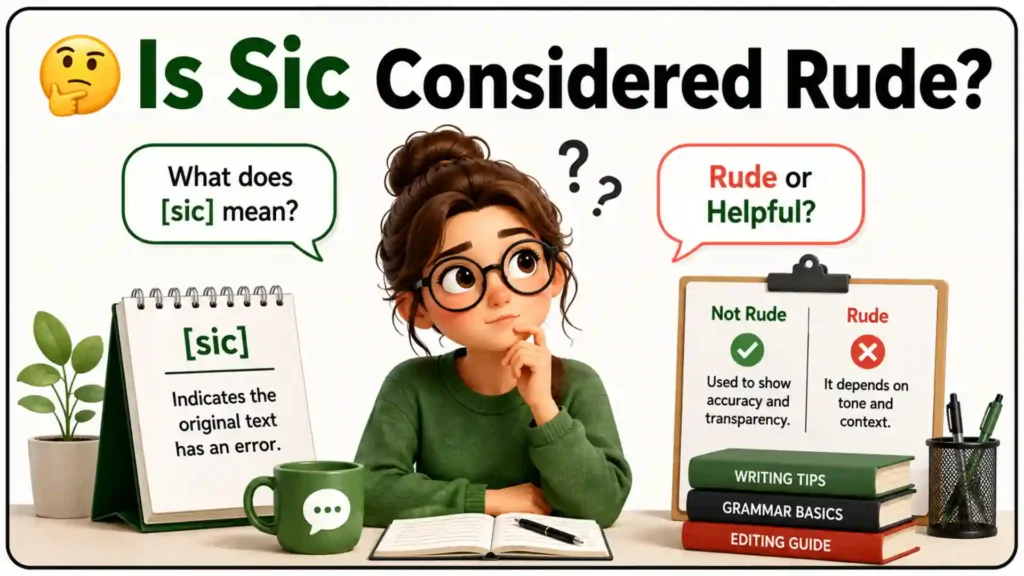
🤔 Is Sic Considered Rude?
Sometimes people wonder whether [sic] sounds rude. The answer depends on how you use it. In academic writing and journalism, it is a normal editorial tool that simply preserves the original wording.
You Might Also Like That: JSP Mean in Text
However, using [sic] to highlight small mistakes unnecessarily may appear sarcastic or disrespectful. Many editors recommend using it only when it adds clarity or protects quotation accuracy. A careful and respectful approach keeps your writing professional.
⚖️ Sic vs Corrected Quotations
When quoting someone, you have two choices. You can reproduce the text exactly and add [sic], or you can paraphrase the sentence in your own words without quoting it directly.
If the exact wording is important, keep the quotation unchanged and use [sic] where needed. If accuracy is less important, rewriting the sentence may create smoother reading. Knowing the difference between these options helps you decide which method fits your writing best.
📚 Similar Editorial Terms
Editors also use other Latin expressions in writing. Understanding them helps you recognise common editorial notes.
| 📌 Term | 📖 Meaning |
| e.g. | For example |
| i.e. | That is |
| et al. | And others |
| cf. | Compare |
| ibid. | In the same source |
Like [sic], these terms appear mainly in academic writing, research papers, and professional publications.
❓ Does Every Mistake Need [sic]?
No. Editors do not add [sic] after every spelling or grammar mistake. If the error is obvious and does not affect the meaning, many style guides suggest leaving it alone or rewriting the sentence if quoting is unnecessary.
The goal of [sic] is not to point out every typo. Instead, it helps preserve quotation accuracy when changing the original wording would be misleading. Good judgement is just as important as knowing the grammar rules.
🏛️ How Major Style Guides Recommend Using Sic
Major writing guides such as APA, MLA, and the Chicago Manual of Style recognise [sic] as a useful editorial notation. They recommend using it only when the original wording should remain exactly as written.
Professional editors also advise against overusing [sic]. If too many editorial notes appear in a quotation, readers may lose focus. Following recognised style guides keeps your writing clear, accurate, and trustworthy.
❓ Frequently Asked Questions
Is sic a real word?
✅ Yes. Sic is a real Latin word that means “thus” or “so.”
Is sic an abbreviation?
❌ No. It is not an acronym or abbreviation. It is a complete Latin word.
Does [sic] always show a spelling mistake?
❌ No. It can also highlight unusual grammar, wording, or factual statements in the original quotation.
Should sic be italicised?
Usually no, although some publishers follow different style guides.
Can [sic] be used in emails or text messages?
Yes, but it is uncommon. When it appears, it usually keeps its editorial meaning rather than becoming texting slang.
Why don’t writers simply correct the mistake?
Correcting a direct quotation changes the original wording. Using [sic] preserves the source while showing that the mistake was already there.
✅ Conclusion
Understanding the sic meaning makes reading and writing much easier. Although [sic] may look unusual at first, it serves a simple purpose: it tells readers that a quotation has been copied exactly as it appeared in the original source. Whether you encounter it in books, newspapers, academic papers, or legal documents, it protects the accuracy of quoted material.
If you remember one key point, let it be this: use [sic] only when preserving the original wording is important. Avoid overusing it, follow recognised style guides, and always focus on clear, respectful communication. Once you know what does sic mean and how to use [sic] correctly, you’ll recognise it with confidence wherever you see it.