
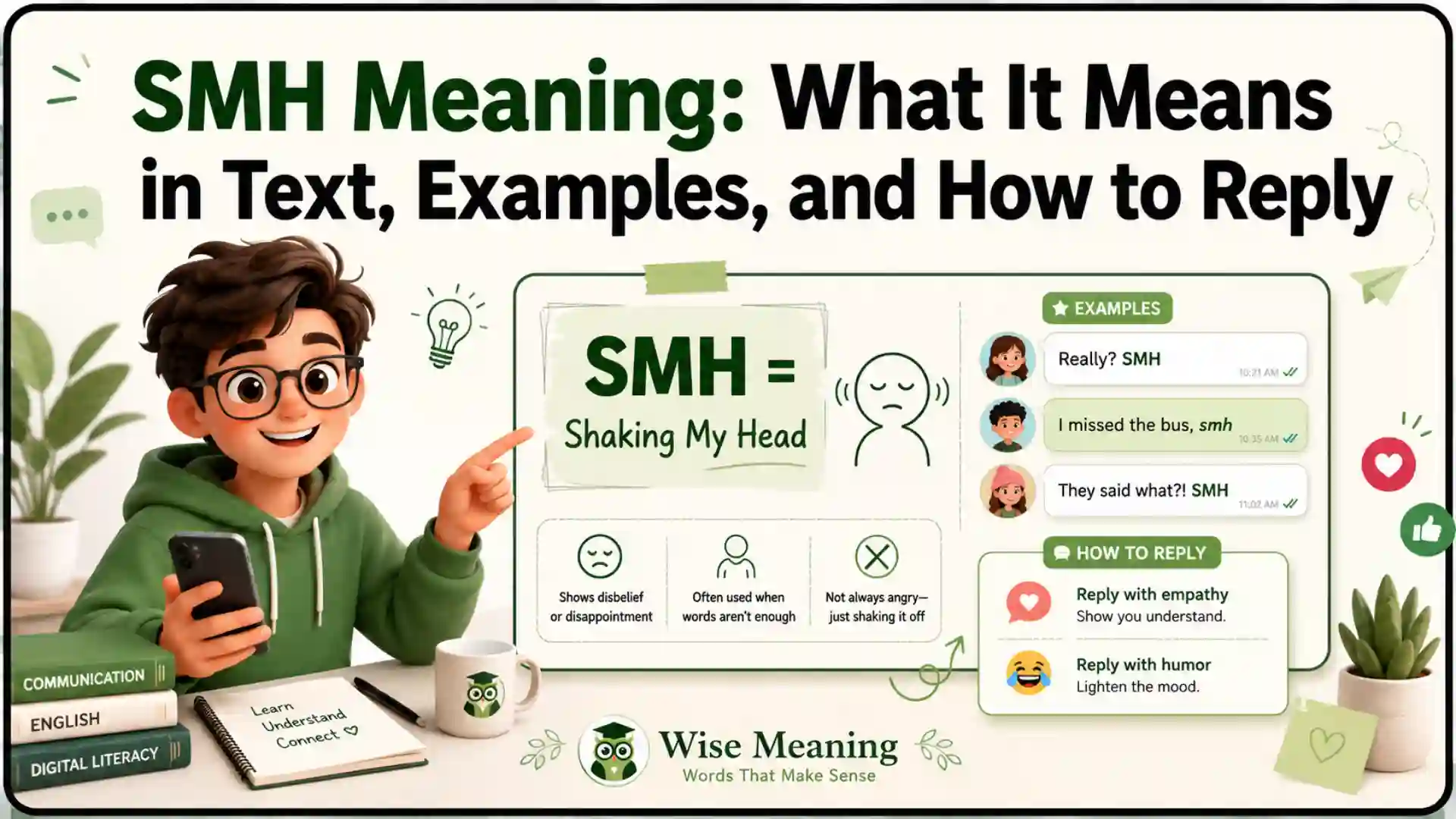
SMH means “shaking my head.” It is an informal internet and texting expression people use to show disbelief, disappointment, frustration, disapproval, or amused disbelief. You may see it in text messages, chats, comments, and social media posts. Cambridge Dictionary defines SMH as an abbreviation used when someone does not believe or approve of something, while Merriam-Webster describes it as an expression of disapproval or disbelief.
The exact tone depends on the situation. “SMH 😂” may be playful, while “SMH.” can sound more serious or judgmental. Understanding the context is often more important than the abbreviation itself.
Quick Answer
SMH means “shaking my head.” It is an informal texting and internet expression used to show disbelief, disappointment, frustration, disapproval, or amused disbelief. The exact tone depends on the context. For example, “SMH 😂” can sound playful, while “SMH.” may sound more serious or critical.
TL;DR
- SMH = Shaking My Head
- It is mainly used in texts, chats, comments, and social media.
- It can express disbelief, frustration, disappointment, disapproval, or amusement.
- SMH is informal, so it is not usually suitable for formal or professional writing.
- The expression is not automatically rude; context and tone matter.
- SMDH is a stronger variation meaning “shaking my damn head.”
- When someone sends only “SMH,” the surrounding conversation usually reveals what they mean.
You Might Also Like That: What Does [sic] Mean in Text
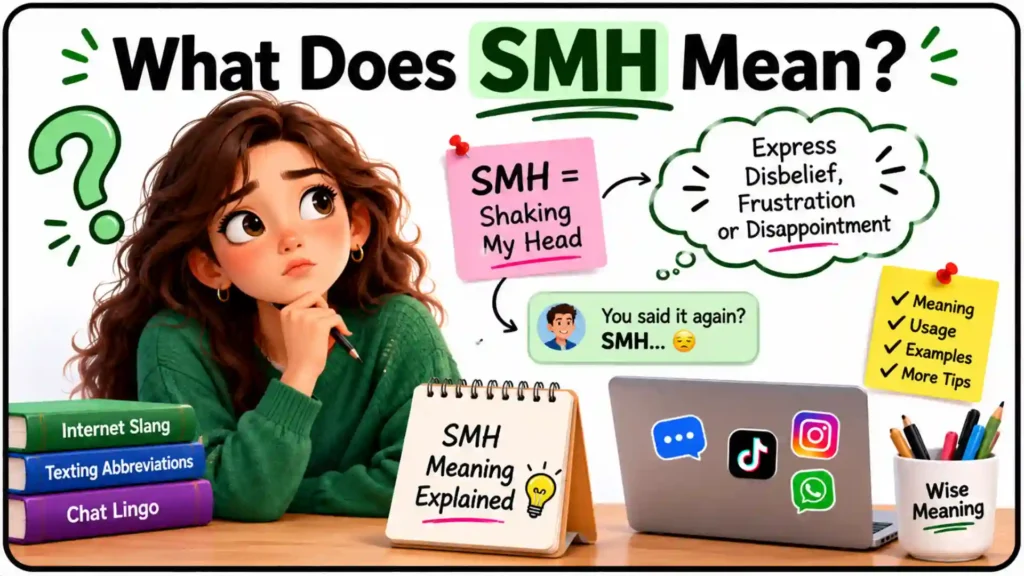
What Does SMH Mean?
SMH stands for “shaking my head.” In online communication, it represents the reaction of shaking your head when something seems unbelievable, disappointing, frustrating, or simply hard to understand. It is not normally meant literally; instead, it communicates a reaction in a quick, casual way.
For example:
“You forgot your wallet again? SMH.”
Here, the sender is probably expressing mild frustration or disbelief, rather than saying they are physically shaking their head. SMH is an informal abbreviation, so it fits casual conversations much better than formal writing.
What Does SMH Mean in Texting?
In a text message, SMH usually means that the sender is reacting negatively or incredulously to something that happened. It can express disappointment, frustration, disapproval, surprise, or amusement depending on the context. Cambridge specifically lists social media and text messages as common settings for SMH.
The expression can stand alone or appear after a statement:
- “SMH. I can’t believe he did that.”
- “I left my keys at home again, smh.”
- “They canceled the event again? SMH.”
The important point is that SMH communicates an attitude toward a situation. It does not have one exact emotional meaning in every message.
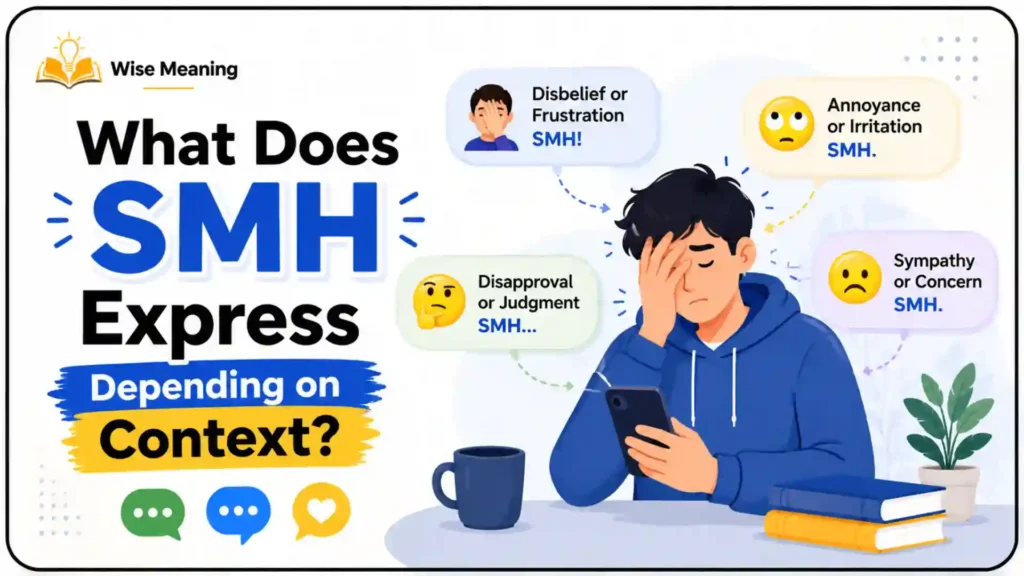
What Does SMH Express Depending on Context?
SMH can cover several related reactions:
- Disbelief: “They actually forgot the appointment? SMH.”
- Disappointment: “We were almost finished and the file got deleted. SMH.”
- Frustration: “The website is down again, SMH.”
- Disapproval: “He ignored every warning. SMH.”
- Amused disbelief: “You really wore two different shoes? 😂 SMH.”
These meanings overlap, so context matters. Merriam-Webster describes SMH as conveying bemused incredulity, frustration, or disapproval, while Dictionary.com includes disbelief, disgust, or shock.
A useful way to interpret SMH is to ask: “What happened immediately before this message?” The answer usually reveals the intended emotion.
You Might Also Like That: Past Tense of See
SMH Examples in Real Conversations
| Situation | Example | Likely Tone |
| Silly mistake | “You forgot your keys again, smh 😂” | Playful frustration |
| Bad decision | “He ignored every warning. SMH.” | Disapproval |
| Unexpected news | “They canceled it again? SMH.” | Disbelief |
| Personal mistake | “I left my phone at home. smh.” | Self-frustration |
| Funny situation | “She really thought that would work 😂 smh.” | Amused disbelief |
| Mild inconvenience | “The bus is late again. SMH.” | Annoyance |
These examples show why the same abbreviation can feel different from one conversation to another. An emoji, punctuation mark, or extra sentence can soften or strengthen the message, but none of those signals has a fixed meaning on its own.
Is SMH Rude or Offensive?
SMH is not automatically rude, but it can sound dismissive, judgmental, or annoyed depending on the context. With a close friend, “smh 😂” may simply be playful teasing. In a serious disagreement, the same expression can make the sender sound critical.
Consider the difference:
“You forgot the tickets again 😂 smh.”
This sounds lighthearted.
“SMH. That was completely irresponsible.”
This sounds much more serious.
It is also safer to avoid SMH in formal or professional communication unless you already know the audience uses casual slang. QuillBot similarly recommends caution with supervisors, clients, instructors, and people you do not know well.
How to Use SMH Correctly
Use SMH in casual digital communication when you want to react to something frustrating, surprising, disappointing, ridiculous, or mildly unbelievable. It works naturally in texts, group chats, social media comments, and informal messages.
It is generally a poor choice for:
- Academic assignments
- Formal business writing
- Professional emails
- Official documents
- Serious communications that require a neutral tone
SMH is also more natural when the situation itself is relatively ordinary. For something tragic or extremely serious, a casual slang reaction can sound insensitive.
One useful rule is simple: use SMH when you would naturally say something like “Seriously?” or “I can’t believe this” in a casual conversation.
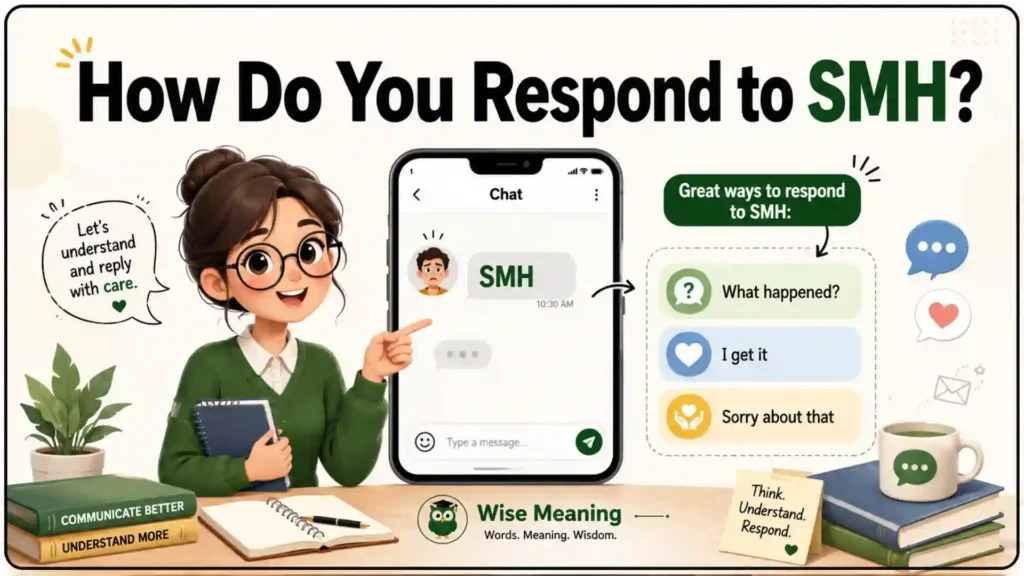
How Do You Respond to SMH?
The best response depends on why the person used SMH.
If They Are Joking
Keep the response light:
“😂 I know, I know.”
“Don’t judge me!”
“My bad 😅.”
You Might Also Like That: What Does Pookie Mean in Tex
If They Are Actually Frustrated
A calm response may work better:
“Yeah, I understand why you’re annoyed.”
“You’re right. I should have checked.”
If You Don’t Know What They Mean
Ask for clarification:
“Wait, what did I do? 😂”
“Why the SMH?”
“What happened?”
The key is not to assume that SMH always means anger. Looking at the message before it, the relationship between the people, and the overall tone usually gives a better answer.
SMH vs SMDH and Other Reaction Slang
SMH is part of a broader group of internet expressions, but the terms are not interchangeable.
| Expression | Meaning | Typical Function |
| SMH | Shaking my head | Disbelief, frustration, or disapproval |
| SMDH | Shaking my damn head | Stronger frustration or disapproval |
| SMFH | Shaking my f***ing head | Much stronger frustration, with profanity |
| LOL | Laughing out loud | Amusement or laughter |
| OMG | Oh my God | Surprise, shock, excitement, or disbelief |
Merriam-Webster confirms SMDH as “shaking my damn head,” while Dictionary.com also documents SMDH and SMFH as intensified forms of the expression.
The main distinction is emotional function. SMH signals a head-shaking reaction, while LOL primarily signals laughter and OMG usually signals surprise or strong emotion.
Does SMH Mean Something Different From a Girl or Guy?
No standard gender-specific meaning exists for SMH. If a girl sends “SMH” or a guy sends “SMH,” the basic expression still means “shaking my head.”
What changes is the context. The sender may be joking, disappointed, frustrated, surprised, or criticizing something. Their relationship with you and the surrounding conversation matter much more than their gender.
So, instead of asking whether SMH has a different meaning from a particular type of person, look at what happened immediately before the message and how the sender normally communicates.
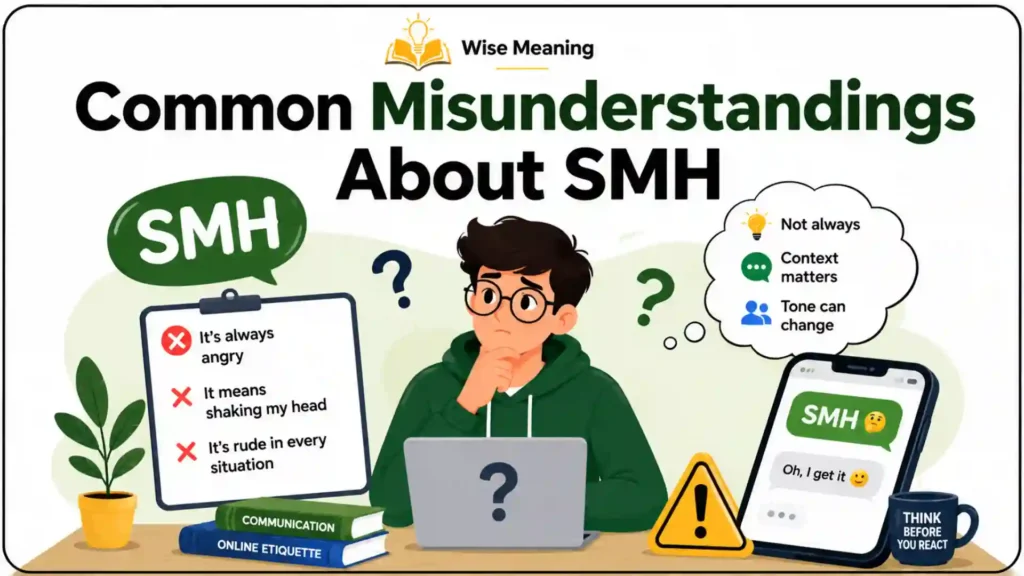
Common Misunderstandings About SMH
A few assumptions can lead to the wrong interpretation:
- SMH does not always mean anger. It can show amusement, disbelief, or mild frustration.
- SMH is not automatically rude. The relationship and context influence how it sounds.
- SMH is not gender-specific. The standard meaning remains the same.
- SMH is not normally formal language. It belongs mainly to casual digital communication.
- “Shaking my head” is the main meaning. Merriam-Webster also records “scratching my head” as an occasional alternative, but it is not the primary meaning for this slang query.
- SMH is not the same as every reaction abbreviation. LOL, OMG, SMDH, and related terms carry different shades of meaning.
You Might Also Like That: Meet Past Tense
Frequently Asked Questions About SMH
What does SMH mean on social media?
SMH means “shaking my head” on social media. People use it to react to something they find disappointing, frustrating, unbelievable, or disapproving. Cambridge lists social media as one of its common contexts.
Is SMH still used?
Yes. SMH remains an established internet and texting abbreviation and is still documented in current major dictionaries. Merriam-Webster’s dictionary entry was updated in February 2026, and Dictionary.com continues to provide current examples of the abbreviation in use.
Is SMH formal or informal?
SMH is informal. It is suitable for casual texts, chats, and social media, but it is usually not appropriate for academic or formal professional writing.
What does it mean when someone sends only “SMH”?
A standalone “SMH” usually means the sender is expressing disbelief, frustration, disappointment, or disapproval about something understood from the surrounding conversation. Without context, the exact emotion cannot be known with certainty.
Can SMH be used jokingly?
Yes. Friends may use SMH playfully to tease each other about silly mistakes or funny behavior. An emoji, laughing phrase, or clearly light situation can make the intended tone more obvious.
Final Thought
SMH means “shaking my head,” and it is mainly used in casual digital communication to express a reaction such as disbelief, frustration, disappointment, disapproval, or amused disbelief.
The most important part is context: the same “SMH” can sound playful in one conversation and critical in another. When you see it in a text or social post, look at the situation, surrounding words, punctuation, and relationship before deciding exactly what the sender means.