
Choosing between “high quality” and “high-quality” can be confusing, especially when both forms appear in everyday English. The good news is that both forms can be correct, but they usually serve different grammatical purposes. Understanding when to use the hyphen can make your writing clearer and more polished.
In this guide, we’ll explain the difference between high quality and high-quality, show you when to use each form, and provide simple sentence examples. Whether you are writing an email, article, resume, or product description, you’ll learn the high quality grammar rule and how to use these forms naturally and correctly.
Quick Answer
The short answer is that “high quality” and “high-quality” can both be correct. The choice depends on how you use the phrase in a sentence. High quality usually works as a noun phrase that describes a standard or level of quality. For example, “The product is high quality.” On the other hand, high-quality usually works as a compound adjective before a noun: “We sell high-quality products.”
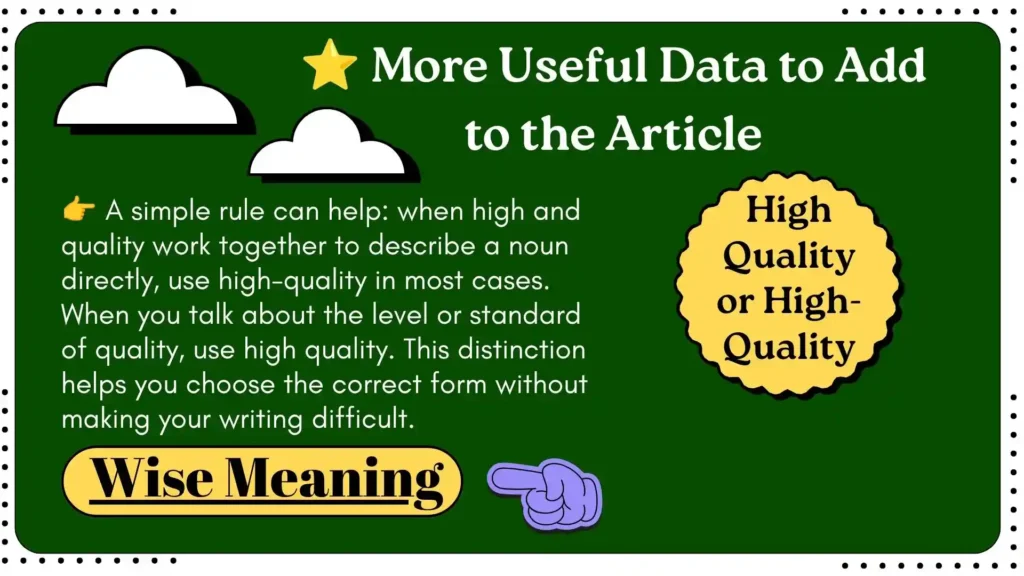
👉 A simple rule can help: when high and quality work together to describe a noun directly, use high-quality in most cases. When you talk about the level or standard of quality, use high quality. This distinction helps you choose the correct form without making your writing difficult.
TL;DR
High quality and high-quality are both correct, but they usually appear in different sentence structures. Use high-quality when the phrase works together as a compound adjective before a noun, such as “a high-quality product.” Use high quality when you describe the level or standard of something, such as “The product is high quality.” The hyphen helps show that high and quality work together to modify the noun. Cambridge lists high-quality as an adjective meaning “very good” or “of a high quality.”
You Might Also Like That: SFW Meaning Explained g
Quick Comparison
| Form | Main Function | Example |
| high quality | Talks about a standard | The service is high quality |
| high-quality | Compound adjective | We provide high-quality service |
| of high quality | Describes a standard | The materials are of high quality |
| ❌ highquality | Incorrect standard spelling | Avoid this form |
⭐ More Useful Data to Add to the Article
1. High Quality or High-Quality Before a Noun
This is one of the most important search-intent points to include. When high and quality work together directly before a noun, the hyphen normally makes the phrase a clear compound modifier.
Examples:
- high-quality content
- high-quality education
- high-quality products
- high-quality materials
- high-quality service
- high-quality work
This follows the general principle that compound modifiers before a noun are often hyphenated.
2. High Quality After a Linking Verb
After a linking verb such as is, are, was, or were, the open form is commonly used:
- The product is high quality
- The service was high quality
- Their work is high quality
- The materials are high quality
This gives readers a practical way to recognize the difference without memorizing complicated grammar terminology.
3. Don’t Write “Highquality”
Add this as a small common mistake section because beginners may wonder whether the phrase can become one word.
❌ highquality product
❌ highquality service
✅ high-quality product
✅ high-quality service
High quality uses two words, while high-quality uses two words connected by a hyphen. Cambridge’s dictionary entry uses the hyphenated form high-quality as an adjective.
4. High-Quality vs Excellent
You can add a short comparison showing that high-quality has several alternatives:
| Expression | Meaning |
| high-quality | Very good standard |
| excellent | Extremely good |
| superior | Better than usual or others |
| top-quality | Very high standard |
| high-grade | High standard or grade |
| first-rate | Excellent or very good |
This helps users understand that high-quality is not only a grammar question—it also has useful synonyms.
5. High Quality vs Good Quality
This is another useful comparison:
- high quality → a strong or very good standard
- good quality → a good standard
- low quality → a poor standard
- poor quality → a bad or unsatisfactory standard
Cambridge’s entry for quality gives examples of expressions such as “high quality,” “good quality,” and “low quality.”
6. High-Quality in Professional Writing 💼
Add examples from different types of writing to make the article more practical:
Business:
“We provide high-quality customer service.”
Marketing:
“Discover our high-quality products.”
Education:
“Students deserve high-quality education.”
SEO/Content:
“Create high-quality content that answers the reader’s question.”
Resume:
“Produced high-quality reports for clients.”
This also gives you natural opportunities to use related keywords without keyword stuffing.
You Might Als0 Like That: Pookie Meaning
7. Important Hyphenation Tip 🔎
The hyphen does not simply mean that two words are always joined. Grammar and sentence position matter. Compound modifiers are commonly hyphenated when they come before the noun they modify.
For example:
a high-quality product ✅
a high-quality service ✅
But:
The product is high quality ✅
The service is high quality ✅
This distinction is one of the strongest pieces of information to emphasize in the article.
🎯 Best “Rule at a Glance” Box
You can add this visually inside the article:
Easy Rule:
👉 Before a noun → high-quality
👉 Describing the standard → high quality
👉 One word → ❌ highquality
Examples:
✅ a high-quality laptop
✅ high-quality content
✅ The laptop is high quality
✅ The content is high quality
One caution: hyphenation can vary by dictionary and style guide, so present this as a strong practical rule rather than an absolute rule for every context. Cambridge and other style resources recognize variation in compound-word treatment.
What Does “High Quality” Mean?
High quality means that something has a good standard, strong value, or excellent characteristics. It describes something that performs well or meets a high standard. The phrase contains two separate words: high and quality. Here, “quality” acts as a noun, while “high” tells us the level of that quality.
For example, you can say, “This furniture is high quality” or “The company provides products of high quality.” In both examples, you talk about the standard of something. 📝 The phrase can describe products, services, work, education, materials, content, and many other things.
What Does “High-Quality” Mean?
High-quality means very good or made to a high standard. It usually works as a compound adjective because the two words work together to describe a noun. The hyphen connects them and makes their relationship clear.
For example, “She bought a high-quality camera.” Here, high-quality directly describes the noun “camera.” You can also use it with words such as work, products, services, education, content, materials, and equipment. ⭐ The hyphen does not change the basic meaning. Instead, it shows readers that high and quality work together as one description.
High Quality vs. High-Quality: What’s the Difference?
The main difference between high quality and high-quality comes from their grammatical function. “High quality” usually works as a noun phrase when you describe a level or standard. “High-quality” usually works as a compound adjective when it directly modifies a noun.
| Form | Common Use | Example |
| high quality | Noun phrase | The work is high quality. |
| high-quality | Compound adjective | She submitted high-quality work. |
| of high quality | Quality as a standard | The materials are of high quality. |
💡 Remember that this is a useful guideline, not a rule that applies to every possible sentence. Context and writing style can also affect the preferred form.
When Should You Use “High Quality”?
Use high quality when you talk about the standard or level of quality rather than placing the phrase directly before a noun as one compound modifier. For example, you can write, “The service is high quality.” You can also say, “We only use materials of high quality.”
This form commonly appears after linking verbs such as is, are, was, and were. It also appears naturally in phrases such as “very high quality” and “of high quality.” ✅ These examples show why high quality grammar depends on how the phrase functions in the sentence, not simply on whether the phrase appears before or after a verb.
When Should You Use “High-Quality”?
Use high-quality when the phrase directly describes a noun as a compound adjective. The hyphen joins the words so readers can understand them as one description. For example, “The company produces high-quality products.” Here, “high-quality” describes “products.”
You can use this form in many situations, including high-quality work, high-quality service, high-quality content, and high-quality education. ✍️ This construction appears often in professional, academic, business, and marketing writing. When you place the phrase directly before a noun, high-quality will usually provide the clearest and most natural choice.
Why Does “High-Quality” Need a Hyphen?
The hyphen in high-quality helps connect the two words when they work together as a compound modifier. Without the hyphen, readers may not immediately see that high modifies quality, and that the complete phrase describes the noun that follows.
For example, “a high-quality product” clearly presents “high-quality” as one description of “product.” Similar constructions appear in phrases such as long-term plan, full-time job, and well-known author. 🔗 The hyphen therefore improves clarity. However, you should not add hyphens simply because two words appear next to each other. Always consider their grammatical role first.
High Quality Work vs. High-Quality Work
The phrase “high-quality work” is usually the preferred choice when you place the expression directly before the noun “work.” Here, high-quality acts as a compound adjective that describes the type or standard of work.
For example:
- ✅ She always produces high-quality work.
- ✅ We need high-quality work for this project.
- ✅ His work is high quality.
- ✅ His work is of high quality.
Notice how the form changes with the sentence structure. 🎯 High-quality work directly modifies “work,” while high quality describes the standard of the work. This is one of the most common examples people search for when learning this grammar rule.
High Quality vs. High-Quality in Sentences
Seeing both forms in real sentences makes the difference much easier to understand. Compare these examples:
- 📌 The company provides high-quality services.
- 📌 The services are high quality.
- 📌 We need high-quality materials.
- 📌 These materials are of high quality.
- 📌 She creates high-quality content.
- 📌 Her content is high quality.
In each example, the meaning stays similar, but the sentence structure changes. Use high-quality when it directly modifies the following noun. Use high quality when you describe the standard or level of something. These simple examples can help you apply the rule naturally in everyday and professional writing.
Common Mistakes With High Quality and High-Quality
Writers often make small mistakes when they use this phrase. The most common mistake involves leaving out the hyphen when high quality directly modifies a noun. For example, “a high-quality product” is the clearer standard form.
Another common mistake involves joining the words into one word. ❌ “Highquality” is not the standard spelling. Writers also sometimes add a hyphen where they do not need one. For example, “The product is high quality” normally works well without a hyphen. ✅ Always check whether the phrase acts as a compound adjective or a noun phrase before choosing the form.
Can You Use “High-Quality” After a Verb?
Yes, you may sometimes see “high-quality” after a linking verb, especially in modern English. For example, some writers use “The product is high-quality.” However, many editors and style guides prefer “The product is high quality” in this structure.
The safest approach for clear standard writing is to use high quality when you describe the quality of something after a linking verb, and high-quality when the phrase directly modifies a noun. 📚 Still, English usage can vary, so you should consider the style guide and audience you follow. Avoid treating the common hyphen rule as an absolute grammar law.
High Quality in Formal and Professional Writing
Both forms work well in formal and professional writing when you use them correctly. Businesses often use high-quality before nouns in product descriptions, reports, websites, resumes, and marketing materials. For example, “We provide high-quality customer service.”
You can also use high quality when discussing a standard: “Our goal is to maintain high quality in every project.” 💼 In professional writing, consistency matters. Choose the form that matches your sentence structure, and avoid unnecessary hyphens. Clear writing helps readers understand your message quickly and makes your content look more polished.
High Quality vs. Other Similar Expressions
Several expressions can communicate a meaning similar to high quality, but they may carry slightly different shades of meaning. Common alternatives include excellent, superior, first-rate, top-quality, high-grade, and outstanding.
For example, you could write:
- ⭐ high-quality materials
- ⭐ excellent materials
- ⭐ superior materials
- ⭐ top-quality materials
- ⭐ high-grade materials
The best choice depends on your context. High-quality sounds natural and neutral, while words such as outstanding or superior can sound stronger. If you want simple and clear English, high quality and high-quality remain excellent choices.
High Quality vs. Low Quality
High quality and low quality describe opposite standards. Something of high quality meets a strong standard, performs well, or has desirable features. Something of low quality fails to meet the expected standard or may perform poorly.
You can also use the hyphenated forms before nouns:
- high-quality product → a product with a high standard
- low-quality product → a product with a low standard
- high-quality work → work completed to a strong standard
- low-quality work → work completed to a poor standard
🔄 This comparison can help you understand why the hyphenation rule applies in similar compound adjectives.
Simple Rule to Remember
You can remember the basic difference with one simple idea: look at what the phrase does in the sentence.
👉 Before a noun, use high-quality in the normal compound-adjective construction: “a high-quality product.”
👉 When you describe a standard or level of quality, use high quality: “The product is high quality.”
👉 You can also use of high quality: “The product is of high quality.”
This rule works in most everyday cases. However, English usage can vary, so do not treat it as an unbreakable rule. When in doubt, choose the form that makes the sentence clear and natural.
You Might Also Like That: Sic Meaning
Frequently Asked Questions
Is high quality one word or two?
High quality consists of two words. When you use the phrase as a compound adjective before a noun, you normally write high-quality with a hyphen. You should not write highquality as one word.
Is high-quality hyphenated?
Yes. High-quality uses a hyphen when the two words work together as a compound adjective, especially before a noun. For example, “She provides high-quality services.”
Is high quality grammatically correct?
Yes. High quality is grammatically correct when it works as a noun phrase describing a standard or level of quality. For example, “The product is high quality.”
Is high-quality grammatically correct?
Yes. High-quality is also grammatically correct. It commonly works as a compound adjective before a noun, as in “a high-quality product.”
Should I write high quality work or high-quality work?
Use high-quality work when the phrase directly describes “work.” The hyphen connects “high” and “quality” as one compound modifier.
Can I say “the product is high-quality”?
You may see this form in modern English, but many formal writing contexts prefer “the product is high quality.” Follow the style guide and conventions used by your audience.
Why is high-quality hyphenated?
The hyphen shows that high and quality work together as one compound modifier describing the noun that follows.
Conclusion
The choice between high quality and high-quality becomes simple once you understand their grammatical roles. Use high-quality when the phrase works as a compound adjective directly describing a noun, such as high-quality work or high-quality products. Use high quality when you describe the standard or level of quality, such as “The work is high quality.”
⭐ The key is to look at the sentence structure, not just memorize a single rule. Once you understand how each form works, you can use both expressions naturally in everyday, academic, and professional writing.