
If you’ve ever written an email, spoken with a friend, or prepared for an important event, you’ve probably heard or used the phrase “I look forward to it.” It is one of the most common English expressions used to show anticipation, excitement, or a positive expectation about something that will happen in the future. However, many English learners wonder about the exact meaning I look forward to, whether the phrase is grammatically correct, and how to use it naturally in everyday conversations and professional writing.
Understanding the look forward meaning is more than memorizing a definition. You also need to know the correct grammar rules, common sentence patterns, and the situations where this phrase sounds natural. In this guide, you’ll learn what “I look forward to it” means, how to use “look forward to” correctly, see plenty of sentence examples, discover formal and informal alternatives, and avoid common grammar mistakes. Whether you’re improving your English grammar, writing a business email, or simply trying to sound more like a native English speaker, this article will help you use the phrase with confidence.
📌 Quick Answer
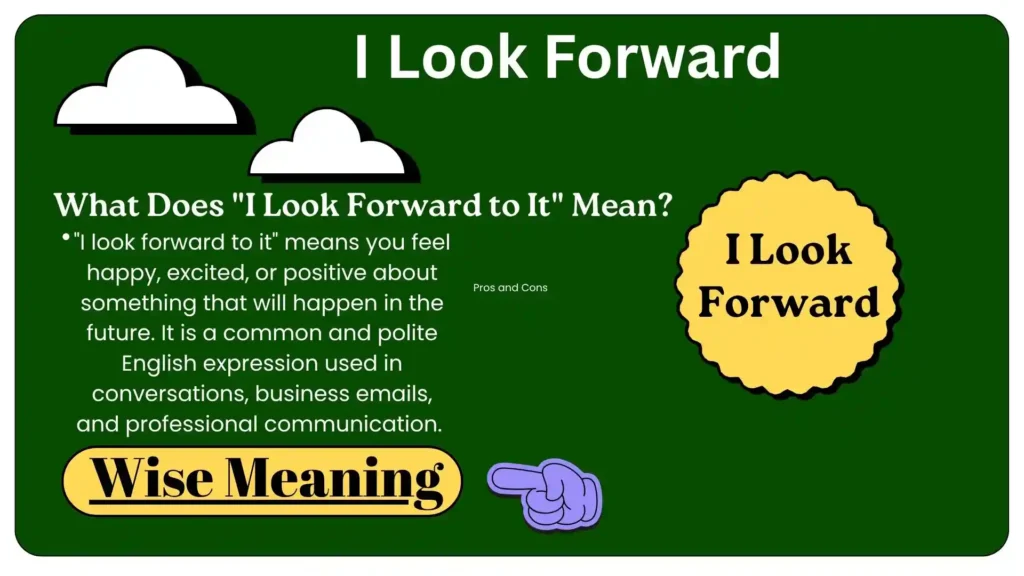
“I look forward to it” means you feel happy, excited, or positive about something that will happen in the future. It is a common and polite English expression used in conversations, business emails, and professional communication.
To use it correctly, remember the grammar pattern: look forward to + noun, pronoun, or -ing verb. Since “to” is a preposition, the verb after it must always end in -ing (for example, “I look forward to meeting you”). By understanding its meaning, grammar, and common usage, you can avoid mistakes and use this phrase naturally in both formal and informal English.
TL;DR
“I look forward to it” means you feel happy, excited, or positive about something that will happen in the future. It is a polite and natural English expression commonly used in conversations, business emails, and professional communication. The correct grammar pattern is look forward to + noun, pronoun, or -ing verb because “to” is a preposition, not part of an infinitive. For example, say “I look forward to meeting you,” “I look forward to hearing from you,” or “I look forward to your reply.” Avoid incorrect forms like “I look forward to meet you.” Learning this simple grammar rule will help you speak and write more confidently in both formal and informal English.
You Might Also Like That: Grammar Meaning
What Does “I Look Forward to It” Mean? 😊
The phrase “I look forward to it” means that you feel happy, excited, or positive about something that will happen in the future. It shows that you expect an event, meeting, or activity with pleasure. This common English expression appears in both spoken and written English. Knowing that I look forward to its meaning helps you communicate politely and naturally. You can use it with friends, coworkers, teachers, or clients whenever you want to express genuine interest in a future event.
Literal vs. Intended Meaning
The literal meaning of look forward suggests looking ahead, but the phrase is actually an idiomatic expression. It does not mean using your eyes to look ahead. Instead, the look forward meaning is to expect something with pleasure or excitement. For example, when you say, “I look forward to our meeting,” you mean you are happy that the meeting will happen. Understanding this difference helps English learners avoid confusion and use the phrase naturally.
When People Commonly Use It
People use “I look forward to it” in many everyday situations. You may hear it in business emails, school messages, interviews, friendly conversations, or customer service replies. It is also common before holidays, events, trips, or meetings. This phrase fits almost any situation where you want to express positive expectations. Because it sounds polite and professional, many native English speakers use it regularly in both formal and informal communication.
What Does “Look Forward” Mean? 📖
The look forward meaning is to feel pleased or excited about something that will happen in the future. According to standard English grammar, the phrase always refers to a future event that you expect with happiness. You can use look forward to before a noun, pronoun, or an -ing verb. It is one of the most common English expressions because it works well in conversations, emails, and professional writing. Learning this simple meaning makes your spoken and written English sound more natural.
| 📌 Expression | Meaning |
| Look forward to | Expect something happily |
| I look forward to it | I am happy about a future event |
| Looking forward to it | I am excited about what is coming |
🔊 Pronunciation: look FOR-werd too
Word Origin
The phrase look forward has been part of English for many years. Originally, the word “forward” referred to moving ahead. Over time, the expression developed a figurative meaning. Today, it no longer describes physical movement. Instead, it expresses hope, anticipation, and positive expectation. This change makes it an important part of modern English usage, especially in emails, conversations, and professional communication.
You Might Also Like That: Grammar Meaning
How to Use “I Look Forward to It” Correctly ✍️
Basic Grammar Rule
The phrase looks forward to following a simple grammar pattern. You use it before a noun, pronoun, or an -ing verb (gerund). This is one of the most important grammar rules that every English learner should remember. Following the correct pattern helps you write better business emails, speak confidently, and avoid common mistakes. Once you understand this rule, using look forward becomes much easier.
Why “To” Is a Preposition
Many learners think “to” is part of an infinitive, but that is not true here. In the phrase look forward to, “to” is a preposition, not an infinitive marker. Because it is a preposition, another verb must appear in its -ing form. Understanding this grammar point explains why some sentences sound correct while others do not. It is one of the most important parts of using look forward to grammar correctly.
Why an -ing Verb Comes After It
Since “to” acts as a preposition, the next verb should always end in -ing. For example, you should say “I look forward to meeting you” instead of “I look forward to meeting you.” This rule applies in formal writing, conversations, and professional emails. Learning this pattern helps you avoid one of the most common English grammar mistakes and makes your writing sound more natural to native English speakers.
Sentence Structure of “Look Forward To” 📝
The sentence structure for look forward to is easy to remember. You simply use the subject, followed by look forward to, and then a noun, pronoun, or gerund (-ing verb). This structure works in both formal and informal situations. Whether you are writing an email or having a conversation, following this pattern ensures correct English grammar and clear communication.
| ✅ Correct Structure | Example |
| Subject + look forward to + noun | I look forward to the event. |
| Subject + look forward to + pronoun | We look forward to it. |
| Subject + look forward to + -ing verb | She looks forward to meeting you. |
| Subject + look forward to + possessive + -ing verb | I look forward to your joining us. |
You Might Also Like That: Grammar Meaning
❓ Frequently Asked Questions
Is “I look forward to it” grammatically correct?
✅ Yes, “I look forward to it” is completely grammatically correct. It is a common English expression used to show that you are happy or excited about a future event. You can use it in conversations, emails, and professional writing.
What does “I look forward to it” mean?
The “I look forward to it” meaning is to feel excited or pleased about something that will happen in the future. It expresses positive expectation and is suitable for both formal and informal situations.
Is “I look forward to it” formal or informal?
The phrase is neutral, which means it works in both formal and informal settings. It is especially common in business emails, job applications, and professional communication, but you can also use it naturally with friends and family.
Why is it “look forward to meeting you” instead of “look forward to meet you”?
The word “to” in look forward to is a preposition, not part of an infinitive. Because of this, the next verb must be in the -ing form. That is why “I look forward to meeting you” is correct, while “I look forward to meet you” is incorrect.
Can I use “I look forward to it” in an email?
Yes. It is one of the most popular phrases for ending a professional email politely. For example:
- I look forward to your reply.
- I look forward to hearing from you.
- I look forward to working with you.
These expressions sound respectful and professional.
What can I say instead of “I look forward to it”?
You can use several alternatives depending on the situation, such as:
- I can’t wait.
- I’m excited about it.
- I’m eager to hear from you.
- I’m excited to work with you.
- I’m anticipating the event.
Choose the expression that best matches the tone of your conversation or writing
🎯 Conclusion
Understanding the look forward meaning helps you use one of the most common English expressions with confidence. The phrase “I look forward to it” means you are happy or excited about something that will happen in the future. It is suitable for everyday conversations, business emails, academic writing, and many other situations. Remember that look forward to is always followed by a noun, pronoun, or an -ing verb, because “to” acts as a preposition.
By learning the correct grammar rules, studying sentence examples, and avoiding common mistakes, you can make your English sound more natural and professional. Whether you’re writing to a client, speaking with a friend, or preparing for an interview, using “I look forward to it” correctly will help you communicate clearly and politely. Keep practicing this phrase in real-life situations, and it will soon become a natural part of your everyday English.