
Have you ever paused while writing and wondered whether you should write “of course” or “ofcourse”? You’re not alone. This is one of the most common English grammar and spelling mistakes that confuses students, writers, professionals, and English learners. Many people search for “is it of course or ofcourse,” “which is correct of course or ofcourse,” or “how do you spell of course” because they want to write correctly and avoid simple errors. Fortunately, the answer is clear and easy to remember.
The correct spelling is “of course,” written as two separate words. The form “ofcourse” is incorrect and is not accepted in standard English. In this guide, you’ll learn why “of course” is correct, what the phrase means, how to use it in different situations, and how to avoid this common grammar mistake. You’ll also find practical sentence examples, a comparison table, useful alternatives, and answers to frequently asked questions to help you use “of course” with confidence in both formal and informal writing.
🚀 Quick Answer
If you’re wondering “Is it of course or ofcourse?”, the answer is simple. “Of course” is the correct spelling, while “ofcourse” is incorrect. In standard English, the phrase is always written as two separate words.
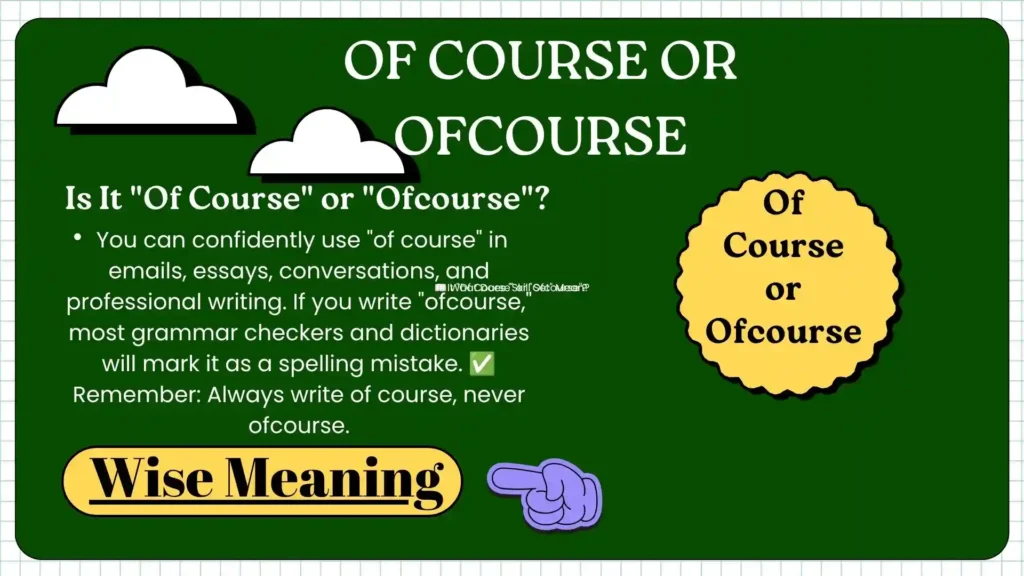
You can confidently use “of course” in emails, essays, conversations, and professional writing. If you write “ofcourse,” most grammar checkers and dictionaries will mark it as a spelling mistake. ✅ Remember: Always write of course, never ofcourse.
You Might Also Like That: Grammar Meaning
TL;DR
- ✅ “Of course” is the correct spelling in standard English.
- ❌ “Ofcourse” is incorrect and is considered a spelling mistake.
- 📝 “Of course” is always written as two separate words.
- 💬 The phrase means certainly, definitely, naturally, or without doubt.
- 📚 You can use “of course” in both formal and informal writing.
- ✍️ Examples: “Of course I’ll help you.” and “Yes, of course.”
- 🚫 Avoid writing “ofcourse,” even in casual messages, because it is not accepted by dictionaries or grammar guides.
- ⭐ Easy Rule to Remember: If you’re wondering “Is it of course or ofcourse?”, always choose “of course” with a space between the two words.
Is It “Of Course” or “Ofcourse”?
Many people ask, “Which is correct: of course or ofcourse?” The correct answer is “of course.” This phrase has always been written as two separate words in standard written English. Although “ofcourse” appears online because of typing mistakes or fast texting, it is not a real English word. If you want clear and professional writing, always choose “of course.” This small spelling choice makes your writing more accurate and easier to understand.
✅ Which Spelling Is Correct?
The correct spelling is “of course.” It appears in dictionaries, grammar books, and style guides because it follows proper English grammar rules. The spelling “ofcourse” is simply a common mistake. Whether you’re writing a school assignment, a business email, or a social media post, using “of course” helps you communicate clearly and confidently.
Why Is “Of Course” Correct?
The phrase “of course” is correct because it is made up of two separate words that work together as a fixed expression. It means certainly, naturally, or without any doubt. Native English speakers use it every day in both speaking and writing. Since it is a well-established phrase, grammar experts and dictionaries recognize “of course” as the only correct spelling. Using it correctly improves your writing and avoids unnecessary grammar mistakes.
📖 Grammar Explanation
In English grammar, “of course” functions as an idiomatic phrase rather than a single word. The word “of” is a preposition, while “course” is a noun. Together, they create an expression with a meaning that cannot be understood by looking at each word separately. This is why the phrase always stays as two words instead of becoming “ofcourse.”
✍️ Why It Is Always Two Words
English has many expressions made from separate words, and “of course” is one of them. Over time, the phrase has remained unchanged in standard English. No respected dictionary or grammar guide accepts “ofcourse” as one word. 💡 Easy tip: If you’re ever unsure, remember that “of course” should always have a space between the two words.
Why Is “Ofcourse” Incorrect?
The spelling “ofcourse” is incorrect because it is not recognized in English dictionaries or grammar references. It usually appears when people type quickly or forget to add a space. While readers may understand what you mean, using “ofcourse” can make your writing look less professional. If you’re aiming for correct English spelling, always avoid writing it as a single word.
❌ Common Spelling Mistake
Many English learners accidentally write “ofcourse” because they often see phrases joined together in text messages or online posts. However, casual typing does not change grammar rules. Spell checkers, proofreading tools, and editors usually underline “ofcourse” because it is considered a spelling error. ✅ The correct form is always “of course.”
📚 Why Dictionaries Don’t Recognize It
Trusted dictionaries include only words and accepted phrases used in standard English. Since “ofcourse” has never become an accepted word, it does not appear as a valid entry. Instead, dictionaries list “of course” as the correct phrase. Whenever you ask, “Is ofcourse a real word?” The answer is no. Following dictionary-approved spelling keeps your writing accurate and professional.
What Does “Of Course” Mean?
The phrase “of course” means certainly, definitely, naturally, or without any doubt. People use it to show agreement, confidence, or that something is obvious. It is one of the most common English phrases in everyday communication. You can use it while talking to friends, replying to emails, or answering questions. Learning the meaning of “of course” helps you use it naturally and avoid confusion with the incorrect spelling “ofcourse.”
📖 Literal Meaning
The literal words “of” and “course” have their own meanings, but together they form an idiomatic expression. The phrase does not refer to a school course or training course. Instead, it simply expresses certainty or willingness. That is why you should learn it as a complete phrase rather than trying to understand each word separately.
💬 Common Meanings in Conversation
Depending on the situation, “of course” can have several meanings.
- ✅ “Certainly.”
- ✅ “Yes, definitely.”
- ✅ “Naturally.”
- ✅ “No problem.”
- ✅ “Without question.”
For example:
- “Can you help me?” — “Of course!”
- “Will you attend the meeting?” — “Of course I will.”
How to Use “Of Course” Correctly
Using “of course” is simple once you know its purpose. You can place it at the beginning, middle, or end of a sentence, depending on what you want to emphasize. The phrase works well in formal writing, informal conversations, emails, and presentations. However, avoid using it too many times in the same piece of writing because repetition can make your content sound less natural.
👥 Everyday Conversations
In daily conversations, “of course” shows kindness, agreement, or confidence.
Examples:
- Of course I’ll help you.
- Of course you can borrow my book.
- Yes, of course!
These examples sound friendly and natural in spoken English.
💼 Formal Writing
You can also use “of course” in reports, business emails, and professional communication. It works best when you want to confirm something politely.
Example:
- Of course, we appreciate your feedback.
- The project will, of course, follow company guidelines.
😊 Informal Writing
In text messages or social media, “of course” is still the correct spelling.
Examples:
- Of course I’m coming!
- Of course that’s a great idea.
Even in casual writing, never write “ofcourse.”
“Of Course” in Sentences
Reading sentence examples is one of the easiest ways to understand how to use “of course” correctly. The phrase fits naturally in many situations. Whether you’re writing an email, speaking to a friend, or answering a question, using “of course” correctly makes your English sound more fluent and confident.
✅ Positive Examples
- Of course I remember your birthday.
- She will, of course, join us later.
- Of course you can ask another question.
- We will, of course, keep you informed.
❓ Question Examples
- Can I sit here? — Of course.
- May I call you later? — Of course you may.
- Can we start now? — Of course!
💼 Professional Examples
- Of course, we will review your application carefully.
- Our team will, of course, respond within 24 hours.
- Of course, customer satisfaction remains our priority.
😊 Casual Examples
- Of course I’m excited!
- Of course that’s funny.
- Of course we’ll meet this weekend.
Correct vs. Incorrect Usage
Many people confuse “of course” with “ofcourse,” but remembering the correct form is easy. The table below shows the difference clearly. Whenever you proofread your writing, check that you’ve written “of course” as two words.
📊 Comparison Table
| ✅ Correct Usage | ❌ Incorrect Usage |
| Of course I’ll help you. | Of course I’ll help you. |
| Yes, of course. | Yes, of course. |
| Of course we agree. | Of course we agree. |
| Of course it’s possible. | Of course it’s possible. |
⭐ Rule to Remember: Always leave a space between “of” and “course.”
Common Mistakes People Make
Although the rule is simple, many writers still make mistakes with “of course.” Most errors happen because of fast typing, lack of proofreading, or misunderstanding the phrase. Knowing these mistakes helps you write with greater confidence and avoid common English spelling mistakes.
❌ Writing It as One Word
The biggest mistake is writing “ofcourse.” This spelling is incorrect and should never appear in formal or informal writing. If you notice it while editing, simply separate the two words.
🔁 Overusing the Phrase
Using “of course” repeatedly in one paragraph can make your writing feel repetitive. Instead, replace it with words like certainly, definitely, or absolutely when appropriate.
✍️ Using the Wrong Punctuation
Sometimes “of course” needs commas, especially when it interrupts a sentence.
Example:
- The results will, of course, be announced tomorrow.
Correct punctuation makes your writing smoother and easier to read.
Alternatives to “Of Course”
Although “of course” is useful, using the same phrase too often can make your writing sound repetitive. Fortunately, English offers many alternatives with similar meanings. Choosing different expressions helps improve your writing style while keeping your message clear and natural.
| 🌟 Alternative | Best Used When |
| Certainly | Formal conversations |
| Absolutely | Strong agreement |
| Definitely | Showing confidence |
| Naturally | Something feels expected |
| Sure | Casual conversations |
| Indeed | Formal writing |
| Without a doubt | Strong certainty |
💡 Tip: Choose the alternative that best matches your tone and audience instead of repeating “of course” throughout your writing.
You Might Also Like That: Grammar Meaning
Does British English and American English Differ?
Many English learners wonder whether British English and American English use different spellings for “of course.” The good news is that there is no difference. Both varieties of English follow the same rule and write the phrase as two separate words. Whether you are writing for a school assignment, a business email, or an international audience, “of course” is always the correct choice.
🌍 Same Rule Everywhere
No matter where you live, “of course” keeps the same spelling and meaning. You will see it in books, newspapers, websites, and official documents from both the UK and the US. ✅ Tip: You never need to change the spelling based on the country you’re writing for.
Why People Mistype “Ofcourse”
The spelling “ofcourse” is a very common typing mistake. It usually happens because people type quickly or rely too much on mobile keyboards. Seeing the incorrect form on social media can also make some writers believe it is acceptable. However, repeated use does not make it correct. In standard English, the phrase must always remain two words.
⌨️ Fast Typing
When people type quickly, they sometimes forget to add a space between “of” and “course.” This creates the incorrect spelling “ofcourse.” Slowing down and proofreading your work can help you catch this simple mistake before publishing or sending your writing.
📱 Mobile Keyboards and Autocorrect
Phones and tablets sometimes fail to correct spacing errors, especially when you’re typing fast. If you depend only on autocorrect, mistakes may go unnoticed. 💡 Helpful Tip: Read your writing once before sending it to make sure “of course” is written correctly.
What Do Dictionaries and Style Guides Say?
If you’re asking “Is ofcourse a real word?”, trusted dictionaries and grammar guides give a clear answer: No. Standard English dictionaries recognize “of course” as the correct phrase, while “ofcourse” is treated as a spelling error. Professional editors and proofreading tools also recommend writing the phrase as two words.
📚 Dictionary Consensus
Major dictionaries list “of course” as a fixed English expression meaning certainly, naturally, or without doubt. You will not find “ofcourse” listed as an accepted English word. Following dictionary-approved spelling makes your writing more accurate and professional.
✍️ Grammar Recommendations
Grammar experts recommend using “of course” in both formal and informal writing. Whether you’re writing an essay, report, email, or social media post, the correct spelling remains the same. ✅ Remember: Good grammar begins with correct spelling.
Is “Of Course” an Idiom or Just a Phrase?
Many learners wonder whether “of course” is simply a phrase or an idiom. It is commonly treated as an idiomatic expression because its meaning goes beyond the individual words “of” and “course.” Instead of referring to a class or direction, the phrase expresses certainty, agreement, or something that feels obvious.
💡 Why This Matters
Understanding that “of course” is an idiomatic expression helps you use it naturally in conversation and writing. Instead of translating each word separately, learn the phrase as one complete expression. This approach improves both your English vocabulary and your confidence when communicating.
When Should You Avoid Using “Of Course”?
Although “of course” is polite in many situations, there are times when it may sound too direct or make the other person feel their question was unnecessary. In professional communication, choosing another expression can sometimes create a warmer and more respectful tone.
⚠️ Situations Where It May Sound Dismissive
Imagine someone asks a genuine question and you immediately reply, “Of course.” Depending on your tone, it might sound like the answer was obvious. In these situations, alternatives such as “Certainly,” “I’d be happy to,” or “Absolutely” may sound more welcoming.
🤝 Better Alternatives in Professional Communication
If you’re writing to a client, manager, or colleague, you can replace “of course” with:
- Certainly
- I’d be happy to help.
- Absolutely.
- With pleasure.
These expressions keep your writing professional while still showing confidence and kindness.
You Might Also Like That: Grammar Meaning
Frequently Asked Questions
❓ Is “ofcourse” a real word?
No. “Ofcourse” is not a real English word. The correct spelling is “of course.”
❓ Is it “of course” or “ofcourse”?
The correct spelling is “of course,” written as two separate words.
❓ Why is “of course” written as two words?
It is a fixed expression in standard English. Dictionaries and grammar guides recognize only the two-word form.
❓ Can I use “of course” in formal writing?
Yes. “Of course” is suitable for both formal and informal writing when it fits the context.
❓ What words can replace “of course”?
Some good alternatives include certainly, definitely, absolutely, sure, indeed, and naturally.
Conclusion
Knowing the difference between “of course” and “ofcourse” is simple once you understand the rule. The correct spelling is always “of course,” while “ofcourse” is a common spelling mistake that should be avoided. Using the correct form improves your English grammar, makes your writing more professional, and helps you communicate clearly in every situation.
Whether you’re writing an email, an essay, or a social media post, always remember this easy rule: leave a space between “of” and “course.” 📌 By following this simple guideline and practicing with real examples, you’ll avoid one of the most common English spelling mistakes and write with greater confidence every time.