
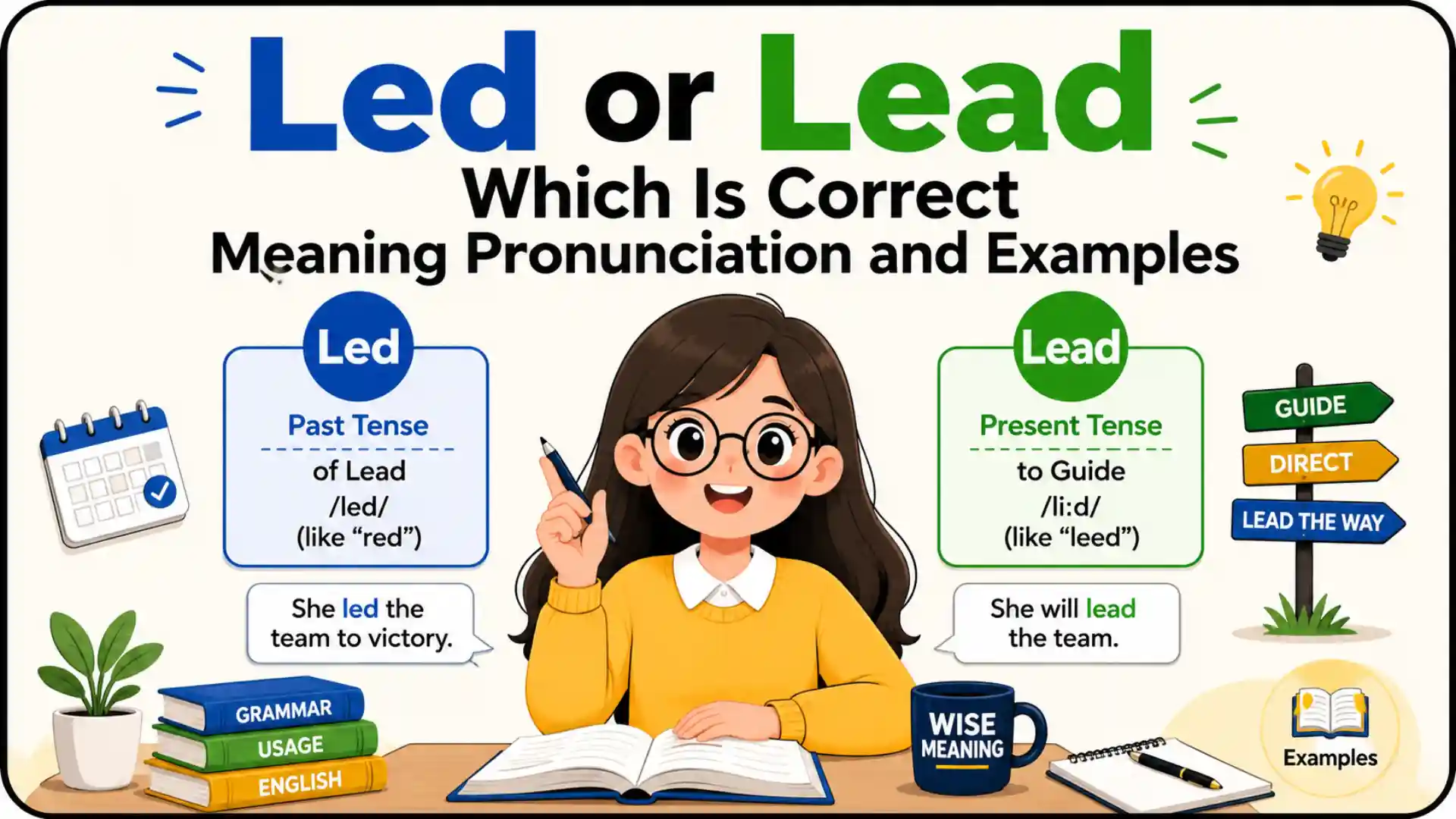
Have you ever wondered whether the correct word is led or lead? You are not alone. These two commonly confused words look almost identical, but they serve different purposes in English. Lead usually works as a present-tense verb meaning to guide or direct someone, while led is the past tense of lead. The pronunciation also adds to the confusion because lead can sound like “leed” when it means to guide, while led sounds like “red.”
In this guide, we’ll explain the difference between led and lead, including their meanings, grammar, pronunciation, and everyday usage. You’ll learn when to use lead or led, whether led is the past tense of lead, and how to avoid common mistakes such as writing “has lead” instead of “has led.” We’ll also look at lead as a noun, lead as a metal, LED, and simple examples that make the difference easy to remember.
Quick Answer: Is It “Led” or “Lead”?
Led is the correct past tense of lead when lead means to guide, direct, or manage someone. Use lead for the present or base form and led for the past tense. For example, you can say, “I lead the team,” but “I led the team yesterday.”
You can also use led as the past participle: “She has led the project for two years.” So, if you are asking, “Is led the past tense of lead?”, the answer is yes. Remember: lead today, led yesterday.
TL;DR
- ✅ Lead means to guide, direct, or manage someone and is usually pronounced “leed.”
- ✅ Led is the past tense and past participle of lead and is pronounced like “red.”
- 📚 The basic verb pattern is lead → led → led.
- 🗣️ Use lead for present or base-form sentences: “I lead the team.”
- ⏳ Use led for past actions: “I led the team yesterday.”
- ✍️ The correct phrase is “has led,” not “has lead.”
- 🔗 Use lead to for present/base forms and led to for past actions.
- 👥 Led by is correct for passive sentences: “The project was led by Sarah.”
- 🔤 Lead can also mean the metal, and in that meaning it is pronounced like “led.”
- 💡 LED means light-emitting diode and is different from the word led.
- 🌎 Led is the standard past tense in both British and American English.
- 🧠 Easy rule: “Today I lead; yesterday I led.”
Led vs. Lead: Quick Comparison
| Word | Function | Meaning | Pronunciation | Example |
| lead | Verb | Guide or direct | “leed” | I lead the team. |
| led | Past verb | Guided or directed | “led” | I led the team yesterday. |
| lead | Noun | A type of metal | “led” | The pipe contains lead. |
| LED | Acronym | Light-emitting diode | “L-E-D” | I bought an LED bulb. |
This led vs lead comparison shows why these words cause confusion. The spelling looks similar, but the meaning, grammar, and pronunciation can change. When lead means “guide,” pronounce it like leed. When led describes something that already happened, pronounce it like bed. The word lead can also describe the metal, and in that case, it sounds exactly like led. This simple difference can help you choose the correct word quickly.
You Might Also Like That: What Does BSF Mean in Text
What Does “Lead” Mean?
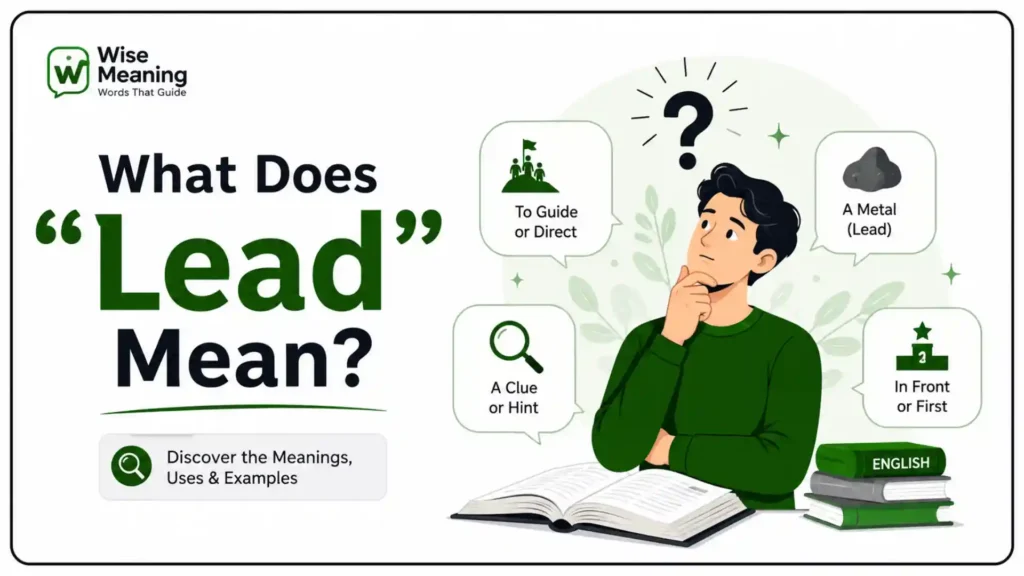
The word lead has several meanings, but its most common use appears as a verb. It can mean to guide, direct, manage, or go first. For example, “She will lead the team” means she will guide or manage the team.
You can also say, “This road leads to the city,” meaning the road goes toward the city. In another use, lead can describe being ahead, as in “Our team has the lead.” Understanding these meanings makes it easier to know when lead is correct.
Lead as a Verb
As a verb, lead means to guide someone or take control of something. You might lead a team, lead a meeting, lead a project, or lead the way. It can also describe a result or direction. For example, “Regular practice can lead to better results.”
The present-tense form stays lead, while the third-person form becomes leads. For example, “I lead the group,” but “She leads the group.” These examples show why lead belongs to present or base-form sentences rather than simple past sentences.
Lead as a Noun
Lead can also work as a noun and does not always describe an action. It can mean an advantage, a clue, or a position of importance. For example, “Our team has a five-point lead” means the team is ahead.
A detective might say, “We found a new lead,” meaning a useful clue. In entertainment, lead actor, lead singer, and lead character describe the main person. These meanings have nothing to do with the past tense led, so context helps you understand which meaning the writer intends.
Lead as an Adjective
You can also use lead as an adjective when you want to describe something as the main or most important part of a group. Common examples include lead actor, lead role, lead story, and lead product. For example, “She played the lead role in the movie.” Here, lead does not mean “guided” and it does not mean the past tense led. Instead, it tells us that someone or something holds the main position. This meaning is useful to know because lead can appear in many different parts of English sentences.
What Does “Led” Mean?
Led is the past tense and past participle of lead when lead means to guide or direct. Use it when the action happened in the past. For example, “Sarah led the team last year” tells us that Sarah guided the team in the past.
You can also use led with helping verbs such as has, have, and had. For example, “Sarah has led the team for three years.” The basic verb pattern is simple: lead → led → led. This makes led the correct answer when you need the past form.
Lead vs. Led Pronunciation
Pronunciation creates much of the confusion between lead and led. When lead means “guide,” pronounce it like leed, with a long “ee” sound. Led sounds like red, with a short “e” sound. The word lead, when it means the metal, has the same pronunciation as led.
So, the spelling alone cannot always tell you how to pronounce lead. You need to look at the meaning and context. Learning these two sounds makes the lead vs led pronunciation difference much easier to understand.
“Lead” as a Verb
When lead works as a verb meaning “guide” or “direct,” pronounce it /liːd/, like need, feed, or seed. For example, “I lead the team” uses the long “ee” sound. The same pronunciation appears in phrases such as lead the way, lead a project, and lead by example.
This pronunciation stays the same when you use the verb in the present tense. Once you connect lead = leed = guide, you can quickly separate it from led, which describes a completed action.
“Led”
The word led has the pronunciation /led/ and rhymes with bed, red, and said. It describes the past form of the verb lead. For example, “She led the group yesterday.” You should never pronounce this word like “leed” when you use it as the past form.
A simple trick helps: lead sounds like need, while led sounds like bed. This small pronunciation clue can help you remember the spelling and meaning whenever you are unsure whether to write led or lead.
“Lead” as a Metal
The noun lead, meaning the chemical element, has the same pronunciation as led: /led/. For example, “The old paint contained lead.” This meaning has no connection to the verb lead or its past tense led.
The context tells you which meaning the writer intends. This creates one reason people sometimes confuse these words. They see lead written on a page but hear the sound “led.” Remember that lead can mean the metal, while led is the past form of the verb meaning “guide.”
Is “Led” the Past Tense of “Lead”?
Use up and down arrow keys to resize the meta box pane.
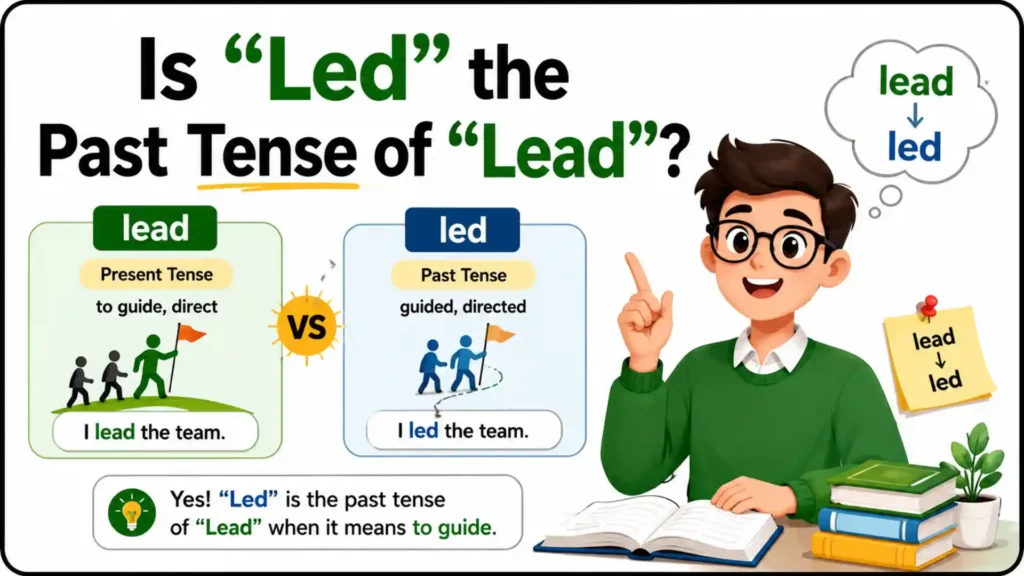
Yes, led is the past tense of lead when the verb means “guide” or “direct.” It is also the past participle of the same verb. English treats lead as an irregular verb because it does not form its past tense by simply adding -ed.
You Might Also Like That: Of Course or Ofcourse
The basic pattern is lead → led → led. Compare this with a regular verb such as walk → walked → walked. For example, “I lead the team today,” “I led the team yesterday,” and “I have led the team before.”
Lead, Leads, Led, and Leading: What’s the Difference?
The verb lead changes form depending on the sentence. Lead works as the base or present form, while leads works with he, she, or it. Led shows the past tense and past participle, while leading uses the -ing form.
For example, “I lead the team,” “She leads the team,” “She led the team yesterday,” and “She is leading the team now.” Learning all four forms gives you a clearer understanding of lead grammar and prevents you from using lead when you actually need led.
| Form | Use | Example |
| lead | Base/present | I lead the team. |
| leads | Present, third person | She leads the team. |
| led | Past | She led the team yesterday. |
| led | Past participle | She has led the team. |
| leading | -ing form | She is leading the team. |
“Has Led” or “Has Lead”: Which Is Correct?
The correct phrase is “has led,” not “has lead,” when you mean that someone guided or directed something. The same rule applies after have and had. For example, “She has led the company for years,” “They have led the project,” and “He had led the group before.” The form lead can appear after modal verbs or in the base form, such as “She will lead the team.” Remember this simple pattern: has led, have led, had led. This helps prevent one of the most common mistakes.
“Led By” vs. “Lead By”: What’s Correct?
Both led by and lead by can appear in correct sentences, but they serve different grammatical purposes. Use led by when you describe a past or passive action: “The project was led by Maria.”
Use lead by example when lead acts as the main verb: “Good managers lead by example.” The key difference comes from the sentence structure. If you describe something that someone already guided, use led. If you describe what someone does now or should do, use lead. This distinction clears up a common confusion.
Lead To vs. Led To
The phrases lead to and led to follow the same tense rule. Use lead to for the present, base form, or after words such as can and will. Use led to for a completed past action. For example, “Hard work can lead to success,” while “Hard work led to success” describes a past result. You can also say, “Her decision has led to major changes.” Other useful forms include leads to, leading to, and led to. These phrases are common in everyday, academic, and professional writing.
Common Mistakes With Lead and Led
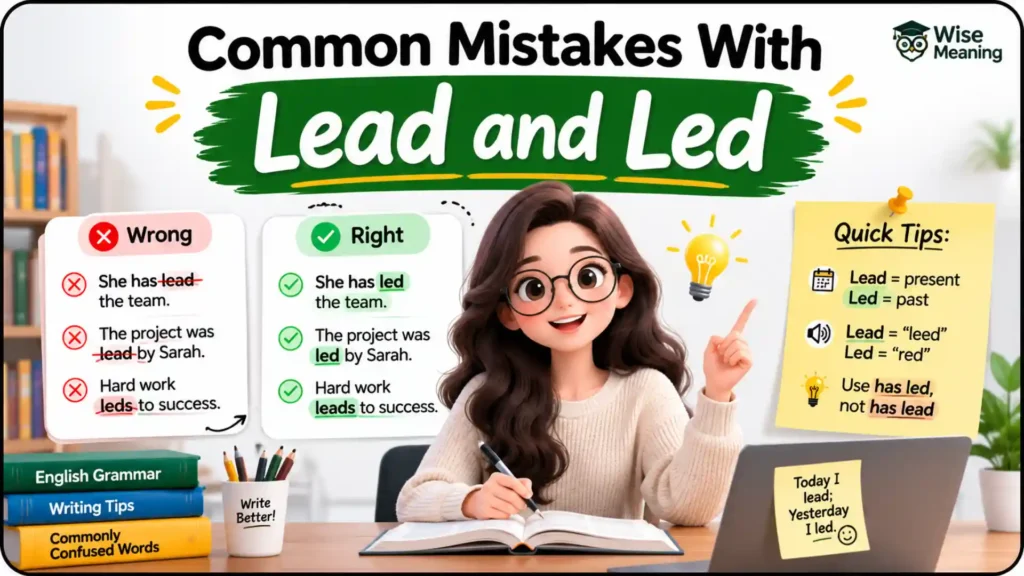
Many writers make simple mistakes when choosing between lead and led. For example, “She lead the team yesterday” should be “She led the team yesterday.” Similarly, “He has lead the project” should be “He has led the project.”
Another common mistake appears in passive sentences: “The team was lead by John” should be “The team was led by John.” You should also watch phrases such as lead to and led to. Check the tense before choosing the word, and the correct form usually becomes clear.
You Might Also Like That: And vs Or Explained
Why Do People Confuse “Lead” and “Led”?
People often confuse lead and led because English does not always connect spelling with pronunciation in a simple way. The word lead has two common pronunciations depending on its meaning.
The metal lead sounds like led, while the verb lead sounds like leed. The similar spelling of read and read can also create confusion because those forms change pronunciation with tense. Some people may also remember incorrect forms from past learning or repeated exposure. Understanding the meaning, tense, and sound together makes the difference much easier to remember.
Is “Lead” Ever Correct for the Past Tense?
When lead means “guide” or “direct,” its standard simple past form is led, not lead. However, you can still see lead in a sentence that talks about the past if another word controls the verb form.
For example, “She said she would lead the team” is correct because would takes the base form lead. Similarly, “She planned to lead the group” is correct because to comes before the base verb. So, lead is not the past tense, but it can appear in sentences that refer to past situations.
Is “Led” the Same in British and American English?
Yes. Standard British English and American English both use led as the past tense and past participle of lead. There is no standard UK-versus-US spelling rule that changes the past form to lead. People may still become confused because of personal teaching experiences, pronunciation, or common spelling mistakes.
If you write for either British or American readers, use led for the past form of the verb. This simple rule applies in both varieties of English and makes lead vs led much easier to handle in international writing.
Lead as a Metal: Why Is It Pronounced “Led”?
The word lead has an unusual pronunciation when it refers to the metal. In this meaning, lead sounds exactly like led. For example, “The workers tested the water for lead.” This pronunciation does not mean that lead becomes the past tense.
It represents a completely different noun. The verb lead, meaning “guide,” sounds like leed. Remember these two meanings: lead = guide sounds like “leed,” while lead = metal sounds like “led.” Context helps you understand which meaning the writer intends.
What Does “LED” Mean?
LED usually stands for light-emitting diode, a small electronic component that produces light. You can find LEDs in light bulbs, televisions, screens, headlights, and displays. Although LED looks exactly like the lowercase word led, the two have completely different meanings.
Led is the past tense of lead, while LED is an abbreviation used in technology. For example, “She led the team” uses the verb form, while “The room has an LED light” refers to technology. Capital letters often help readers recognize the difference.
Easy Trick to Remember Led vs. Lead
A simple memory trick can help you remember led vs lead without checking a dictionary every time. Think of this sentence: “Today I lead; yesterday I led.” The word lead connects with the present, while led connects with the past.
You can also remember the sounds: lead as a verb rhymes with need, while led rhymes with bed. If you see a past action such as “She ___ the team yesterday,” choose led. This quick rule works well for everyday writing and conversation.
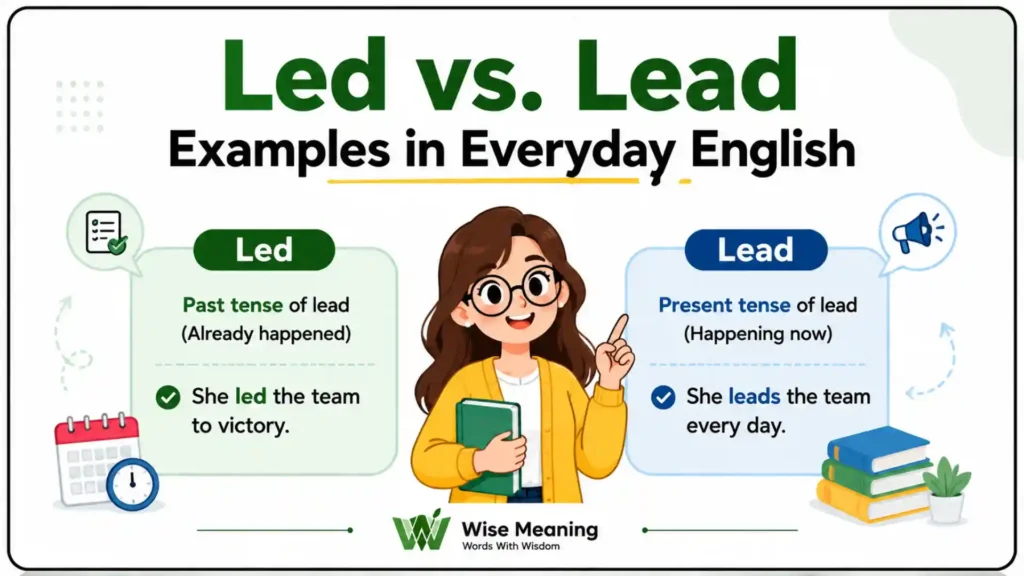
Led vs. Lead Examples in Everyday English
Examples make the difference much easier to understand. In leadership, you can say, “I lead the team today,” but “I led the team last year.” For directions, “This road leads to the station,” while “The guide led us to the station.”
You Might Also Like That: Synonyms for This Shows
For results, “Exercise can lead to better health,” while “Exercise led to better results.” In passive writing, you might say, “The project was led by Sarah.” These examples show how lead, leads, and led change according to tense and sentence structure.
Quick Reference Table
| Word | Meaning | Grammar | Sound | Example |
| lead | guide/direct | Base/present | “leed” | I lead the team. |
| leads | guides/directs | Present, third person | “leeds” | She leads the team. |
| led | guided/directed | Past | “led” | She led the team. |
| led | guided/directed | Past participle | “led” | She has led the team. |
| leading | guiding/directing | -ing form | “lee-ding” | She is leading us. |
| lead | Metal | Noun | “led” | The paint contains lead. |
| LED | Light-emitting diode | Acronym | “L-E-D” | Use an LED bulb. |
Frequently Asked Questions
Is led the past tense of lead?
Yes. Led is the past tense of lead when lead means to guide or direct. For example, “She led the team yesterday.”
Is lead ever correct instead of led?
Yes, but not as the simple past form. You can use lead after words such as will, can, should, or to: “She will lead the team.”
Is it “has led” or “has lead”?
The correct form is has led. You can also use have led and had led because led works as the past participle.
How do you pronounce lead?
When lead means “guide,” pronounce it like leed. When it means the metal, pronounce it like led.
Is LED the same as led?
No. LED means light-emitting diode, while led is the past tense of lead.
Is led correct in British English?
Yes. Led is the standard past tense of lead in both British and American English.
Conclusion
The difference between led and lead becomes simple once you focus on meaning and tense. Use lead when you mean to guide or direct in the present or base form, and use led when that action happened in the past.
The basic pattern is lead → led → led. Also remember that lead can mean the metal, and in that meaning it sounds like led. Finally, keep this easy rule in mind: “Today I lead; yesterday I led.” With a little practice, you can confidently choose the correct word in everyday, academic, and professional writing.